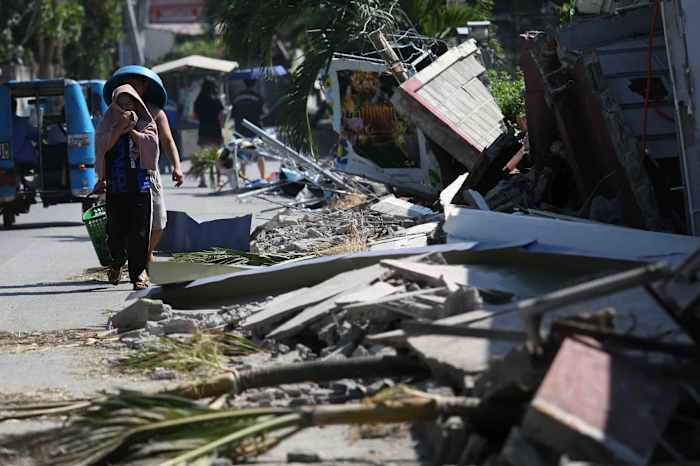


GENERAL SANTOS – Following a devastating earthquake, the mayor of a southern Philippine town urgently called for helicopters to deliver food to several villages cut off by landslides, highlighting the dire hunger situation.
The earthquake, registering a magnitude of 7.8, struck off the coast of the southern Sarangani province on Monday. This seismic event, one of the most powerful to hit the Philippines in half a century, resulted in at least 47 fatalities, injured 688 individuals, and left 31 people unaccounted for.
Over 45,000 residents remain displaced, with roughly half taking refuge in temporary shelters. The earthquake damaged more than 12,600 homes in rural towns and cities, leaving many residents too frightened to return due to ongoing aftershocks, according to provincial authorities.
The province of Sarangani experienced the highest casualty rate, reporting 20 deaths, primarily due to a landslide that engulfed homes in the coastal town of Glan, as confirmed by the Office of Civil Defense, the government agency responsible for disaster management.
Glan’s Mayor, Victor James Yap, noted that power outages persist across the province, and 10 out of the 31 villages in his town, which has a population exceeding 100,000, remain inaccessible, largely because of landslides. He urged the government to send air force helicopters to deliver essential supplies to these isolated areas.
“We desperately need food and water, but reaching some villages is challenging due to their isolation,” Yap expressed to DZMM radio network. “Helicopters are essential for transporting food, as people there are facing severe hunger.”
A key access road to the town has been reopened and will allow the delivery of fuel as early as Thursday, but the town remained without power and cellphone services were still spotty, according to Yap.
Most of the deaths from the quake were caused by falling debris from collapsed buildings and landslides in Sarangani, the coastal city of General Santos, and the outlying provinces of South Cotabato and Davao Occidental.
Two swimmers drowned and one remained missing off General Santos after being swept out to sea shortly after the quake hit. Waves of up to 1.4 meters (4.6 feet) above tide level were measured in the country’s south and smaller waves washed ashore in Indonesia and Palau and as far away as southern Japan.
The earthquake was one of the strongest to hit the country since an 8.1 magnitude quake and tsunami on Aug. 17, 1976, that killed about 8,000 people.
The Philippines is often hit by earthquakes and volcanic eruptions due to its location on the Pacific “Ring of Fire,” an arc of seismic faults around the ocean.
___
Associated Press journalist Jim Gomez contributed to this report from Manila, Philippines.