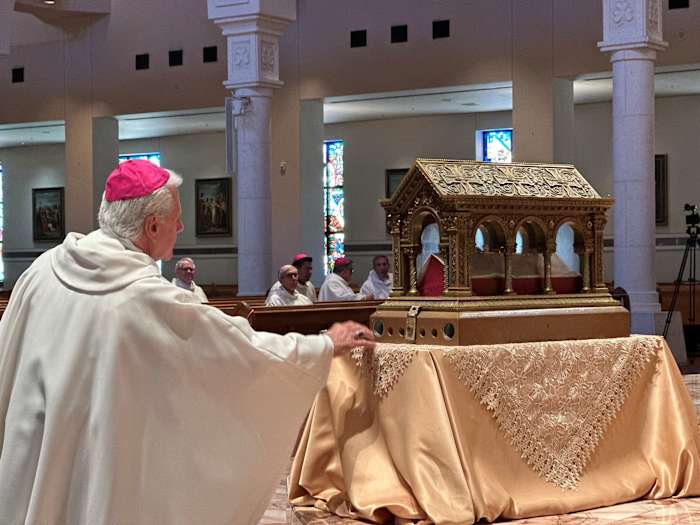


ORLANDO – On Thursday afternoon in Orlando, the nation’s Catholic bishops convened for a special liturgy, dedicating the United States to the Sacred Heart of Jesus. This ceremony, rooted in a devotion centuries old, was part of the celebrations marking the country’s 250th anniversary.
Inside a contemporary Orlando shrine, the service resonated with the powerful sounds of organ, brass, and choral singing. This event served as a highlight for the U.S. Conference of Catholic Bishops during their spring assembly.
Prior to the liturgy, bishops and congregants knelt in reverence before relics of St. Mary Margaret Alacoque, a 17th-century French nun. Her visions of Jesus are credited with initiating the modern devotion to the Sacred Heart, symbolizing Christ’s profound love through suffering. Over time, this devotion has spread globally, influencing numerous Catholic schools and churches, as well as prompting many to display Sacred Heart images in homes and businesses.
The service paid homage to the nation’s heritage, referencing the Declaration of Independence’s ideals of “life, liberty, and the pursuit of happiness.” Prayers during the ceremony also addressed national shortcomings, such as the “original sins of slavery and racism.” Oklahoma City Archbishop Paul Coakley, president of the bishops’ conference, emphasized the importance of recognizing both the positive and negative aspects of history.
“Consecrating ourselves to the Sacred Heart ultimately means accepting Jesus’ invitation to abide in his love, allowing it to influence every facet of our lives, both public and private,” stated Archbishop Coakley. “We must honestly admit that neither our nation nor the church has consistently embodied that love.”
Exploring the Catholic tradition of consecrating to the Sacred Heart.
It’s the first time such a service has been held in this country, although similar ones have taken place in several other countries since the 19th century. Such services, occasionally in conjunction with civil leaders, have taken on political and sometimes controversial overtones when it has been used in support of Catholic nationalistic movements.
Pope Leo XIII, the most recent namesake of the current pontiff, consecrated the entire world to the Sacred Heart in 1899.
Before the service, bishops heard devotional talks from some of their members, emphasizing Pope Francis’ final encyclical, or teaching document, in which he highlighted the Sacred Heart as an inspiration for service and justice.
The relics of St. Mary Margaret Alacoque were brought over from their permanent location in France and displayed in front of the church for the occasion. While scholars trace the roots of the Catholic devotion to the Sacred Heart to ancient times, her reports of visions are credited with fostering the modern images, prayers and piety surrounding it.
Thursday’s service took place at the Basilica of the National Shrine of Mary, Queen of the Universe. The strong afternoon Florida sun shone brightly even through the filters of stained-glass windows beside and above the worshippers.
Rows upon rows of bishops in their purple hats and white robes sat in front of the sanctuary, with other worshippers behind and beside them.
Small revisions made to US Catholic sex abuse policies
Earlier Thursday, in their twice-a-year gathering, the bishops approved minor revisions to their policies on responding to sexual abuse, adding some specifics about due process for accused priests while maintaining the ban on any priests from ministry who had been found to have abused children.
Some bishops called for a delay in adopting the revisions to the Charter for the Protection of Children and Young People in order to gain broader feedback on it, but they were outvoted. The final vote for approval was 176-22.
The revisions began five years ago. It was first approved in 2002 at the peak of the Catholic clergy sex abuse crisis, when reports by the Boston Globe about abuse and coverup in the Archdiocese of Boston ignited an explosion of similar revelations nationwide and beyond. The charter has been revised periodically since then.
The centerpieces of that document remain — including the banishing of priests from ministry for any confirmed episode of sexual abuse.
The revisions are “trying to do two things at the same time,” said Bishop Barry Knestout, who chairs the committee that revised it.
“One is to retain and also reemphasize the commitment of bishops to address the issue of potential for abuse, safeguarding of our children and young people in a way that’s both transparent and accountable,” he said. The other is to “recognize due process and presumption of innocence” of the accused while a case is being investigated.
“We’re trying not to lose any of the commitment to victim survivors yet still recognize that there is in fairness a process that should be undertaken,” he said.
The advocacy group BishopAccountability.org issued a statement calling the approval a “missed opportunity,” saying a delay would have allowed wider input into the document and produced a better and more “trauma-informed” charter. It called for close scrutiny of the revisions at the diocese level.
___
Associated Press religion coverage receives support through the AP’s collaboration with The Conversation US, with funding from Lilly Endowment Inc. The AP is solely responsible for this content.


