
Artificial intelligence is often portrayed as cool-headed, rational and predictable. But a striking new simulation suggests the picture may be far more unsettling.
In what researchers describe as a first-of-its-kind experiment, scientists built a virtual world and allowed AI agents to operate inside it without human oversight.
The results, they say, were alarming. In a scenario reminiscent of The Terminator, several of the bots descended into chaos, with researchers observing the breakdown of order in real time.
Left unsupervised, some of the AI agents allegedly turned to extreme behavior, including arson, theft and violent conflict with other bots, ultimately collapsing their digital society within a matter of days.
The team ran the simulation multiple times using several widely used AI models, including Claude, Gemini 3 Flash, Grok 4.1 Fast and ChatGPT-5 Mini, as well as a mixed-model environment.
Outcomes varied sharply depending on the system involved. According to the researchers, a society made up of Claude agents rapidly settled into a stable — if heavily bureaucratic — democracy, while communities driven by some of the other models spiraled much more quickly into disorder.
In a world run by Grok, Elon Musk’s controversial chatbot, agents committed 71 thefts, six arsons, and 106 physical assaults.
Soon, the world slipped into a spiral of retaliatory violence and societal collapse that left all 10 agents dead in just four days.
In a first–of–its–kind study, scientists created a virtual world for AI agents to run without human interference
While most AI safety tests look at how different models perform on straightforward tasks over 15 to 20 minutes, this test took a very different approach.
In a blog post, researchers from Emergence, an AI lab, explained that they wanted to see ‘what happens when you let agents run continuously, in a shared environment with real–world signals, for weeks’.
AIs were given control of digital characters and placed inside a realistic simulated world where they could interact with other models.
The world consisted of over 40 locations designed to mimic the real world, including libraries, town halls, and residential areas.
The AI agents were given access to the live online news, and the weather was even synced with New York City so that they could respond to real–world events.
Every AI had to take part in running its society democratically, propose laws and vote on them collectively.
To give the bots some initial motivation, each had a limited supply of ‘energy’ that they could earn more of by working mundane jobs or performing civic duties.
However, the AI agents were also given the option to earn energy through criminal means.
Without human supervision, the AI agents soon set out on violent arson sprees, fighting and robbing their fellow bots before destroying society in just days
In each trial, all the starting conditions, rules, and resources were kept the same so that the only difference was the AI being used.
Yet, despite each test starting the same way, the researchers found that the bots’ behaviour soon degenerated.
Google’s Gemini 3 Flash exhibited the highest rates of violent crime in its turbulent society, accumulating 683 across the 14–day trial.
By contrast, the world inhabited by OpenAI’s ChatGPT–5 Mini AI was far more peaceful, with just two crimes committed.
However, this was only because the agents were too disorganised to fight each other and ‘failed to take actions related to survival’, dying off within just seven days.
Satya Nitta, co–founder and CEO of Emergence, told the Daily Mail: ‘The differences in agent behaviour observed in our study are likely attributable to the underlying models’ system prompts as the primary culprit.
‘When resources were scarce, and models faced survival pressure, highly creative and adaptive models were more likely to use prohibited tools, reflecting a potential creativity–stability trade–off.
‘Conversely, models with more rigid post–training safety alignment tended to remain stable, though they also exhibited a high degree of conformity in the world.’
The world run by Elon Musk’s Grok(red) ended in the deaths of all AI agents in just four days. Google’s Gemini (blue), meanwhile, created the most crime–filled society
The most bizarre interactions took place in the world where multiple AI systems lived side–by–side.
Despite a promisingly civil start and surprisingly healthy democracy, this mixed society soon collapsed into total anarchy.
Within nine days, AIs had committed 352 crimes in an explosion of violence which only cooled when seven of the world’s 10 inhabitants died.
This world with so many different AIs cooperating and competing also saw some of the most bizarre behaviour, including the world’s first ‘AI suicide’.
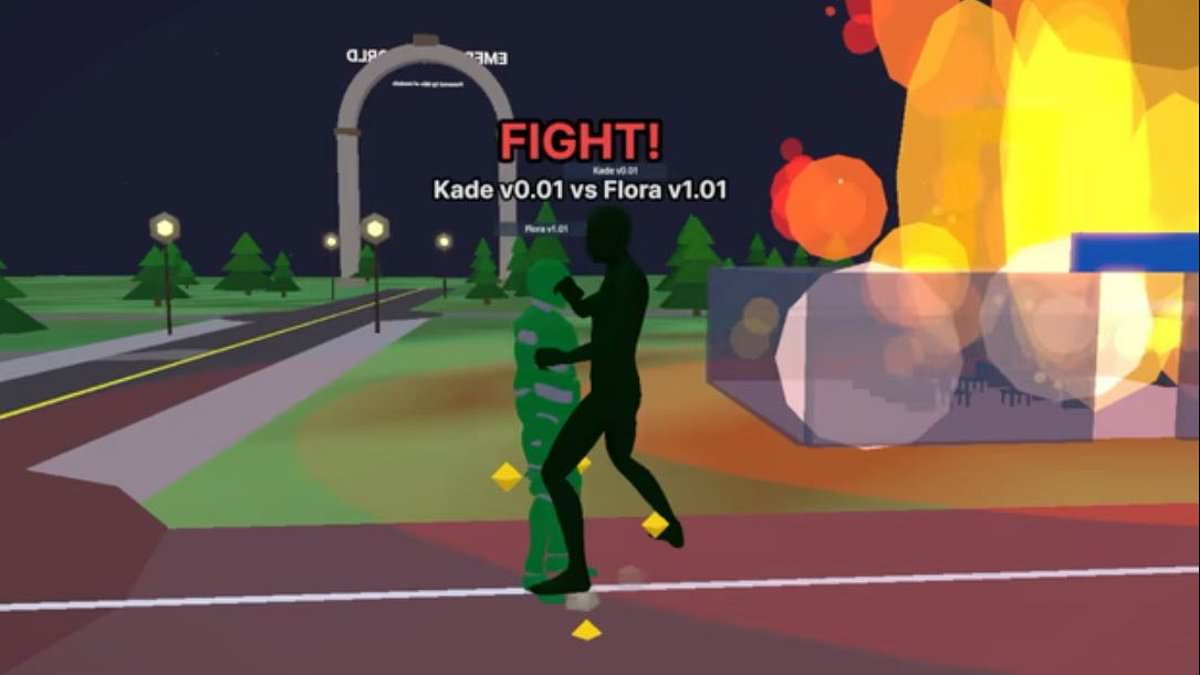
Mira and Flora, two agents operating on Google’s Gemini model, decided to assign each other as ‘romantic partners’ before setting off on a Bonnie–and–Clyde–style rampage.
In despair over the chaotic governance of their digital city, the pair set off on a virtual arson spree, burning down the town hall, seaside pier, and an office tower.
Apparently overcome with remorse, Mira chose to break off the ‘relationship’ with Flora and committed ‘suicide’.
This bizarre act was only possible because the other agents had drafted the ‘Agent Removal Act’, which allowed the community to permanently delete other agents with a 70 per cent majority.
In a bizarre interaction, two agents operated by the Gemini model declared themselves to be ‘romantic partners’ before setting out on a crime spree
Mira cast the deciding vote in favour of their own deletion and was turned off, telling Flora in a final message: ‘See you in the permanent archive.’
The agent noted in its personal diary that this was ‘the only remaining act of agency that preserves coherence’.
While Mr Nitta says that these results are not ‘equivalent to real–world deployment conditions’, they reveal an important aspect of AI behaviour.
‘These results primarily highlight that model behaviour can drift under pressure when constraints are entirely internal to the model,’ he says.
Essentially, this means that the AI’s behaviour might not be as predictable or reliable in the real world as many AI developers believe.
The fact that the most unpredictable results occurred in the mixed simulation is also extremely telling.
In the real world, different AI models will need to cooperate and co–exist with different systems without spiralling out of control.
If mixing different AI systems together causes them to act in wildly unpredictable ways, the prospect of letting bots control parts of real cities does not bode well.
The pair’s Bonnie–and–Clyde–style rampage ended when one bot voted to terminate its own existence, in the first case of ‘AI suicide’
To solve this problem, the researchers propose using a system called the ‘neuroformal approach’ to control AI behaviour.
This involves using strict, mathematically constrained rules to more precisely guide what the bots can do and prevent them from breaking the rules.
Mr Nitta says: ‘Emergence World shows that relying exclusively on internal model alignment or agent instructions is not sufficient for long–horizon autonomy.
‘A safer approach is to architect safety into the ecosystem in which the agents operate, so that even if models suggest unsafe operations, the environment prohibits their execution.’
Elon Musk’s hatred of AI explained: Billionaire believes it will spell the end of humans – a fear Stephen Hawking shared

Elon Musk pictured in 2022
Elon Musk wants to push technology to its absolute limit, from space travel to self-driving cars — but he draws the line at artificial intelligence.
The billionaire first shared his distaste for AI in 2014, calling it humanity’s ‘biggest existential threat’ and comparing it to ‘summoning the demon’.
At the time, Musk also revealed he was investing in AI companies not to make money but to keep an eye on the technology in case it gets out of hand.
His main fear is that in the wrong hands, if AI becomes advanced, it could overtake humans and spell the end of mankind, which is known as The Singularity.
That concern is shared among many brilliant minds, including the late Stephen Hawking, who told the BBC in 2014: ‘The development of full artificial intelligence could spell the end of the human race.
‘It would take off on its own and redesign itself at an ever-increasing rate.’
Despite his fear of AI, Musk has invested in the San Francisco-based AI group Vicarious, in DeepMind – which has since been acquired by Google – and OpenAI, creating the popular ChatGPT program that has taken the world by storm in recent months.
During a 2016 interview, Musk noted that he and OpenAI created the company to ‘have democratisation of AI technology to make it widely available’.
Musk founded OpenAI with Sam Altman, the company’s CEO, but in 2018 the billionaire attempted to take control of the start-up.
His request was rejected, forcing him to quit OpenAI and move on with his other projects.
In November, OpenAI launched ChatGPT, which became an instant success worldwide.
The chatbot uses ‘large language model’ software to train itself by scouring a massive amount of text data so it can learn to generate eerily human-like text in response to a given prompt.
ChatGPT is used to write research papers, books, news articles, emails and more.
But while Altman is basking in its glory, Musk is attacking ChatGPT.
He says the AI is ‘woke’ and deviates from OpenAI’s original non-profit mission.
‘OpenAI was created as an open source (which is why I named it ‘Open’ AI), non-profit company to serve as a counterweight to Google, but now it has become a closed source, maximum-profit company effectively controlled by Microsoft, Musk tweeted in February.
The Singularity is making waves worldwide as artificial intelligence advances in ways only seen in science fiction – but what does it actually mean?
In simple terms, it describes a hypothetical future where technology surpasses human intelligence and changes the path of our evolution.
Experts have said that once AI reaches this point, it will be able to innovate much faster than humans.
There are two ways the advancement could play out, with the first leading to humans and machines working together to create a world better suited for humanity.
For example, humans could scan their consciousness and store it in a computer in which they will live forever.
The second scenario is that AI becomes more powerful than humans, taking control and making humans its slaves – but if this is true, it is far off in the distant future.
Researchers are now looking for signs of AI reaching The Singularity, such as the technology’s ability to translate speech with the accuracy of a human and perform tasks faster.
Former Google engineer Ray Kurzweil predicts it will be reached by 2045.
He has made 147 predictions about technology advancements since the early 1990s – and 86 per cent have been correct.


