
At six years old, I was told by my father that our family would spend three years sailing around the world.
He said that once the voyage was over, we would return home, I would resume school, and my friends — along with my much-loved water spaniel, Rusty — would still be there waiting for me.
Instead, I did not come back for a decade. By then, I had nearly died at sea, struggled to receive even the most basic education, and been left behind in New Zealand at the age of 16.
The damage to my relationship with my parents was lasting, and it never truly healed.
At the time we first set sail, I completely idolised my father.
So when he unveiled his ambitious plan, I never questioned that I would be part of it. I adored him, and he insisted the journey served a greater purpose: we would retrace Captain Cook’s third circumnavigation on the 200th anniversary of the historic expedition.
I thought he could do anything, from fixing cars to trading gold Krugerrands, so of course, he could sail a boat around the world.
We set sail when I was seven years old. On board Wavewalker – which looked appropriately like a pirate ship to me – were my father, mother, younger brother Jon and three crew. I remember Owen in particular, because my father called him a silver fox and because he was the only one of us who had actually sailed across an ocean before.
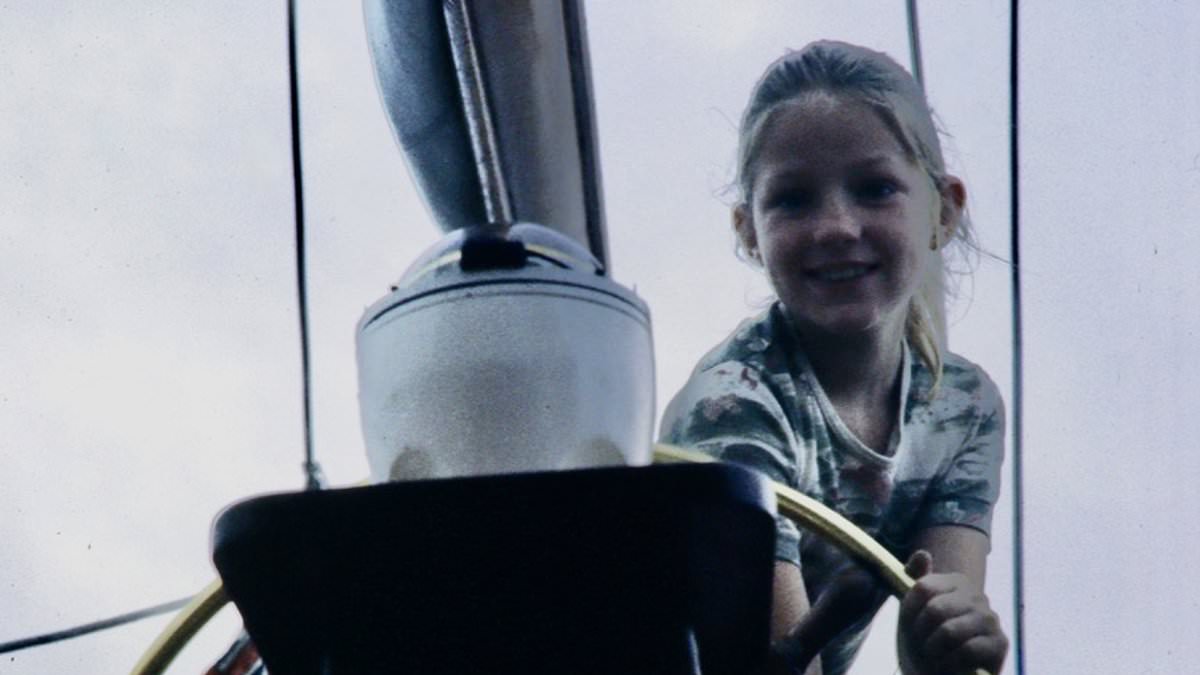
Heywood on the wheel on the way to Hawaii
Wavewalker looked appropriately like a pirate ship to a seven-year-old Heywood
The family on board Wavewalker in their finest clothes after a bon voyage lunch
It is hard to pinpoint when my hero worship of my father began to fade. On that first trip from the UK down to South America, which took several weeks, it was certainly still intact, despite the storms we hit on the way.
Since my mother hated sailing and got terribly seasick, my brother and I were left to fend for ourselves down below. We made do by eating the fruit cake we’d been given before we left, and spent a lot of time dodging the waves that came down through the main hatch.
Things worsened after we set sail from South Africa to Australia across the Indian Ocean, one of the world’s most dangerous oceans. On board, as well as the family, we had two new crew members, Larry and Herbie, who’d never sailed before.
Halfway across, we hit a terrible storm, the waves building up to enormous heights, although I rarely saw them since I had to stay below deck with my brother, which was like being trapped inside a roller coaster you could never get off.
After days of this, with the motion becoming ever worse, we were hit by a wave so large it curled over the back of Wavewalker, which was 69ft, and smashed through her deck halfway down.
Unfortunately, that was just above where I was helping my mother make lunch in the galley. I was thrown against the ceiling and then the wall of the cabin, fracturing my skull and breaking my nose.
We should have all died. Wavewalker filled with water, as every subsequent wave that landed on the deck was funneled down below.
When I regained consciousness, I was in a world of pain, looking out of my bunk to see water flowing through the cabin.
Heywood and her parents aboard Wavewalker before they left England
The only picture Heywood has of her after the accident. ‘My parents took no pictures of me with my head deformed (maybe they did not want to remember that),’ she says
My mother wrote in her diary: ‘Sue still crying. Went to comfort. Found her head disfigured by huge swelling on temple, top of head, side of face – she looked deformed. Panic – she was in tremendous pain. Gave her two pain killers.’
The painkillers didn’t do much, but we had one piece of luck – my father correctly guessed the direction of the only atoll nearby. Had he been wrong, we would not have stayed afloat long enough to reach Australia.
When we arrived at Isle Amsterdam, we found a doctor, but he had no anesthetic suitable for a seven-year-old girl who needed six head operations to relieve the huge swelling that threatened to give her brain damage.
That meant I had those operations fully awake, one man holding me down while the doctor cut into my wound. I also had to endure those operations alone, because my mother hated the sight of blood and my father was busy on Wavewalker.
I think this was when something in me changed, though it would have been hard to explain it at the time. But what I’d learnt was that my father couldn’t keep me safe, and that neither of my parents had been there when I needed them.
Despite our accident, my father remained determined to continue our voyage. So, after repairing the boat, which used up all the remaining money we had, we set out again, this time around Australia and on to New Zealand.
Some things about our voyage were magical – we saw whales and dolphins at sea, phosphorescence in the water, and many different countries.
But I was noticing more things about my parents.
One of these was that when things went wrong, they could never be discussed. This meant I was left alone to manage recurring nightmares about waking up after the accident in the Indian Ocean, watching the cabin fill with water, and fearing I would drown.
Another was that my father didn’t really seem that interested in following Captain Cook – many of the places we went to, like South America or Fiji, Cook didn’t visit on his third voyage. And we completely missed the anniversary of his death in Hawaii.
The other realization, as we made our way up to Hawaii after four years at sea, was that my father had started treating me differently from my brother. I was expected to stay below, cooking and cleaning with my mother, while my brother could help out up on deck.
To underline this, my father gave my brother the only child-sized set of safety equipment for working the sails that we had on board.
Despite all this, my relationship with my father remained relatively good – we bonded, for example, over my attempts to memorize the star constellations.
However, my relationship with my mother was going downhill. She frequently called me names – usually ‘miserable’ or ‘mardy’ – and often wouldn’t speak to me for days at a time. Instead, she would issue instructions through others, turning her head away if I tried to speak to her.
Some things about the voyage were magical – the family saw whales and dolphins at sea, phosphorescence in the water, and many different countries
Heywood attempting to study – which would provide her way off the boat

In time, Heywood built a successful career and had a loving family
When I hit puberty, she mocked my figure and refused to buy me a bra.
When we reached Hawaii, my father announced that we would vote on whether to continue sailing and promised he would abide by our decision.
My brother and I voted to return to England – I wanted to go to school, find my friends, see Rusty and escape my mother; my brother wanted to stop in Disneyland on the way home.
My parents, however, voted to keep sailing, and my father declared that, as captain, he had the casting vote.
When we left Hawaii, we’d already been sailing for five years. After that, we kept going for another four. We were very poor, so we were taking on paying crew, which meant I often had to share a cabin with grown men.
The vote in Hawaii had changed everything for me. After that, I knew I was on Wavewalker against my will. So I started working out a way to escape.
I had no passport, no money, no contact with my wider family and little education. As time passed, I started teaching myself by correspondence, though this was difficult without an address, and it irritated my mother, who would try to disrupt me by demanding more chores or turning up the radio.
When my brother was 15, my parents sent him to school in New Zealand and left me, aged 16, looking after him. They then sailed away.
It was at this point that I finally broke away.
Until then, I’d managed to explain away everything my parents had done. But I couldn’t explain being abandoned in New Zealand. I wrote to every university I’d ever heard of, begging them to consider me, despite my patchy education.
When one offered an interview, I picked kiwi fruit to pay for a ticket home and never looked back.
Unfortunately, I was never reunited with Rusty, but I did go on to have a successful career working in the UK Treasury before joining McKinsey & Co.
I now chair or am on the board of multiple companies including CNH, The Economist and Louboutin.
I had three children – Jonathan, Elizabeth and Peter – with my late husband Jeremy. All enjoyed stable schooling.
My relationship with my mother never recovered and she has since passed away. My father walked out on me and my family in 2019 when I decided to tell my story.
Suzanne Heywood has written about her childhood in her best-selling biography, Wavewalker, which is due to become a mini-series starring and produced by James Norton.
Speaking to the Daily Mail following the book’s publication in 2023, Heywood’s father, Gordon, and brother, Jon, said they did not recognize their own experiences of their years at sea in her account.
However, Heywood pointed out that they have provided no evidence for their denial. She also said that in her father’s book, Schooner to the Southern Ocean, published in 2011, his own original telling of their expedition was different to his subsequent rebuttal.


