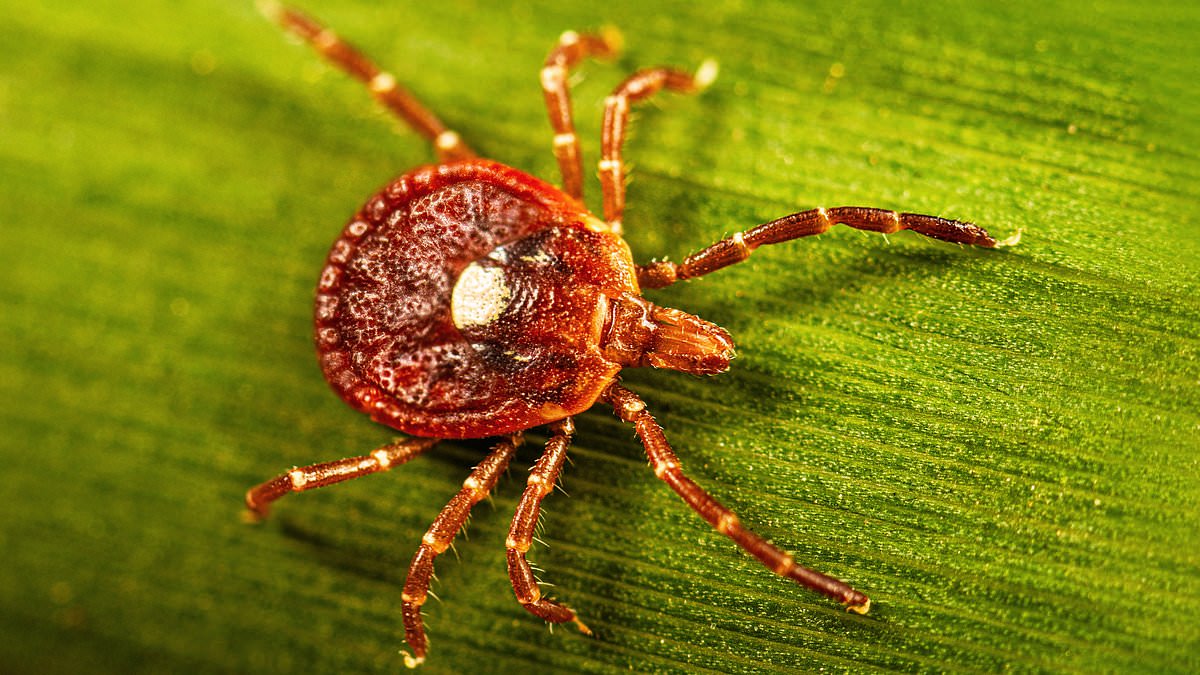

Health experts are warning about a rare but potentially devastating virus carried by ticks as the United States faces its most severe tick season in a decade.
Powassan virus remains uncommon, but reported infections have climbed steadily in recent years. Specialists say shifting weather patterns, including warmer temperatures and wetter conditions, are helping ticks stay active for longer periods and expand their reach.
Unlike some other tick-borne illnesses, Powassan virus can be transmitted quickly — in as little as 15 minutes after a bite. Once in the body, the virus can spread to the brain and cause dangerous inflammation, leading to serious complications such as difficulty speaking, seizures and, in some cases, paralysis.
The disease can have lasting consequences. Experts say roughly half of patients who become symptomatic are left with long-term neurological problems, and as many as 20 percent may die.
Renewed concern followed the recent hospitalization of John Reagan, a 66-year-old former pharmacist and outdoor enthusiast from New Hampshire, who contracted the virus.
Only four months into retirement, Reagan was admitted to the hospital after feeling unusually exhausted in the days following what he had initially believed was a minor tick bite.
By the next day, friends said he could no longer speak and was struggling to move his limbs.
His wife Sharon Reagan told a local publication: ‘It’s a scary, scary, scary thing. We want people to be aware — be vigilant about finding and removing ticks.’
Experts are raising the alarm over the Powassan virus, which is spread by ticks, after it was detected in the US for the first time this year
About 20 to 50 cases of Powassan virus are reported in the US every year, although this tally has been exceeded for the last two years.
In 2025, a total of 76 cases were detected, mostly in the Northeast. Other tick-borne diseases, such as Lyme disease, are also surging nationwide.
Powassan virus is easily spread from infected ticks to humans, taking about 15 minutes to transfer after a bite, compared to 24 to 36 hours for Lyme disease. There is no visual way to tell whether a tick is infected with the virus.
Many patients who are bitten do not suffer any symptoms, but among those who do, warning signs of an infection emerge within one to five weeks.
In the early stages, patients suffer from a flu-like illness with symptoms including a fever, headache and vomiting.
In later stages, the virus can spread to the brain and cause encephalitis, or brain swelling, as well as an altered mental state.
A 2023 study found that after an infection, 44 percent of patients suffered from some form of paralysis, while 33 percent had a cognitive deficit.
There is no treatment for the disease, including an antiviral to fight the virus or a vaccine to prevent an infection.
John Reagan, 66, was just four months into his retirement when he was infected with the virus
Instead, doctors use supportive care to manage symptoms and help patients to battle the infection.
The best way to prevent an infection is to avoid tick bites – which experts recommend doing by wearing long-sleeved clothes and avoiding long grass – and to remove ticks rapidly after being bitten.
For Reagan, when he first started showing symptoms he was prescribed doxycycline, an antibiotic used to clear suspected Lyme disease infections.
When his symptoms progressed, however, he was hospitalized. Doctors then detected Powassan virus using tests.
He was hospitalized for two weeks, where staff also put him on a ventilator and a feeding tube.
This week, he was transferred to Massachusetts General Hospital for further treatment. His wife says he now needs intense rehab to aid his recovery.
Friend Tom Wright yesterday told WMUR9: ‘I talked to his wife this morning. He was moving his fingers and moving his toes, and even his eyelids were moving.
‘So, they have given him a drug to help him wake up and come out of this.’
He was treated at a Concord Hospital for two weeks before being transferred to Massachusetts General Hospital
The above shows the number of Powassan virus cases detected in the US every year since 2004
The above shows where in the US Powassan virus cases have been detected
His wife said they removed a tick after finding it lodged on him before he fell ill, although it was not clear where he had picked it up.
The 2026 tick season is already the worst in a decade, experts say, amid surging emergency department visits for the bites.
In June, there were 126 ED visits for tick bites per 100,000 ED visits, the CDC says, the highest number for the month since 2017. Every region except the South Central US had a higher ED bite rate than a decade ago.
Dr Alison Hinckley, an epidemiologist and Lyme disease expert at the CDC, said: ‘Tick season is here and these tiny biters can make you seriously sick.
‘If you develop a rash or fever in the days to weeks after a bite, or after being in an area with ticks, seek medical care promptly.’
How to avoid tick bites, and what to do if you find a tick on you
About 31 million Americans are bitten by ticks every year, while more than 476,000 of these bites lead to an infection. Lyme disease, which can cause brain complications, is the most common.
CDC officials have revealed seven steps people can take in order to avoid a tick bite.
While outside, officials recommended that people avoid wooded or bushy areas with high grass and leaf litter, where ticks tend to live.
The organization also said people should wear clothing treated with insect repellent, such as Permethrin, and apply an insect repellent to their skin, such as DEET.
After coming inside, officials recommended that people check their clothing for ticks, remove any they find, and tumble dry clothes on a high heat for 10 minutes to kill any that may remain.
People should then do a full body check for ticks, paying close attention to places they are likely to lurk, including under the arms, around the ears, inside the belly button and at the back of the knees.
Individuals should also take a shower within two hours of coming inside, experts said, which can wash off any remaining ticks.
In order to slash the risk, people are also advised to check pets coming indoors for ticks that they may be carrying.

Health officials have given tips on how to remove a biting tick
What about if I find a tick on me?
If you find a tick latched onto yourself, the CDC has several tips for how to handle the situation.
Firstly, health officials say you should remove a tick as quickly as possible, and should not wait to go to a provider.
To remove the tick, the CDC recommends grasping it with fine tweezers as close to the skin as possible and then steadily pulling up. People are told to be careful not to accidentally leave the tick’s head embedded in their skin.
If the tweezers are not available, health officials say people can use their fingers to grasp and then remove the tick.
Afterward, they recommend cleaning the bite area with soap or rubbing alcohol and then monitoring it for symptoms.
If any emerge, such as a rash, fever, headache or muscle pain, people are advised to contact their health provider.