
Contains spoilers for “Toy Story 5”
Does a Roomba have a soul? Do action figures need food? Those are the kinds of questions that start to surface when you examine the “Toy Story” universe a little too closely. What began in 1995 as a clever animated premise about toys secretly coming to life for the sake of their child has, five films later, evolved into something with its own mythology — whether Pixar meant for it to or not. Calling “Toy Story” a fantasy franchise may sound a little ridiculous, but in practical terms, that’s exactly what it has become.
“Toy Story 5” is entertaining and energetic, but it also introduces some of the franchise’s murkiest rules yet, especially when it comes to electronic and battery-operated toys and devices. To be fair, that idea is not entirely new. Buzz Lightyear has always been a battery-powered toy, complete with lights, sounds and voice functions, and earlier entries in the series regularly referenced batteries. Still, the new film makes the relationship between sentience and power sources feel more complicated than ever.
There is also the bigger question of what actually qualifies as a toy. “Toy Story 4” centered heavily on that concept through Forky, who was just a collection of random materials until Bonnie gave him googly eyes and treated him like a toy. But how far does that logic extend? If a child includes an object in play, is that enough to bring it to life? And yes, that raises the obvious question: Could a Roomba count too?
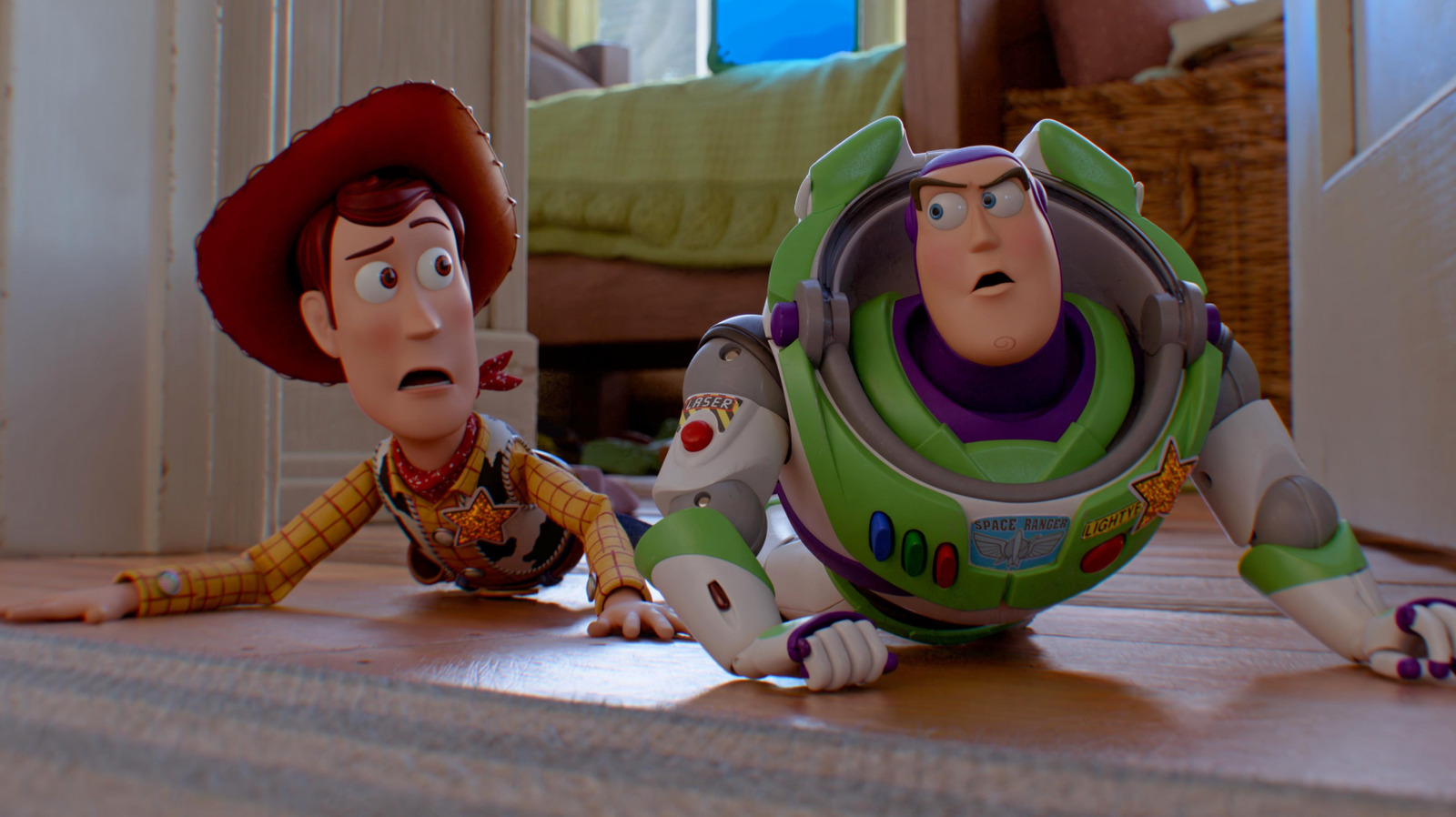
A few things do seem firmly established in “Toy Story 5.” The movie makes clear that toys become sentient before they are ever matched with a child. That is evident in the opening sequence, when advanced Buzz Lightyear toys wash up on an island already capable of independent thought. The same basic rule has appeared elsewhere in the series, including the Al’s Toy Barn scenes in “Toy Story 2.”
The film also reinforces another long-standing idea: toys appear to have a built-in instinct to hide their sentience from humans. Even before the stranded Buzz figures fully understand what they are, they automatically freeze into “toy mode” whenever a person gets close. Once the danger passes, they react as though the response was completely involuntary.
Toy Story 5 complicates how toys work
Here are a few things that are absolutely true about how toys work in “Toy Story 5.” We know that a Toy awakens as a sentient being before they are paired with a child. This is shown with the high-tech Buzz Lightyear figures who wash up on an island at the beginning of the movie, and it’s been shown to be true elsewhere in the franchise, like in the Al’s Toy Barn scenes of “Toy Story 2.” We also know that toys have a natural instinct to preserve the secret of their sentience. Before the Buzzes even understand that they are toys, they naturally fall into “toy mode” when a human comes near, reacting afterward as if it were entirely involuntary.
At the same time, we know that toys can supersede this instinct. In the very first movie, Woody speaks to Syd directly, driving him into a panic. Is this hard to do? Does it require some sort of strong resolve to overpower the “toy mode” instinct? Unclear.
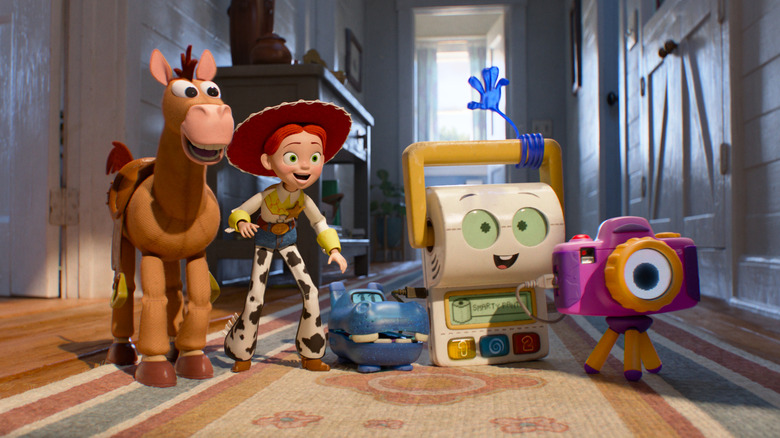
Then there’s the battery situation. “Toy Story” has long played with the premise of batteries as they pertain to a toy’s well-being, but “Toy Story 5” focuses on that aspect in particular. We see that toys with low batteries almost seem drunk, but their batteries dying don’t seem to do any permanent damage. But why do battery-powered toys need batteries to move around, yet regular toys don’t? Woody isn’t alive because he has some sort of electricity running through him. While it would make sense for Lilypad’s screen to stop working if she has no charge, it feels odd that she can’t move at all without power, while other toys with no batteries at all seemingly have endless energy.
Toy Story will never make sense, and that’s okay
Disney/Pixar
Again, we ask: Does a Roomba have a soul? At the end of “Toy Story 5,” Bonnie and Blaze have a playtime session that involves the household Roomba, and afterward, Lilypad implies to Jessie that she is romantically interested in the rotund vacuum robot. It’s a joke, yes — but is the Roomba a toy? Children themselves aren’t the progenitors of a toy’s soul, as evidenced by their sentience pre-sale. Yet in Forky’s case, the intention of a child was the source of life.
As Jaya Saxana wrote for GQ in 2018, tackling this same scholarly topic, “The consciousness of a toy is a tautology — toys are alive, and they are alive because that’s what toys are.” Peer review has found this statement to be true, while the Roomba question remains the subject of academic discourse.
At this point, “Toy Story” seems like it’s intentionally winking at those of us too philosophically minded to ignore such quandaries. The films taunt us, flaunting contradictions even as they stir more debate about the truth of consciousness. Such is the nature of all true art, perhaps, batteries included or otherwise.


