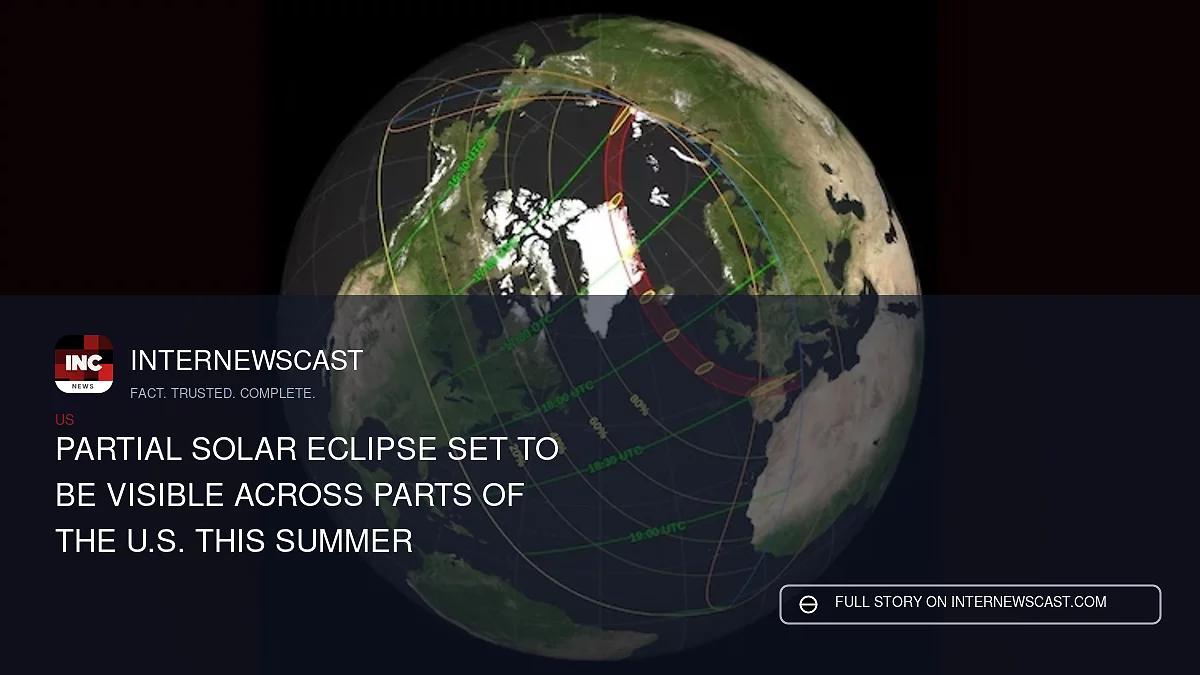

Skywatchers in select parts of the United States may soon get a chance to see the next solar eclipse, astronomy experts say.
NASA says a partial solar eclipse on Aug. 12 will be visible across portions of the U.S., stretching from Alaska to North Carolina. The celestial event will also be seen across most of Canada, large areas of Europe and parts of northwestern Africa.
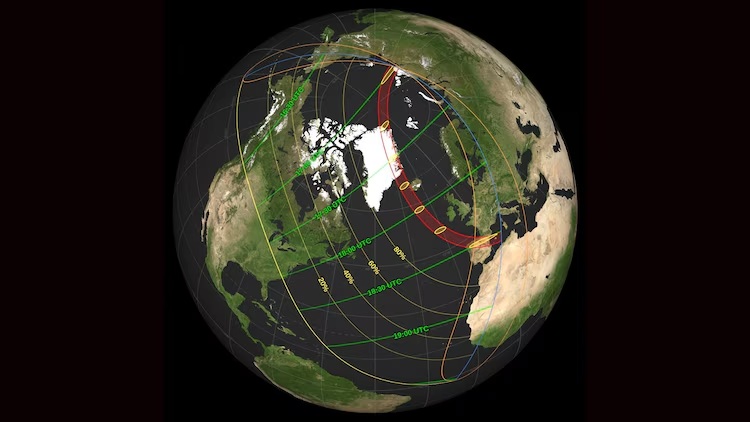
For observers in the United States and southern Canada, the view will be subtle: NASA says the moon will appear to take only a small “bite” out of the sun’s disk.
The main event, however — a total solar eclipse — will sweep across the Arctic Ocean, Greenland, Iceland, the Atlantic Ocean, Portugal and northern Spain, according to the National Solar Observatory.
NASA notes that people along the western portion of the eclipse track, from mainland Europe to Africa, may witness a sunset eclipse. That happens when the sun is still partly covered by the moon as it drops toward the horizon.
Following the Aug. 12 event, the next total solar eclipse is expected on Aug. 2, 2027, when it will be visible from southern Spain and North Africa.
ALSO READ: Prince Andrew’s Defiant Emails to His Daughters — and Why He’s Reportedly Furious with the King
The difference between a total and partial solar eclipse
A total solar eclipse takes place when the moon moves directly between Earth and the sun. NASA explains that viewers positioned in the central part of the moon’s shadow experience totality, the brief period when the moon fully blocks the sun.
A partial solar eclipse, by contrast, is seen by observers who are still within the moon’s shadow but outside the narrow path where totality occurs, according to NASA.
When the solar eclipse will occur
In the U.S., the maximum of the partial solar eclipse will occur in Anchorage at 8:21 a.m. local time but midday on the mainland. The maximum will occur in Bangor, Maine, at 1:53 p.m.; in Boston at 1:55 p.m.; in Detroit at 1:36 p.m.; in New York City at 1:54 p.m.; and in Philadelphia and Washington, D.C., at 1:53 p.m., according to NASA.
The total solar eclipse will occur at midday in a small, remote region of northern Russia. From Greenland to Iceland, totality will occur from late afternoon to early evening.
In Spain and northwestern Portugal, the sun will be fully eclipsed during the late evening, shortly before sunset, according to NASA. A sunset solar eclipse is a “rare spectacle,” according to Space.com.
How to watch the eclipse safely
Anyone who plans to watch the partial solar eclipse will need safe solar viewing glasses to protect their eyes, according to NASA.
UV radiation, whether from natural sunlight or artificial rays indoors, can damage the surface tissue, cornea and lens of the eye, according to the American Academy of Ophthalmology.
The only time viewers can look directly at the eclipse without eye protection is during the brief moments of totality, when the moon completely covers the sun. It is never safe to look directly at a partial solar eclipse without eye protection.
Viewers can also use handheld solar viewers and other safe solar filters that block out most of the Sun’s light and prevent eye damage.
An indirect viewing method, such as a pinhole projector to cast images of the Sun, can also be used to see the partial phases of the eclipse, NASA said. The device has a small opening that projects an image of the Sun onto a nearby surface.
It is not safe to look at the eclipse through a camera lens, telescope, binoculars, or any other optical device while wearing eclipse glasses or using a handheld solar viewer because the concentrated solar rays could burn through the filter and cause serious eye injury, NASA said.
Copyright © 2026 WLS-TV. All Rights Reserved.