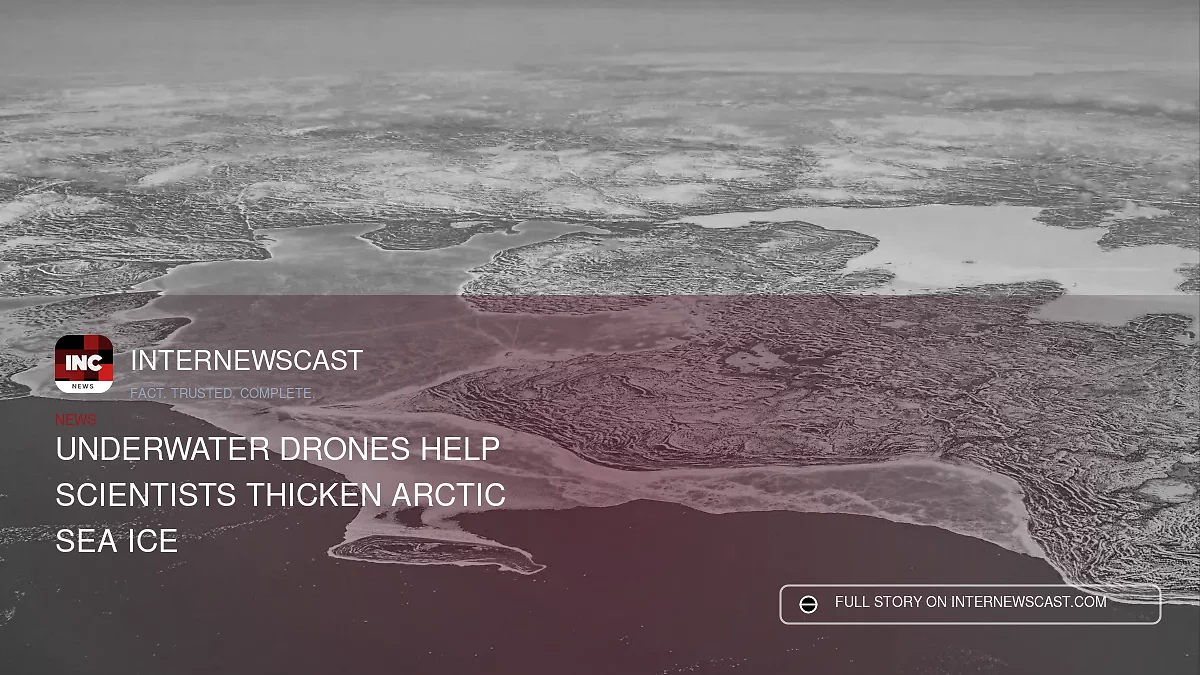

Scientists are trying to give the Arctic a little extra staying power.
A UK government-backed project aimed at slowing the summer melt in one of the coldest regions on Earth is showing promising signs, according to a report, as researchers work to protect the Arctic’s rapidly shrinking sea ice.
The initiative, called Real Ice, relies on hydrogen-powered underwater drones that pump seawater onto the Arctic surface during winter, when temperatures can average around minus 40 degrees Fahrenheit.
Once exposed to the frigid air, the seawater freezes, adding thickness to the existing ice and creating a sturdier barrier that can better withstand the warmer summer season.
“This would have been a wild dream a year ago,” Andrea Ceccolini, Head of Institution at Real Ice, told the Guardian.
Arctic sea ice plays a crucial role in reflecting the sun’s heat back into space, helping regulate global temperatures. But as the planet warms and ice cover declines, less heat is reflected, speeding up melting in what scientists describe as a dangerous feedback loop.
“When the sea ice disappears completely from the Arctic on a Summer day, it will trigger a Blue Ocean Event — a catastrophic tipping point that will result in rapid warming and expansion of the oceans, slowing of cold water currents, ocean acidification, and increasing violent storms and flooding of coastal cities,” according to Real Ice.
“Our goal is to ensure that sea ice remains in the Arctic year-round.”
Not only is Arctic ice shrinking, it’s getting thinner “and more fragile,” according to the National Oceanic and Atmospheric Administration.

Real Ice scientists had worked in temperatures of -40 degrees Fahrenheit months ago in the northern Canadian town of Cambridge Bay to pump 50,000 tons of ocean water to the surface of the Arctic ice, an effort which added roughly 50 centimeters to the frozen layer, they told The Guardian.
The effort resulted in a patch of bright white ice in satellite images of the area, the scientists told the outlet, raising hopes the work could be done at a larger scale.
“We’d like to see the research just continue to go forward in a way that we can have an informed opinion on what this looks like at scale, if it scales at all,” Real Ice co-founder Cían Sherwin said.