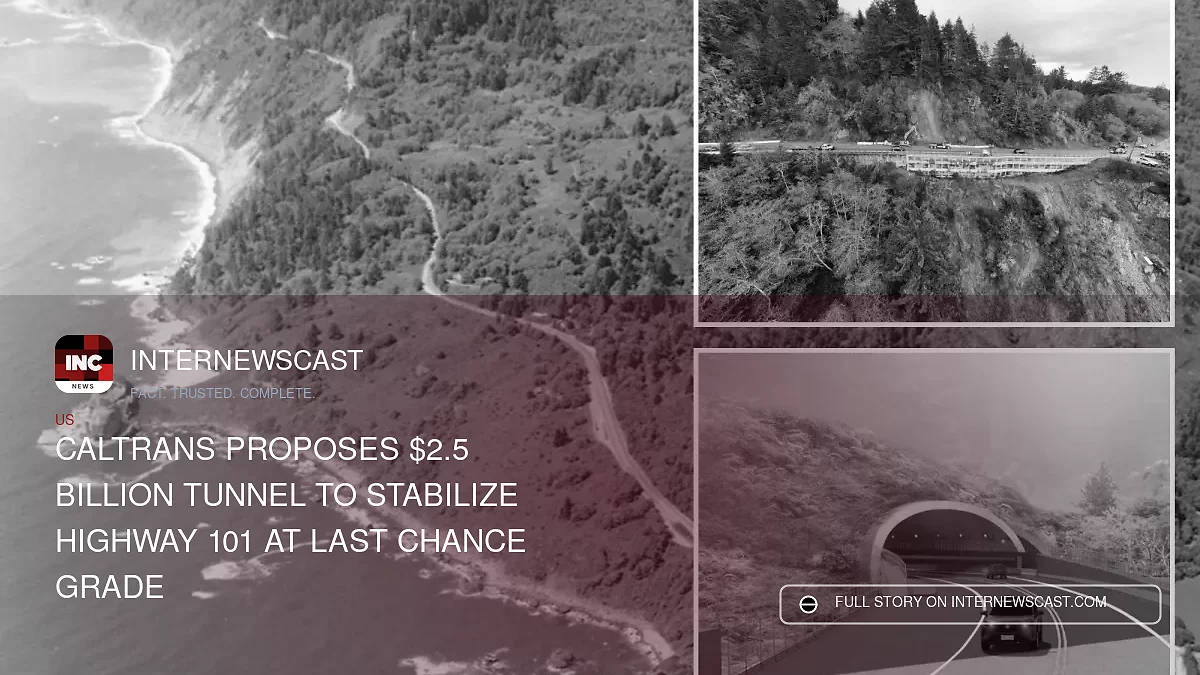

California taxpayers may soon face a multibillion-dollar bill to stabilize one of the state’s most vulnerable highways, a crumbling coastal corridor that is slowly slipping toward the Pacific.
The California Department of Transportation is moving forward with a proposal to build a 1.1-mile tunnel through redwood forest, rerouting traffic around the failing “Last Chance Grade” segment of US Highway 101 at an estimated cost of $2.5 billion.
The eye-popping estimate follows more than 10 years of analysis, public engagement and planning, culminating in a 712-page environmental impact report released in late May that cost $55 million to produce.
Caltrans is expected later this summer to seek $225 million from the California Transportation Commission to cover the tunnel’s design phase, including the hiring of international specialists in earthquake-resistant tunnel engineering.
The project is aimed at a three-mile section of highway in Del Norte County, where the roadway hugs misty cliffs squeezed between old-growth redwoods and the ocean.
Download The California Post App, follow us on social, and subscribe to our newsletters
For Crescent City, a tsunami-exposed community of roughly 6,000 people, the highway is the only practical road link to Humboldt County and the wider region.
When closures occur, motorists face a punishing alternative: a 449-mile detour taking about eight hours through Redding and southern Oregon, unless they risk steep, unpaved logging routes.
The danger has been building for years.
The corridor began life as a wagon trail in 1894 and was rebuilt in the 1930s, despite early warnings from engineers that constant land movement would make maintenance expensive.
Those warnings proved accurate.
During construction, “many slipouts and slides occurred, delaying construction,” according to a 2015 feasibility study.
EXCLUSIVE: Disclosure Day Decoded: The Most Confusing Moments Explained Clearly
Today, the highway sits on four active landslides and has become one of California’s most problematic routes.
In the past, it was reduced to one-way traffic for nine straight years, briefly reopened in October 2023, and has since faced repeated restrictions.
The ground beneath it has shifted dramatically, up to 40 feet horizontally and 30 feet vertically since the 1930s, with some sections now moving several feet each year toward the Pacific.
Efforts to stabilize it have largely failed.
More than two dozen retaining walls have been built over the decades, but many have cracked or shifted as the slope continues to move.
In 1972, a collapse in the pre-dawn hours sent a vehicle off the cliff, killing a married couple.
The state’s solution is an eastward tunnel that would bypass the most dangerous terrain.
At 6,000 feet long, it would become the longest highway tunnel in California, surpassing the 4,233-foot Wawona Tunnel in Yosemite National Park.
But the fix carries environmental consequences as well.
The route cuts through Redwood National and State Parks, a UNESCO World Heritage Site, and would require the removal of 16 old-growth redwood trees wider than four feet, along with additional trees, according to the environmental impact report.
Jaime Matteoli, the Caltrans project manager for Last Chance Grade, called the effort a necessary investment despite the scale of the challenge.
“It’s a proud moment,” Jaime Matteoli, the Last Chance Grade project manager for Caltrans told The Los Angeles Times. “It’s a huge quality-of-life issue for people, feeling safe on that road. It’s universally recognized that this project is needed.”
If funding moves forward, construction could begin around 2031, with the tunnel potentially opening by 2039.


