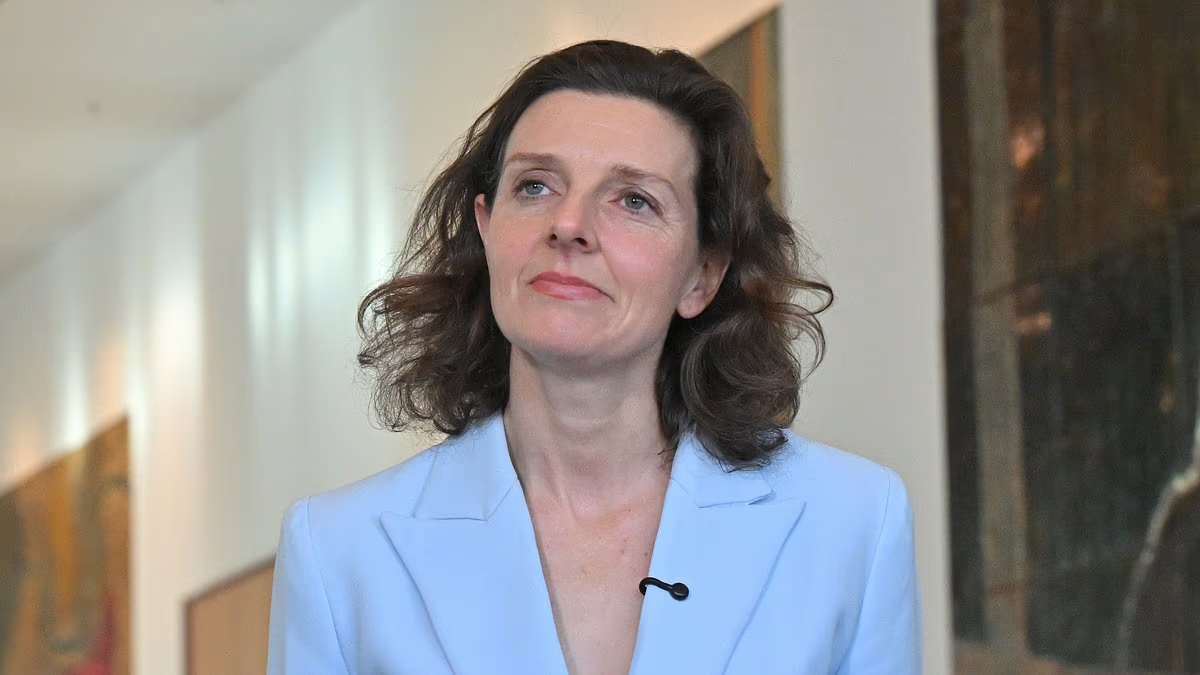
Teal independents Zali Steggall and Allegra Spender have now formally unveiled their new political vehicle: Community Strong Australia.
Both are among the better-known and more politically effective members of the teal cohort, but there is a certain strategic audacity in responding to fading national momentum by creating a party with a name like Community Strong Australia.
The title evokes something closer to a local government funding initiative than a force reshaping federal politics. It is not hard to imagine the branding: a native leaf, a cheerful neighbourhood volunteer and a pledge to “listen” at every opportunity.
Still, the branding is revealing. Steggall and Spender appear to be seeking the advantages that come with a party structure while preserving the carefully cultivated identity of the independent movement. Chief among those advantages is greater fundraising reach, particularly after donation law changes following the last election constrained their ability to raise money — changes pushed through with major-party agreement.
The teals are aiming for national influence while continuing to present themselves as intensely community-based. For now, however, that ambition remains more concept than reality. A two-person party amounts to Wentworth and Warringah becoming more formally coordinated — and it is, unmistakably, a Sydney-centred project.
The cautious launch is understandable. Some teal MPs would clearly strengthen the operation’s economic credentials if brought into the fold; others might be more useful left to continue running local listening events in places like Kooyong. I’ll resist naming anyone.
But unless Community Strong Australia develops roots beyond its current base and builds a broader geographic presence, it risks being caricatured as a Sydney house-price protection society with climate policy attached.
Spender probably would not object to my saying this, but some time after the 2022 election I met her for coffee. I live in her seat, and my view is that she remains one of the more capable figures on the crossbench.

Today teal independents Zali Steggall and Allegra Spender officially revealed their new political party: Community Strong Australia
I made the point that being a pure independent would eventually lose its shine. Sitting on the fringes, permanently locked out of executive government, eventually feels fragmented and powerless.
I suggested she might one day need to join the Liberal Party to drag it back to the centre, as well as get on the frontbench.
To her credit, she made it clear that wasn’t going to happen, which she’d also said publicly. Four years later, with the Coalition reduced to a smoking crater and drifting even further right to muscle up against a surging One Nation, returning to the Liberal fold is impossible.
Founding this party is the halfway house. It’s a structural admission that localism has its limits. The teals rose because they weren’t a party. That was their appeal. They took seats the Liberals believed were theirs by birthright by offering climate action, integrity, and a sense that politics did not have to be left to career politicians. It worked brilliantly in 2022, and well enough in 2025.
But 2026 is a very different environment. Labor holds a massive majority, Pauline Hanson’s support has surged into the space occupied by anti-major party anger, becoming the alternative voice in Australian politics.
EXCLUSIVE: Leaked White House Blacklist Report: Insider Reveals Secret Target List
For the teals, who viewed themselves as the model for sophisticated disruption, this must be deeply irritating. And Hansonism is anathema to most of what the teals stand for. Instead of being the future of post major party politics, they risk becoming the well-credentialed crossbench appendix to a thumping Labor government.
Spender and Steggall have realised this. Movements either institutionalise or fade away. There is also a brutal institutional incentive at play here. Political recognition in parliament isn’t just symbolic.
Numbers matter, they shape the ability to act as more than a loose collection of like-minded MPs. Steggall and Spender need to grow. There is a vulnerability in launching with a fraction of the numbers required to build a political machine, but this pair will now forever be the founders.

Steggall and Spender are playing a longer game, building the scaffolding for Senate power too, where minor parties can more easily wield influence
Several teals were happy to confirm discussions had taken place when the story first broke, before quickly retreating to the safety of their local mandates. If your political identity is built on not being a party politician, joining a party is not an administrative tweak. It is a philosophical about shift that’s a little risky, especially for the teals whose standing is less certain.
But Steggall and Spender are playing a longer game, building the scaffolding for Senate power too, where minor parties can more easily wield influence.
A registered party can raise money, coordinate messaging, and endorse upper-house candidates on a party ticket above the line, while letting lower-house MPs pretend they are still purely local. The sitting teals can keep saying they are independent while quietly benefiting from a broader ecosystem on the rise.
The risk is that politics is rarely kind to half-steps. If you announce a party, voters expect to see a party. They expect at least some discipline, and a purpose larger than maintaining relevance.
This is where CSA must evolve. If it’s serious, it needs to become more than a holding company for respectable centrism. Integrity, climate, and community are values, not a governing philosophy. A serious party needs more than that, even if the major parties are showing less and less of it in the modern age.
The opportunity for this new party is vast. There is a massive void in Australian politics for a socially moderate, economically literate, climate-serious, institutionally clean force. The Liberal Party has vacated the centre. Labor occupies some of it, but is weighed down by incumbency and caucus discipline. The Greens are too far left for many professional-class voters, and One Nation is more protest vehicle than governing project, even if it now tops the primary vote count according to the polls.
There is room for a new centrist force.
Beneath the slightly ridiculous branding sits a serious maturation. The teals have reached the moment every insurgency eventually faces: do they remain a loose protest against the old system, or do they build the machinery to replace it? And who will join in?
One of the powerful aspects of the teals’ arrival in 2022 was that they popped up right around the country, not just in any one city. Spender and Steggall therefore need others to join them sooner rather than later to reflect that diversity. Adding a regional MP like Helen Haines would also help, opening the party up to the rich vein of support for rural independents that already exists.
The fact this is a merry band of sisters rather than brothers is an added touch. Given the traditional boys clubs in Canberra, it would be nice to see something different challenge that archaic stereotype that has dominated major party politics for too long.


