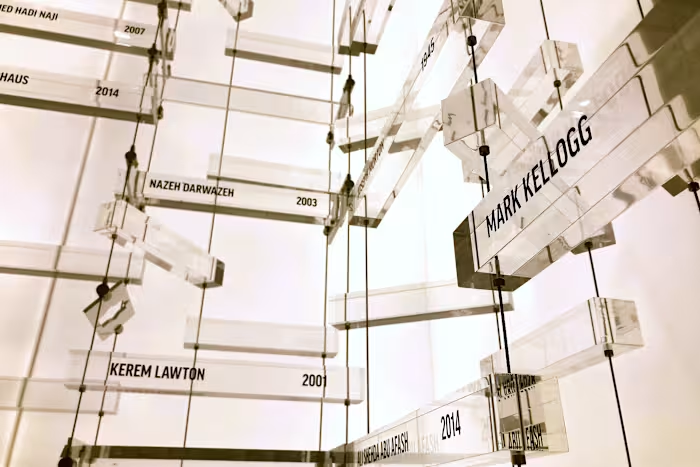


They have been killed by artillery, gunfire and aircraft crashes, lost to disease, and, in some cases, executed while working in conflict zones and other dangerous places across the globe.
Across The Associated Press’ 180-year history, 38 journalists have died while doing their work for the independent, not-for-profit news organization.
Thursday marks 150 years since the death of the first among them: Mark Kellogg, who was one of five civilians killed along with Lt. Col. George Armstrong Custer and his soldiers at the Battle of Little Bighorn.
Kellogg, 43, had accompanied Custer’s troops into the field. He was filing reports for The Bismarck Tribune and the New York Herald, with the AP distributing his dispatches nationally, when Custer badly misjudged the size of a Sioux village he chose to attack.
Outnumbered, Custer and his men made their final stand on a hill, where they were wiped out by Native American defenders. Kellogg’s scalped body was later discovered nearby.
His final published dispatch included a line that would become inseparable from his story: “I go with Custer and will be at the death.”
The phrase was likely meant more as a dramatic flourish than a prediction. Even so, Kellogg’s last words, carried by his newspapers and the AP, spread widely after his death. In the process, the relatively unknown part-time journalist — a widower who took on various jobs to provide for his two daughters — became famous posthumously.
Kellogg had become acquainted with Custer and spent time among the soldiers, speaking with them and observing life in their camps, historian Sandy Barnard noted.
“While his record as a journalist might be very small compared to modern reporters who go into combat, he certainly was doing exactly what they are doing,” Barnard said.
The State Historical Society of North Dakota preserves Kellogg’s diary and various belongings, including eyeglasses, tobacco, clothing and a mosquito head net. The fragile diary, now digitized online, documents weather, distances covered, who was riding in front and in back, how many antelope they saw and other day-to-day operations, Deputy State Archivist Lindsay Meidinger said. The diary ends before the battle.
“It’s a primary source of the historical event that not many other primary sources remain from that time period related to the Seventh Cavalry and Custer,” she said.
In other ways, Kellogg was much different from modern journalists. He carried a rifle into action, pointed out Barnard, author of a Kellogg biography and other books on the Battle of the Little Bighorn.
“During the last stages of the campaign, Kellogg was probably more of a soldier than he was a newspaper man,” said Barnard.
And Kellogg made no attempt to avoid not just bias but racism against Native Americans, whom he called “red devils.”
Others who have perished while reporting for AP in war zones include:
— Mariam Dagga, a freelance visual journalist who was killed in an Israeli strike on a hospital in the Gaza Strip last August;
— Anja Niedringhaus, a photographer shot by a police officer as she sat in her car in Afghanistan in 2014;
— Myles Tierney, a videojournalist killed while traveling in a convoy that came under fire in Freetown, Sierra Leone, in 1999;
— Joseph Morton, a war correspondent who was the only U.S. reporter known to have been executed by the Nazis following his capture alongside Slovakian partisans in 1944.
___
Associated Press corporate archivist Sarit Hand in New York and Jack Dura in Bismarck, North Dakota, contributed to this report.


