
Travel measures have been tightened after France confirmed its first Ebola case connected to the current outbreak this week.
The Democratic Republic of Congo, where health officials are fighting an outbreak involving a rare Ebola strain, has introduced a 21-day quarantine requirement for people returning from affected areas before they are allowed to travel overseas.
The new restrictions follow France’s report of its first imported Ebola infection linked to the ongoing outbreak.
Health authorities say the outbreak is being fueled by the Bundibugyo strain, a form of Ebola that can carry a mortality rate of up to 50 percent. There is currently no vaccine or treatment for this strain.
Figures released by the government on Wednesday listed 1,118 Ebola cases and 291 deaths, making the outbreak the second largest ever recorded, according to the CDC.
The case in France involves a humanitarian doctor who had been traveling on a commercial flight from Kinshasa. He reportedly had no symptoms when he boarded the plane but became ill during the flight.
In response, DRC health minister Samuel-Roger Kamba signed a decree Wednesday ordering anyone identified as a contact of a confirmed or suspected Ebola patient to complete 21 days of health monitoring.
During that monitoring period, all domestic and international travel is prohibited unless health authorities grant specific permission.

Healthcare workers tend to an Ebola patient at the Rwampara Treatment Center in Ituri, Congo

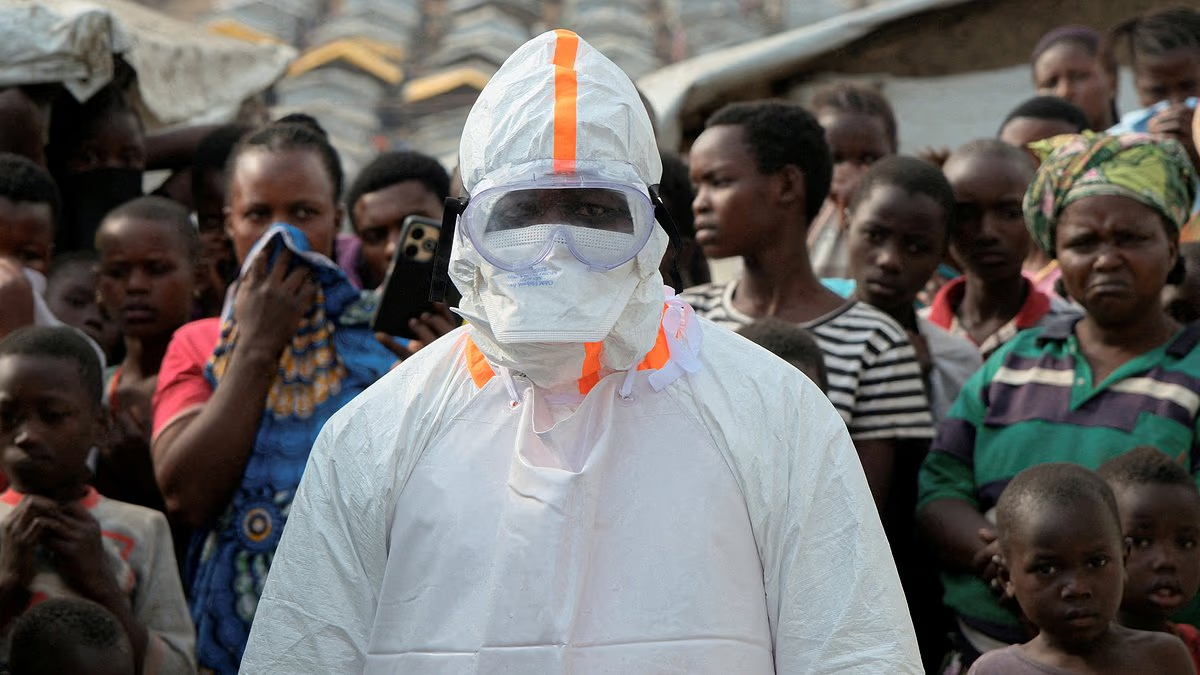
A healthcare worker in personal protective equipment stands near displaced people waiting for the burial of suspected Ebola victims in the DRC
The travel restrictions also apply to healthcare workers, lab staff and response teams returning from affected areas.
Additionally, anyone who has stayed in a province in the DRC with Ebola cases may only travel abroad after they’ve spent at least 21 days outside of the area.
All international passengers arriving in the DRC must complete a health declaration form and undergo any applicable airline screening measures.
In France, the patient is said to be in a stable condition but has been isolated to prevent spread of the virus.
Officials maintain that the risk to the general European population is low.
However, contact tracing efforts are underway as they work to identify anyone who may have been exposed through contact with the doctor.
READ MORE: Is Crip Mac a legitimate member of the Crips gang and is he disabled? Find out what happened to him.
The outbreak in the DRC was declared an international health emergency by the World Health Organization on May 17. On the same day, Rwanda closed its land border with the DRC to prevent the spread of the virus.
Since then, the French patient is the second to be treated for the virus in Europe, after an American doctor who contracted Ebola in the DRC was flown to Germany for treatment last month.
In the US, the CDC has a level 3 travel advisory in effect for the DRC, indicating to Americans to ‘reconsider nonessential travel’ to the country. No cases of Ebola associated with this outbreak have been identified in the US.
The American embassy in the DRC said last month: ‘The US government is extremely limited in its ability to provide emergency services to US citizens in Ituri province. Do not travel to this area for any reason.’

Healthcare workers carry a possible Ebola patient on a stretcher from an ambulance at the Ebola Treatment Center (ETC) in Bunia, Ituri, in the DRC

A sign warns travelers about Ebola at the Stockholm Arlanda Airport in Sweden
Ituri province is the epicenter of the outbreak. CDC officials maintain the risk to the general US public remains low but urged travelers to the area to avoid contact with any sick individuals.
The CDC has also said travelers should watch for symptoms of Ebola for 21 days after leaving the DRC.
Last month, US officials introduced travel restrictions for people coming to America from the DRC, Uganda and South Sudan, which currently remain in place.
The restrictions require any passenger who has visited these countries within the last 21 days to arrive via John F Kennedy International Airport in New York, George Bush Intercontinental Airport in Houston, Washington Dulles International Airport in Virginia, and Hartsfield-Jackson Atlanta International Airport for enhanced screening.
This is the 17th Ebola outbreak in the DRC, where the virus is endemic, since it was discovered in 1976, but only the third caused by the Bundibugyo strain.
The other two Bundibugyo outbreaks were in 2007 and 2012.
The most recent Ebola outbreaks in the DRC were in 2018 and 2020 and they killed more than 1,000 people each. The largest Ebola outbreak occurred in 2014 to 2016 in West Africa when more than 28,600 cases were reported.
Ebola spreads through contact with the blood or body fluids of an infected person, as well as contact with contaminated objects or infected animals such as bats or primates.
Symptoms include fever, headache, muscle pain and weakness, diarrhea, vomiting, abdominal pain and unexplained bleeding or bruising.
The mortality rate for the Bundibugyo virus ranges from 25 to 50 percent.