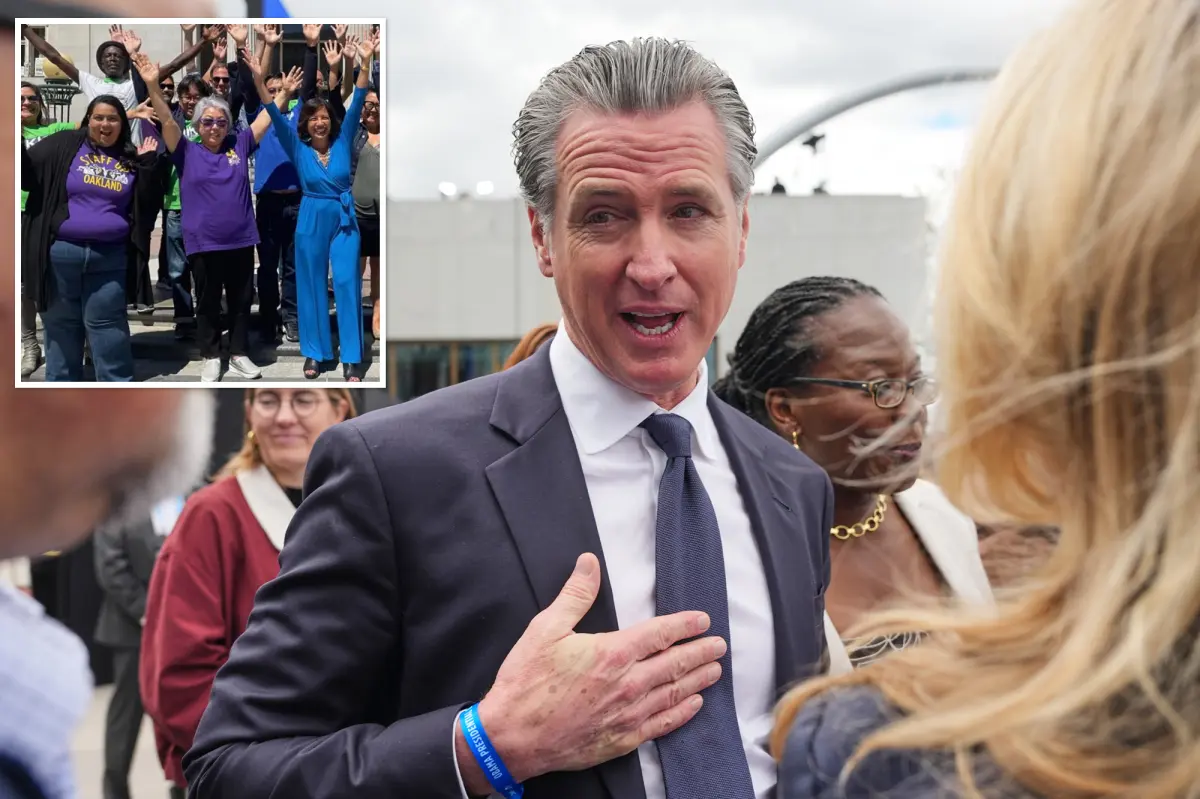

Gov. Gavin Newsom was unable to strike an eleventh-hour agreement to keep California’s contentious billionaire tax measure off the November ballot, clearing the way for what could become one of the country’s costliest and most politically charged fights over whether the ultra-wealthy should help pay for federal health care cuts.
“Ironically, Gov. Newsom is in lockstep with [President] Donald Trump and billionaires like Peter Thiel and Sergey Brin on this issue,” Debru Carthan, vice president of SEIU-United Healthcare Workers West, said at a news conference Thursday evening. The union is leading the campaign for a one-time 5% tax on California residents with a net worth above $1 billion.
“Gov. Newsom has had seven months to put forward a solution to prevent hospitals from closing and save patient lives, but he hasn’t — because Gov. Newsom has no plan,” Carthan said.
Newsom had pledged to stop the proposal from passing, but talks between the governor’s chief of staff, Nathan Barankin, and SEIU-UHW, the health care union led by hard-charging political strategist Dave Regan, ultimately broke down. The failure of those negotiations now leaves the governor facing a high-stakes ballot campaign that could demand a significant amount of political capital.
The governor’s office did not immediately respond to a request for comment.
The decision now falls to voters, who will be asked whether California should adopt an unprecedented wealth tax. Supporters argue the money is urgently needed to blunt anticipated federal health care cuts tied to President Trump and Republicans’ “Big Beautiful Bill.”
Newsom, along with business organizations such as the Chamber of Commerce and the State Building and Construction Trades Council, has warned that the measure could speed up the departure of billionaires, investors and startups from California at a time when the state is already battling concerns about its business climate.
Earlier this month, CalChamber criticized the proposal, saying the “unprecedented wealth tax is not only misguided but creates a dangerous precedent that will cause more problems than it would ever solve.”
Download The California Post App, follow us on social, and subscribe to our newsletters
Newsom refused to back down last week after organizers behind the billionaire tax initiative offered to reduce the proposed tax from 5% to 2%.
California is home to more than 200 billionaires whose combined wealth exceeds $2 trillion. Supporters argue even a small slice of that wealth could preserve Medi-Cal, hospitals, food assistance and education programs facing financial pressure.
EXCLUSIVE: Akbar Shamji Wife Daniela Karnuts Age And Wikipedia
Opponents counter that the state risks permanently driving away the very taxpayers responsible for a disproportionate share of California’s income tax revenue.
Google co-founder Larry Page, Palantir co-founder Peter Thiel, Amazon founder Jeff Bezos and Oracle founder Larry Ellison have all reportedly established ties elsewhere in recent years, while Google co-founder Sergey Brin, SpaceX investor Steve Jurvetson and AI executive Naveen Rao have relocated to Nevada’s Lake Tahoe region.
Former Hewlett-Packard and eBay CEO Meg Whitman also recently sold her sprawling Northern California ranch amid the growing debate over the proposed wealth tax.
The prospect of another wave of departures has fueled an aggressive counteroffensive from Brin and other wealthy Californians. Through Building A Better California, the group has poured tens of millions of dollars into competing ballot initiatives designed to blunt or potentially neutralize the billionaire tax if voters approve it.
One of those measures, which also qualified for the November ballot, would require new audits of programs funded through new state special taxes and includes provisions critics say could create legal hurdles for implementing the billionaire tax. Political observers say the strategy effectively gives opponents multiple paths to stop the measure, even if voters initially approve it.
The billionaire tax itself is the brainchild of SEIU-UHW’s president, Regan, who has built a reputation for using statewide ballot initiatives to force negotiations with elected officials.
Chris Hannan, president of the State Building and Construction Trades Council, publicly broke with fellow labor leaders this month, warning that a retroactive wealth tax could discourage billionaires from financing major developments that employ thousands of union workers.
“It’s not because we feel that anyone shouldn’t have to pay their fair share, but doing a retroactive tax, we believe, would drive people out of the state and drive investment out of the state,” Hannan told Politico.
Supporters contend the billionaire tax asks only a tiny number of the state’s wealthiest residents to shoulder the burden rather than forcing cuts to hospitals, clinics and health coverage for millions of Californians.
Newsom has argued a California-only wealth tax would be difficult to enforce, vulnerable to constitutional challenges and ultimately cost the state more revenue than it generates if billionaires relocate.
“The governor supports making the wealthiest Americans pay their fair share, but this poorly designed state-only measure will defund teachers, schools, clinics, and public safety,” his office previously said.
“This will be defeated — there’s no question in my mind,” Newsom told The New York Times in January. “I’ll do what I have to do to protect the state.”