‘Don’t leave me… why are you doing this to me?’
They were the haunting last words of Francys ‘Fran’ Arsentiev, 40, before she died on Mount Everest on May 23, 1998.
The mother of one had only just secured a place in mountaineering history, becoming the first American woman to stand on the summit of the world’s tallest peak without supplemental oxygen.
Yet the dream she had pursued for years turned catastrophic when she ran into trouble high on the mountain and was unable to descend safely.
During the climb down, drained and dangerously starved of oxygen, she became separated from her husband and climbing partner, Sergei Arsentiev, in Everest’s notorious ‘death zone’ — the region above 26,000 feet where the air is so thin that survival can hinge on every passing minute.
Overwhelmed by the extreme altitude and brutal conditions, she died at around 28,000 feet.
In the years that followed, climbers began referring to her as ‘The Sleeping Beauty of Everest,’ a nickname inspired by the eerily peaceful way her body remained preserved high on the mountain.

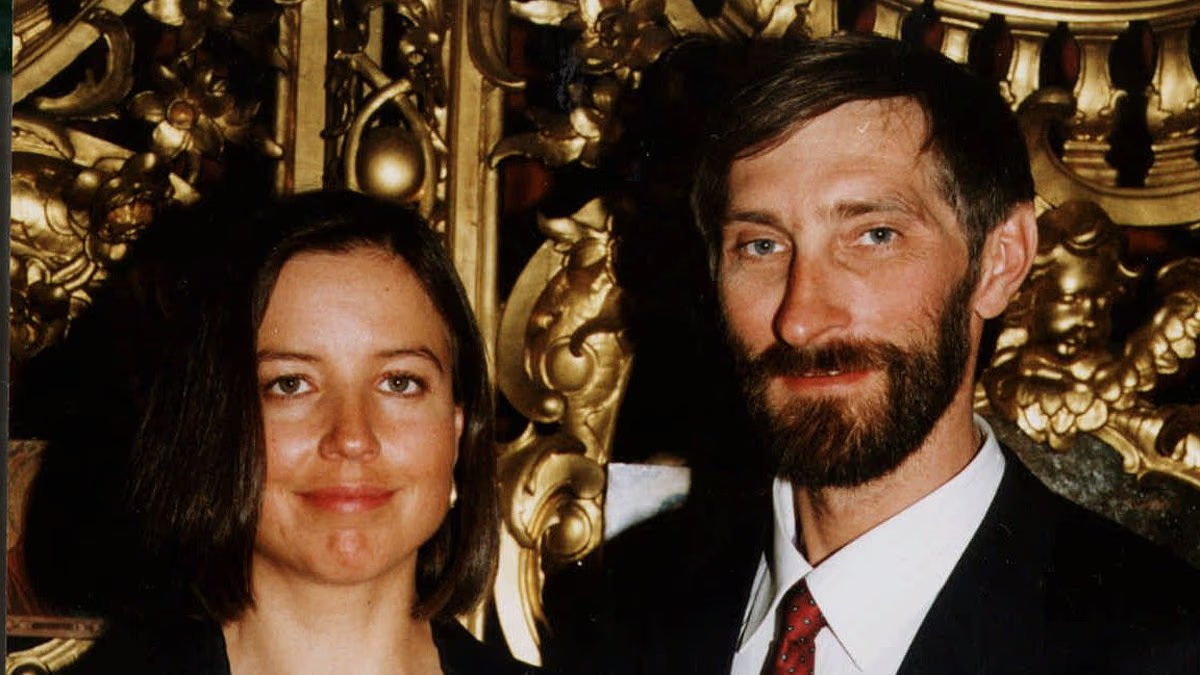
Fran and her husband Sergei Arsentiev reached Everest’s summit together in 1998, but their historic climb ended in tragedy when both died during the descent
For years, her body remained frozen on the North Ridge route and a morbid reminder of the mountain’s harsh conditions.
Mystery has surrounded her final moments for nearly 30 years, and several questions remain over the tragedy.
Fran had attempted the ascent alongside Sergei, a respected Russian climber.
The pair reached the summit on May 22, 1998.
Before reaching the top, Fran had penned a message to her ten-year-old son, Paul, whom she’d had from a previous marriage.
‘Hi Paul! We’re at Base Camp. Miss you and love you. XXX Mom.’
Those would be the last words Paul would receive from his mother.
That is because although Fran and Sergei reached the summit, their descent quickly turned deadly.
According to accounts, the couple became separated while traversing the treacherous ‘death zone’ due to poor visibility.
Sergei is understood to have made it back to one of the camps, but turned back to search for his wife on discovering she had not returned. He was never seen alive again.
Fran, meanwhile, was stuck on the mountainside and was suffering from severe frostbite. She was rapidly deteriorating at such a high altitude.
One of the last people to see her alive was South African climber Cathy O’Dowd, who was scaling the mountain with her British husband Ian Woodall and a local Sherpa guide.
On their final stretch of the ascent on May 23, Cathy spotted a figure in distress.

This photograph taken on May 20, 2026, shows mountaineers climbing a slope lined up during their ascent from the Hillary Step to summit Mount Everest in Nepal
She stared at the body in disbelief and heard moaning, but her guide gestured to her to keep moving.
In her book ‘Just For The Love Of It’, Cathy explained that it is every man and woman for themselves up on Everest.
The conditions are so unforgiving that saving a life could cost you your own.
‘Anyone who becomes immobile on a mountain as large and remote as Everest is probably going to die,’ she wrote.
‘On this side of the mountain, we would have to get the victim all the way back to base camp before we could contemplate trying to find a helicopter. If they had to be carried, that would require a number of teams, dozens of people, and at least three days climbing.’
‘I suspected we had virtually no chance of saving this climber,’ Cathy said.
Despite this, Cathy described being unable to walk away.
‘All the debates, the issues, the logical analysis were useless.
‘I simply could not do it. I could not put the summit of a mountain ahead of a human life. I would not want to live with myself if I could. However hopeless this person’s situation might be, I had to try.’
She approached Fran, who was already suffering from severe frostbite and slipping in and out of consciousness.
But as she briefly stepped away to coordinate with her team, she heard Fran speak.
‘Don’t leave me,’ the climber said.
Cathy reassured her. ‘I need to fetch the rest of my team. We have several people here. We will try to help you. I will come back, I promise.’
Fran responded: ‘Why are you doing this to me?
‘I am an American.’
Together with her husband and Sherpa guide, Cathy attempted to assess whether a rescue was possible.
Soon after, a group of Uzbek climbers passed by and explained they had previously attempted to help her but had been unable to.
They had left oxygen for her, but by now, the tank was already empty.
As Fran’s condition continued to deteriorate and she slipped further from consciousness, the climbers were forced to accept that there was no viable way to bring her back down.
After an hour of attempts and deliberation, they made the difficult decision to keep going, leaving Fran to fall into an eternal sleep on the mountain.
Too upset to continue, Cathy abandoned her attempt to climb Everest.
After her expedition, she wrote: ‘I climb because I enjoy it, not because of an obsessional desire to reach a summit at all costs.
‘After finding Fran, there was no way reaching the top could have given me pleasure.’
Cathy would later become the first woman to reach the summit from the south and north routes.
READ MORE: Orange County Enforces Stricter Fireworks Regulations
But Fran stayed frozen in time, lying peacefully on the slopes of the world’s highest mountain.
Although her body remained intact for nearly ten years, Fran was eventually moved from the main climbing line in 2007 during an expedition led by Cathy’s husband, Ian.
He said he had spent years haunted by his inability to save her, and was deeply disturbed by the fact that her body had become a landmark on Everest.
‘It was an opportunity to say goodbye,’ he said after the expedition. ‘But most importantly, to get her out of sight.’
Bringing her remains back down would have been considered extremely dangerous as helicopters are unable to land at that altitude, meaning experienced Sherpas and climbers must manually move the body down steep terrain while facing risks such as avalanches, storms and oxygen deprivation.

Climber Cathy O’Dowd (pictured in 1999) was one of the last people to see Fran alive
Instead, Fran’s stiff, frozen body was wrapped in an American flag and lowered over the mountain’s edge.
Fran’s son, Paul, only heard of this development through the media.
He had spent the last decade of his life disturbed by the fact that his mother remained on the mountain and that hundreds had seen her lifeless body.
‘I was like, “Dude, that’s my mom!”‘, he said about the moment he learned his mother’s body had been moved.
But Paul realised that Ian and Cathy, having witnessed the final moments of his mother’s life, had their own special connection with her.
‘My mother and I are bonded by blood, and Ian, Cathy and her are bonded by death,’ he told the BBC.
‘I feel that they had just as much a right to move her as we did, and my family honours their effort.’
What remains clear is the symbolic power that the remains on the mountain have come to hold.
Everest is often portrayed as the ultimate test of human endurance and ambition, but Fran represents another side of the mountain’s story.
She is a reminder of the steep cost that such ambition can have from adventurers.
No one knows exactly how many bodies remain on Mount Everest today, but estimates surpass 200.
Countless climbers and Sherpas are tucked into the mountain’s crevasses or buried under snow.
Some are hidden from view, but others have become familiar fixtures on the route to the summit.
Perhaps the most famous is ‘Green Boots’ – the nickname given to the body of a man whose identity remains disputed nearly three decades after his passing.
Known only as ‘Green Boots’ for his distinctive neon mountaineering footwear, still visible beneath layers of ice and snow, he has become one of the most haunting symbols of Everest’s deadly allure.
For years, exhausted climbers making the perilous ascent via the Northeast Ridge route would pass within touching distance of the corpse, some stopping nearby to catch their breath before continuing towards the summit.
Others were forced to step over his stiff legs.
His final resting place, a small limestone alcove carved into the mountainside at almost 28,000 feet, became so well known it acquired its own nickname – Green Boots Cave.
The man inside is believed by many to be Tsewang Paljor, an Indian climber who disappeared during one of Everest’s darkest disasters.
Yet others insist the body belongs to one of his teammates, Lance Naik Dorje Morup.
The uncertainty surrounding who Green Boots really was has only deepened the fascination with his story.
What is beyond doubt, however, is that like Fran’s, his death serves as a stark reminder that on the world’s highest mountain, triumph and tragedy often exist side by side.

The body of Green Boots, believed by many to be Indian policeman Tsewang Paljor, is used as a marker for climbers to locate themselves on their ascent
The location of the body sits in a cave deep within Everest’s ‘death zone’.
Over time, passing expeditions began referring to the site as Green Boots Cave.
The nickname derived from the striking neon-green Koflach boots worn by the deceased climber, which protruded from beneath the body and proved impossible for passing mountaineers to ignore.
As Everest expeditions increased during the years that followed, Green Boots became an unsettling but practical point of reference.
Another tragic victim on Everest is Briton Michael Matthews, the brother of businessman James Matthews and Made In Chelsea star Spencer Matthews.
Michael perished on the mountain in 1999, aged 22, after becoming the youngest Briton to reach the summit.
He disappeared during the descent in the ‘death zone’.
Michael is likely to have passed away due to exhaustion, disorientation, or falling, with his body never recovered.
The experienced mountaineer, who had previously conquered Aconcagua, the Pyrenees and the Swiss Alps, was the 162nd person to die on Everest.

Briton Michael Matthews disappeared on Mount Everest in 1999
The former Made In Chelsea star filmed a Disney+ documentary titled Finding Michael in 2023 after his family received a photograph of a body, which they thought could be Michael’s.
The programme documented just how dangerous it is to recover the bodies stuck in the death zone.
Speaking about his decision to document his attempt at recovering his brother’s body, Spencer told The Sunday Times: ‘He’s frozen in time. I’m his big brother now. I was unable to stop thinking about it. I wanted to bring him home for my mum.’
Spencer added: ‘I found the idea unbearable of him being out there on the mountain, alone, with people walking past him en route to the summit.
‘I’m not the most emotional person but the nearer we got to the mountain, the more potent my feelings became. It’s the closest I’ve felt to Mike since his death.’