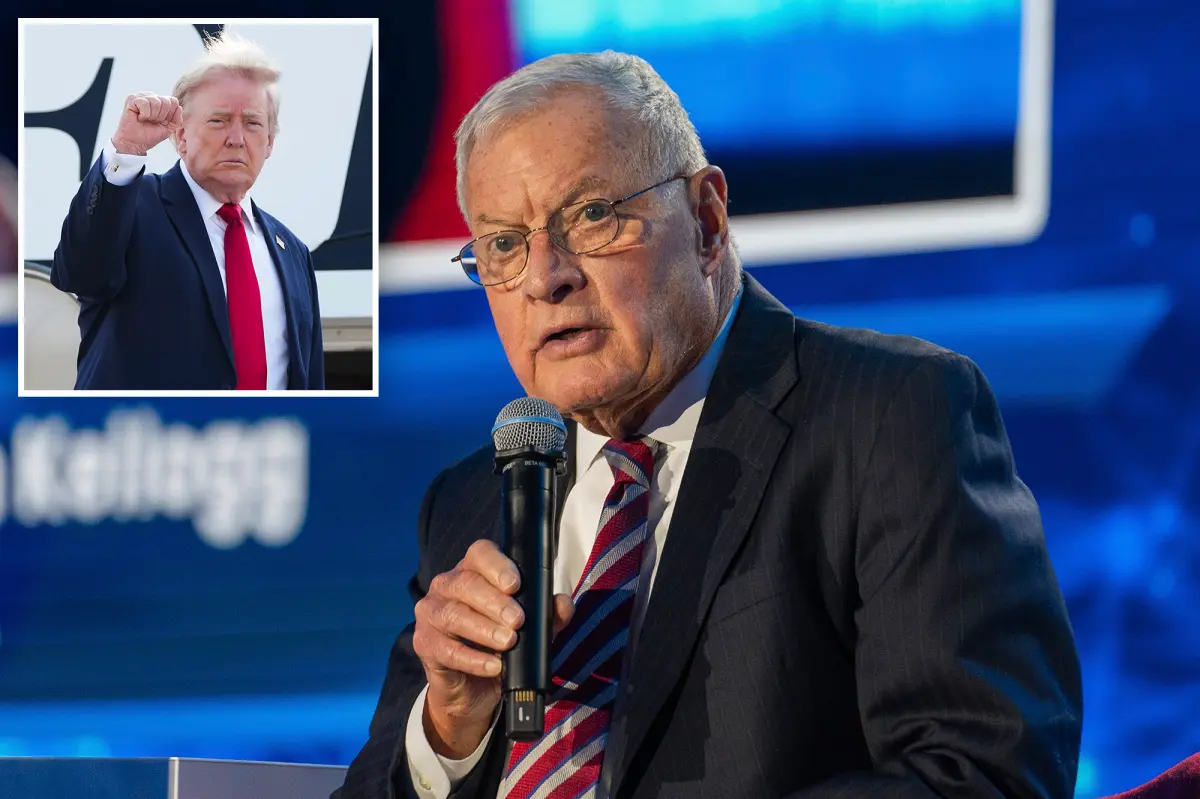

President Trump should not spend valuable time pursuing a final agreement with Iran and should instead begin preparing the public for a possible return to military action, including strikes aimed at Tehran’s key economic arteries, retired Lt. Gen. Keith Kellogg told The Post.
“[We should be telling Americans] the fight’s not over. It’s going to take a day or two — buckle up,” Kellogg, a former Trump adviser, said in an interview Wednesday. “The American people are great about that … if they explain it to them, they’ll understand it.”
Kellogg voiced doubt about the current 60-day round of US-Iran negotiations laid out in the memorandum of understanding signed last month by Trump and Iranian President Masoud Pezeshkian.
Should those discussions collapse, Kellogg said the administration ought to weigh a move against Kharg Island, the strategically vital energy hub that handles roughly 80% to 90% of Iran’s oil exports.
“This is when you go to someplace like Kharg Island,” he said. “You can take it, wholly control the oil.”
Kellogg said Trump should be recognized for attempting diplomacy before force — and for taking aggressive steps aimed at preventing Iran from obtaining nuclear weapons — but he argued the MOU talks are unlikely to alter the conduct of a regime he said has long used negotiations to stall for time.
“They think differently,” said Kellogg, who served as the National Security Council’s chief of staff during the first Trump administration. “They use negotiation as a tool. They don’t see negotiation the same way we do.”
Kellogg’s remarks come as Trump has raised the possibility of restarting a broader war with Iran, while continuing to give diplomacy a chance for the time being.
The Wall Street Journal reported Wednesday that Trump has spoken to War Secretary Pete Hegseth and Gen. Dan Caine, the chairman of the Joint Chiefs of Staff, about abandoning peace talks and launching additional strikes against the Islamic Republic, but has decided negotiations are currently the best way to ensure Iran dismantles its nuclear weapons program.
A US official on Wednesday told The Post that Trump “knows exactly how this regime negotiates,” and is willing to abandon the diplomacy if no progress is made.
“We are hopeful that Iran will come to the table to negotiate seriously, but we are prepared to walk away if they do not,” the person said. “If we are able to advance towards a good place, then we’ll continue the discussion.”
READ MORE: Texas Sisters Charged in Fatal Stabbing of Mother of Five
“President Trump reserves the right [to] return to combat or reinstitute the blockade at any time,” the official added.
The US — along with Israel — started its war on Iran on Feb. 28 with the stated goals of preventing Tehran from obtaining a nuclear weapon, destroying Iran’s ballistic missile and drone capabilities, annihilating its navy, stopping terror proxy groups, and encouraging the Iranian people to rise up to take out the regime.
With sustained fighting until an April ceasefire, the US and Israel knocked off key military targets and killed Iranian leaders, including Ayatollah Ali Khamenei. But the Islamic Revolutionary Guard Corps is still calling the shots with the new supreme leader, Mojtaba Khamenei, and has exerted power over the Strait of Hormuz.
As long as the hardline regime remains in charge, Kellogg doubts that change can come through diplomacy alone.
“Once you started this, you are in the fight whether you like it or not,” said Kellogg, who served a year in the current Trump administration as special envoy to Ukraine. “It’s like being half pregnant: there’s no such thing.”
He suggested Trump should explain the stakes of crushing the regime directly to Americans — it would prevent a nuclear Iran, protect global commerce and finish what the US started, the general said.
Kellogg gave a few examples: the Strait of Hormuz will remain under the regime’s thumb, causing prices to increase. And because nuclear powers are “treated differently,” denuclearizing the country protects not just the immediate threat, but also Tehran’s position in future conflicts and negotiations.
Rather than continuing widespread airstrikes across Iran, Kellogg argued that squeezing Iran’s economy would put pressure on the regime where it hurts most.
“You’re basically telling the Iranian people your economy can get starved out,” he said. “If the economy goes sour, it’s because of [the regime.]”
Trump on June 11 told Fox News that he had long preferred seizing Iran’s critical Kharg Island, but he doubted the public would support it.
“My preference has always been — take Kharg Island… my preference would be that,” he told “Fox and Friends.” “I don’t know that America has the stomach for it, to be honest with you.”
White House spokeswoman Olivia Wales told The Post that what “the president has achieved on the battlefield and at the negotiating table is nothing short of remarkable and will strengthen American security for many years to come.”
“Under President Trump’s leadership, the United States decimated the Iranian regime’s military capabilities in 38 short days and strangled their economy – forcing Iran to the negotiating table,” she said. “Now, the Strait of Hormuz is open, oil and gas prices are falling, and President Trump holds all the cards.”