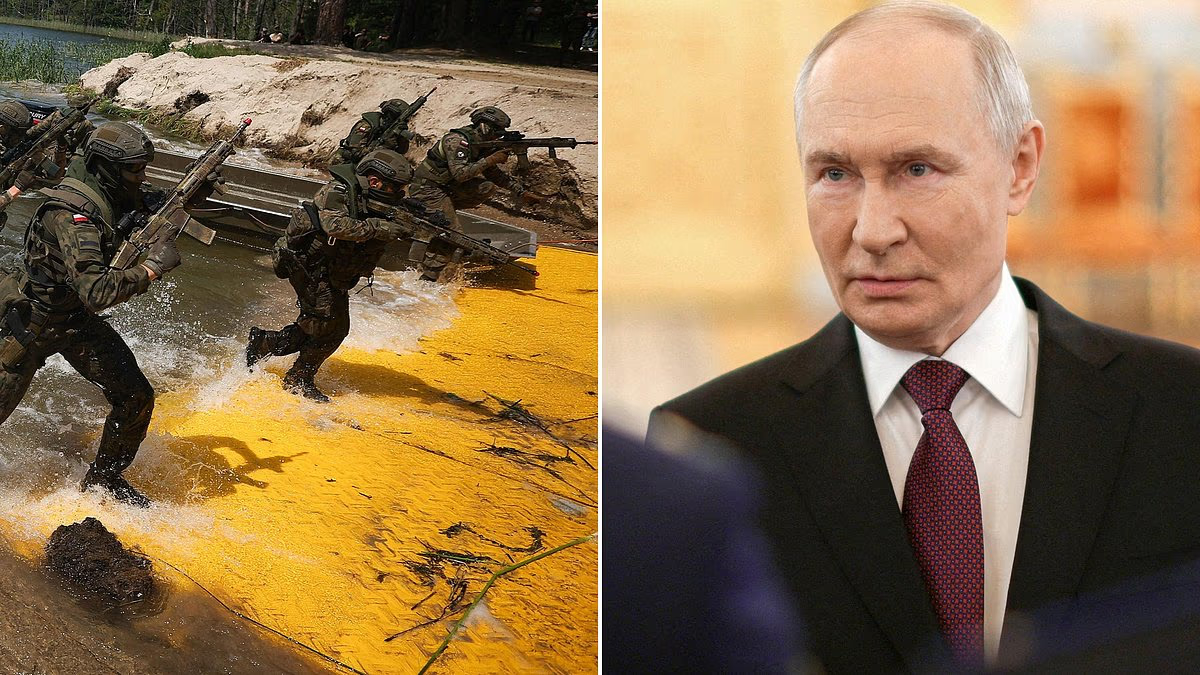

Washington has reportedly warned that the Kremlin may be preparing a limited armed incursion into Poland in an effort to test Nato’s reaction.
The alleged provocation could involve Russian forces crossing onto Polish territory, with missiles and drones potentially aimed at critical infrastructure.
Sources close to Polish President Karol Nawrocki told the news outlet Onet that US officials have been alerting Warsaw to the suspected plan for some time.
The reported objective, according to those accounts, would be to trigger a crisis serious enough to intimidate Western governments and weaken their support for Ukraine.
Polish security specialists have also raised concerns that Russia and Belarus could send a small group of troops across the Nato frontier as part of such a move.
Energy facilities may also be at risk, with possible air strikes designed to force Poland to activate its air defence systems.
Polish sources cited by Onet said Moscow could try to explain away any territorial violation by blaming a GPS navigation mistake or claiming it was linked to an emergency helicopter recovery.
The strategy is said to rest on the belief that the United States would pressure Poland to negotiate rather than respond with military force.

Polish soldiers move ashore from a military motorboat during the Bursztynowy Obronca-26 (Amber Defender-26) military exercise in June 2026

Polish soldiers ride in a military motorboat during the Bursztynowy Obronca-26 (Amber Defender-26) military exercise in June 2026

The provocation could see Putin’s troops cross over into Poland , and vital infrastructure could be targeted by missiles and drones
A peaceful, negotiated retreat would be treated as a strategic win for the Kremlin, which could leverage the talks to demand a halt to Western military assistance for Ukraine.
And in a worst-case scenario for Nato, Russia would aim to undermine Polish sovereignty, force the withdrawal of Western support for Ukraine and expose Nato as a paper tiger.
According to sources, a ground-based attack could come from Kaliningrad – which borders northern Poland – or from Belarus to the east.
Russia depends on targeted, limited provocations to probe Nato’s defences, as its military is too heavily committed in Ukraine to launch a major war.
Although Poland is a vital security partner for Ukraine, their alliance has recently fractured over agricultural trade and past historical grievances. Moscow is expected to try to worsen this divide.
A source close to the Polish president said that the US ‘systematically informs Poland about ever-new Russian plans for a conventional attack on Nato’s eastern flank, from which Poland is by no means excluded’.
Two separate sources – an ambassador to one of Poland’s allies in the Nato alliance and a source in the Polish defence ministry – also confirmed that there is a serious risk of an incursion in Poland and the Baltic States.
However, European security sources also said that a provocation targeting Poland would be more useful than targeting the Baltics.
Speaking to The Telegraph, a Baltic security source said Moscow was currently discussing these plans.
Russia reportedly may attempt to pin the provocation on Ukraine after it is carried out.
A recent naval exercise in Latvia, in which the US Navy and Marines participated, is understood to have been designed to remind Putin that an attack on the eastern flank would be seen as an attack on US troops.
Poland has conducted similar exercises, according to a member of the Polish ministry’s defence leadership.
Nato could respond to the attacks with attacks on Kaliningrad, it is understood, which German air force chief Holger Neumann has cited as a potential target.
He also singled out the Kola Peninsula, where Moscow holds nuclear weapons, and the Black Sea as potential targets.
Speaking to The Telegraph, Neumann vowed that Germany would defend ‘every inch’ of Nato territory, including Poland if needed.

Polish President Karol Nawrocki (C) meets with soldiers of the Polish Military Contingent

A Polish soldier kneels next to a military vehicle during the Bursztynowy Obronca-26 (Amber Defender-26) military exercise in June 2026
Last week, the defence ministry of the Netherlands warned that Russia could launch a military campaign against a Nato country just a year after the end of its invasion of Ukraine.
In its annual defence policy strategy document, the ministry said Europe stood in a ‘grey area’ between war and peace, vowing to bolster Dutch defence investment, notably in unmanned weapons such as drones.
‘The Dutch intelligence services estimate that Russia is preparing for a long-term confrontation with Europe,’ the ministry said in its report.
MORE STORY: Elliot Williams CNN Ethnicity, Parents, Wiki, Biography, Age, Wife, Children, Career, Net Worth & More
‘In the worst-case scenario, a limited war against Nato members could be possible within one year of the Russian war in Ukraine ending,’ the officials said.
The warning came as the Kremlin threatened Nato nation Finland over its plan to lift a long-standing ban on hosting nuclear arms in its territory.
Finland, which shares an 830 mile border with Russia, said in March it would amend a Cold War-era nuclear act, aligning with Nordic neighbours in a move that could open the door to deploying atomic bombs on Finnish soil during times of war.
Moscow has warned that the decision will make Helsinki more vulnerable.
Russian Foreign Ministry spokeswoman Maria Zakharova said on Monday that the move posed ‘real threats’ to Russia’s national security and that Moscow would move quickly and effectively to readjust its military and political stance accordingly.
Meanwhile, Ukraine’s top military commander also said in an interview broadcast on Tuesday that his forces were preparing for a possible new Russian attack from the north, but any attempt to advance on Kyiv was unlikely.
Oleksandr Syrskyi, interviewed on TSN Ukrainian television, also said an attack from neighbouring Belarus was unlikely after weeks of Ukrainian allegations that Moscow was trying to press its ally to play a greater role in the war.
‘The most likely scenario, and this is confirmed by several data sources, is possible offensive action in the north from the territory of Russia, from the Bryansk region,’ Syrskyi said.
‘This is a realistic option, of course, and we are preparing for it.’
The aim of such an operation, he said, was not to try to move on Kyiv as Russian forces had attempted to do after their February 2022 invasion before withdrawing and focusing on the Donbas region in the east.
Instead, they would try to seize territory in Ukraine’s Chernihiv region and draw Ukrainian forces engaged elsewhere along the 775-mile front line.
Such a strategy would amount to ‘stretching the front and depriving us of reserves’.
But Belarus, which allowed Russian President Vladimir Putin to use its territory in launching his initial push into Ukraine, was unlikely to agree to further involvement, he said.
Last month Zelensky gave Belarus, under veteran President Alexander Lukashenko, a week to dismantle relay stations Kyiv he said were being used to attack Ukraine. Zelensky has since said the stations are no longer operating.
In his comments to the broadcaster, Syrskyi also said there were indications that Russian troops were exhausted and the intensity of frontline battles was declining.
He said Russian frontline activity had declined by 30 per cent while Ukrainian forces pressed on with a campaign of long-range strikes against Russian targets, mainly linked to the oil industry.
It comes as Russia’s most powerful banker has broken ranks and called on Putin to end his invasion of Ukraine as soon as possible.

Ukraine has been striking key Russian facilities, like the Kapotnya Oil Refinery which sits just ten miles from Moscow
German Gref, who heads up the state-controlled Sberbank, said that Russians are deeply concerned by the worsening economic conditions of the country, which are being exacerbated by the war and Ukraine’s strikes on oil refineries.
He said in an interview with state TV: ‘I think what’s worrying every one of us is one and the same thing.
‘I don’t think there’s a single person who isn’t concerned about anything other than a rapid end of hostilities, that’s clear.’
Gref’s unprecedented public plea came as a poll showed 81 per cent of Russians want the war to end, the highest since the conflict began, according to the Kyiv-based Institute for Conflict Study and Analysis.
The banker has already made clear the war, with its high military spending, is leading to havoc in the economy which is suffering from petrol queues, falling wages, redundancies, soaring prices and cripplingly high interest rates.
He warned Putin: ‘We have already overcooled the economy.’
Videos have been emerging of motorists brawling at petrol stations across Russia as tensions continue to escalate amid worsening fuel shortages.
In one clip, a motorist throws punches through his window at another driver who has got out of his car and is standing beside the vehicle.
The man then climbs through the driver’s window and appears to continue the fight inside the car, with only his legs visible outside as the pair scuffle.
His friend is seen frantically tapping him, seemingly trying to pull him away and stop the attack.
In another video, a man appears to repeatedly punch a driver outside a petrol station while another bystander looks on.
Elsewhere, a woman is seen in tears as she claims a man threatened her with a knife and deflated her tyres after accusing her of cutting in front of him at a petrol station.
Footage appears to show the man unscrewing a tyre valve before standing up with what looks to be a knife in his hand.
Meanwhile, in Moscow, two women waiting in a queue were filmed screaming at each other after one accused the other of cutting in line. ‘**** you! I’ll smash your face in!’ one of them shouts.
Another video from the western city of Ryazan shows two men exchanging punches outside a petrol station until a bystander steps in to break up the fight.
The queues are hitting the vast majority of Russia’s 83 regions and six invaded territories.
In one region, police were forced to crackdown on a mafia group which resold petrol at triple the price.
It comes after Putin acknowledged that the country was facing ‘a certain shortage’ of fuel in an interview published by the Kremlin on Sunday, after repeated Ukrainian strikes in their four-year war.
‘As for strikes against critical infrastructure in general, and energy infrastructure in particular, of course these attacks on our infrastructure facilities create problems, that’s obvious,’ Putin said.
‘Right now we’re observing a certain shortage, but it’s not critical.’