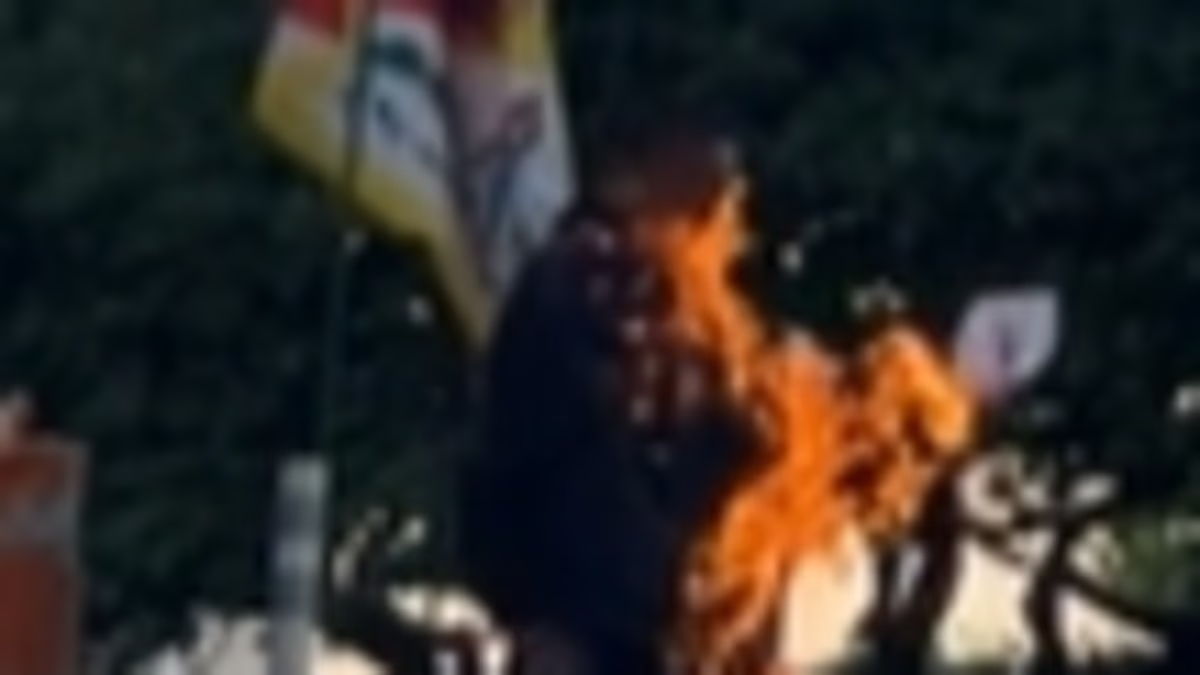

A Tibetan protester died Thursday after setting himself on fire outside the United Nations headquarters in New York City, according to sources.
The man, identified as 52-year-old Palden Lobsang, recorded the incident on video as he walked toward the corner of 42nd Street and First Avenue in Midtown Manhattan while wearing monastic robes and carrying a Tibetan flag, sources told the Daily Mail.
In the recording, Lobsang stood in the intersection and scattered flyers bearing messages including “China out of Tibet” and “Free Tibet” as vehicles moved through the area.
Roughly a minute later, he collapsed in the roadway while still engulfed in flames. Two security officers then rushed toward him and worked to put out the fire.
A woman who came upon the scene appeared to place an emergency call, according to the footage.
Police officers from the NYPD’s 17th Precinct arrived about five minutes after the recording began, followed by a fire truck approximately two minutes later.
First responders found Lobsang with severe burns and attempted lifesaving measures before taking him to Bellevue Hospital, where he was pronounced dead at 7:04 p.m., sources said.
The video concluded as officers took custody of the device used to record the incident.
But the Tibetan flag he had planted into the ground remained there for about an hour as officers investigated the scene, the New York Post reports.


Palden Lobsang, 52, filmed himself as he set himself on fire outside the United Nations building in New York City on Thursday

Lobsang, who has lived in the United States for about 20 years, had earlier shared pictures of himself sitting outside the Cipriani event venue carrying New York City tourism bags
READ MORE: Hansjörg Wyss: Secretive Swiss Billionaire Compared to George Soros
Lobsang, an Uber driver has lived in the United States for about 20 years, had earlier shared pictures of himself sitting outside the Cipriani event venue carrying New York City tourism bags.
He also shared online the flyers he would later throw into the busy intersection.
A fellow Uber driver said he knew Lobsang from gatherings in New York City’s Tibetan community, and noted that his friend was enraged by the restrictions the Chinese government placed on his people.
‘They have to speak the Mandarin language; they must learn Chinese. They must read that literature; they cannot learn anything else,’ the friend told AMNY. ‘That’s the main thing he was worried about.
‘I am emotionally so sad,’ he added. ‘He should not have done that.’
The ‘Free Tibet’ movement challenges China’s sovereignty over the region.
Tibet had functioned with de facto autonomy and maintained its own distinct administration prior to the Chinese Community Party’s rise to power.
But when the People’s Liberation Army moved into the region, China took control of the region under the Seventeen Point Agreement in May 1951 – an accord that sought to establish a peaceful transition.

Lobsang threw flyers reading ‘Free Tibet’ while he was on fire

The ‘Free Tibet’ movement challenges China’s sovereignty over the region
The ‘Free Tibet’ movement’s goal is now to recapture sovereignty for the Tibet Autonomous Region, marked by the restoration of power to the Dalai Lama, the highest spiritual leader in Tibetan Buddhism.
‘Many of the protesters have shouted slogans while on fire, including calling for the Dalai Lama’s long life and his return to Tibet, for the Panchen Lama to be freed and for human rights and freedom in Tibet,’ the movement’s official website notes.
‘Severe punishments are handed out to those accused of assisting or encouraging the protesters or sharing information abroad.’
Yet the movement gained international visibility in the 1990s through the Tibetan Freedom Concerts in the US, which featured prominent bands like U2, the Red Hot Chili Peppers and Rage Against the Machine.


