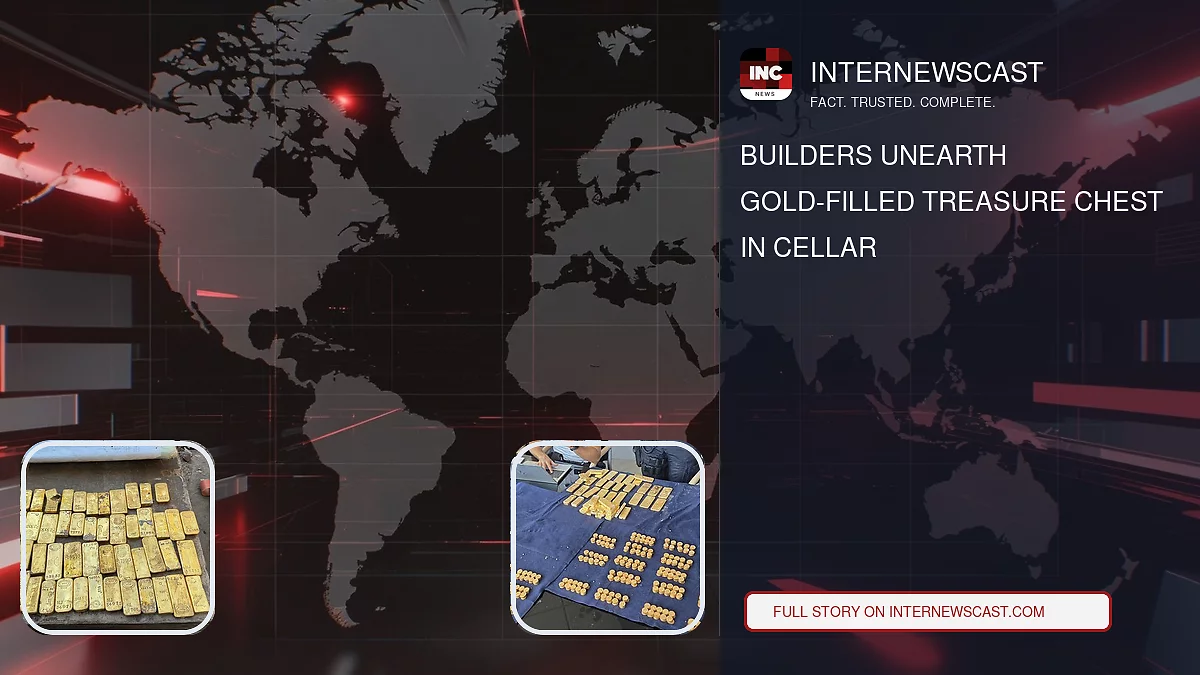

Construction workers renovating a cellar in Belgium have uncovered an extraordinary hidden cache of gold believed to be worth around £7.5 million.
The discovery was made on Monday morning during renovation work at a former brewhouse in Sint-Gillis-Dendermonde.
Concealed inside a wall, the chest reportedly held gold bars, nuggets and a large quantity of coins.
After coming across the haul, the contractors alerted their client, the charity CAW Oost-Vlaanderen, and contacted police.
Authorities have launched an investigation into the origins of the treasure, with questions still surrounding how it came to be hidden in the property. Several of the gold bars appear to bear stamps dating from around 1957 and 1961.
Geert Hillaert, of CAW Oost-Vlaanderen, told local media that tracing the hoard’s original owners could take years.
He said investigators must first determine whether the gold can be connected to any historic criminal activity.
He added that officials are also examining whether any rightful owners can still be identified.

The hoard was found as a Belgian firm worked on a former brewhouse in the town of Sint-Gillis-Dendermonde

The chest, which was hidden in a wall, contained gold bars, gold nuggets and a mountain of coins

Cops are now investigating the source of the treasure
It’s not yet clear whether the charity or the construction firm will get anything for finding the treasure.
Earlier this week, it was revealed that Britain abandoned its claim to a £5.5billion treasure from a Royal Navy shipwreck near Gibraltar over fears it would upset Spain.
Leaked cables from the early 2000s show how ministers scrapped plans to rescue a warship understood to be HMS Sussex in case it would threaten relations with Spain, despite the UK owning the wreck.
HMS Sussex was a Royal Navy flagship lost off Gibraltar more than three centuries ago. It is believed the wreck sits in international waters to the east of Gibraltar, which Britain could claim under international maritime law.
The warship sank in a storm in 1694 while carrying up to 10 tons of gold, records suggested, which would amount to £5.5billion today – making it the most lucrative shipwreck discovered.
In 2001, Odyssey Marine Exploration, the US deep sea exploration company, said it was ’99 per cent’ sure it had found the ship after a three-year search.
The UK government signed an agreement with the company in September 2002, agreeing to recover the wreck and for the sale of treasure to be split.
News of the contract sparked furore and incited diplomatic tensions with Spain, which said it owned the ship due to its position in claimed Spanish waters.
It emerged through once confidential diplomatic cables from the US that UK officials said the dispute was causing ‘an unnecessary threat’ to British-Spanish relations.
In the documents, released by Wikileaks, Dame Denise Holt, then deputy head of mission at the British embassy in Madrid, said officials would seek to ‘terminate’ the contract with Odyssey.
She added in June 2007 the ‘controversy’ made the British embassy ‘distance themselves as much as possible from Odyssey’, and was also impacting ‘Gibraltar issues’.
The Florida-based Odyssey would also, she said, lose British ‘aid’ when their ships sailed from the port of Gibraltar, where they were moored.
Meanwhile Carmen Calvo, Spain’s culture minister, said in a separate cable dated November 2005 that Odyssey would look for HMS Sussex ‘over her dead body’.