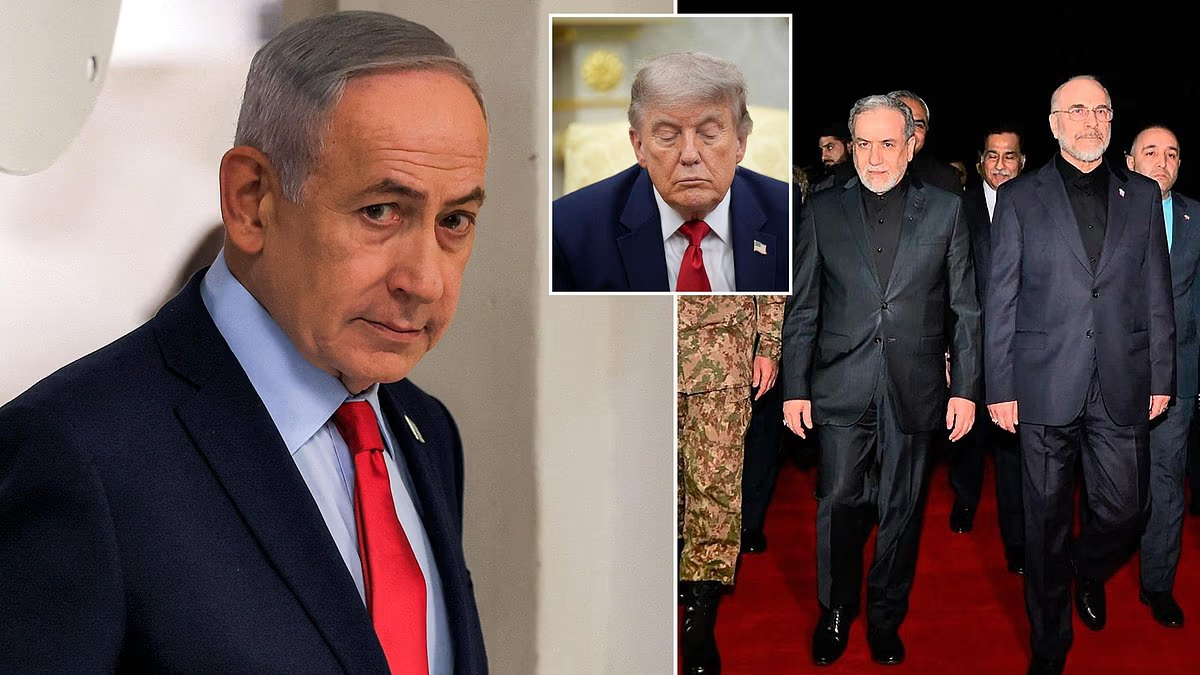

US officials grew increasingly worried that Israel was considering killing Iran’s leading negotiators while they were involved in highly sensitive, secret peace discussions with the administration earlier this spring.
A dramatic account published by the New York Times details how alarm spread through Washington over concerns that Israel might target the same senior Iranian figures central to the peace process.
Targeting high-ranking Iranian commanders had been a core element of Israel’s wartime approach from the outset, but US anxiety intensified sharply as fragile negotiations got underway in April.
Those fears focused in particular on two prominent officials: Abbas Araghchi, Iran’s foreign minister, and Mohammad Bagher Ghalibaf, the speaker of parliament.
According to the report, Washington turned to other governments in the region, asking them to alert Tehran that Israel could be preparing to strike Iran’s key negotiators.
American officials understood that Araghchi and Ghalibaf were regarded by Israel as priority targets, amid Israel’s continued push for regime change inside Iran.
The conflict began on February 28 after a major Israeli airstrike killed Iran’s Supreme Leader, Ayatollah Ali Khamenei, along with several of the regime’s most powerful senior figures. The leadership-targeting operation was carried out with support from US intelligence.
As the fighting progressed, the two allies began to diverge sharply over strategy.

US officials were gripped by fears that Israel was plotting to assassinate Iran’s top negotiators during highly sensitive, secret peace talks with the administration earlier this spring, current and former American officials have revealed to the New York Times . This exposes the behind-the-scenes friction between Washington and Jerusalem as the US has been efforting a complicated truce with the Iranian regime

US officials knew that Araghchi and Ghalibaf were viewed as main targets by Israel, which remained fiercely intent on regime change inside the country

As the administration desperately tried to broker a deal, American officials watched with growing alarm as Israel prepared to potentially take out the very men holding the keys to the negotiations

Minister of Foreign Affairs of Iran, Seyyed Abbas Araghchi, left, and Speaker of the Islamic Parliament of Iran, Mohammad Bagher Ghalibaf, right, at the Buergenstock resort in Obbuergen, near Lucerne, Switzerland
While the American military focused its firepower on crippling Iran’s naval assets and missile launch capabilities, Israel adopted a far more aggressive, personalized approach.
In those chaotic early weeks, the Israelis made hunting down and liquidating Tehran’s political and military high command their priority, determined to wipe out as many regime kingpins as possible.
Beyond setting their sights on Araghchi and Ghalibaf, Israel had already killed other Iranian leaders during the strikes that were viewed as more moderate, including Iran’s former foreign minister Kamal Kharazi and their national security leader Ali Larijani.
Araghchi and Ghalibaf have served as Iran’s primary point men in frantic negotiations with various regional powers to secure a ceasefire and, ultimately, a more permanent peace deal with the United States.
Against all odds, those efforts yielded a massive breakthrough in June, when Washington and Tehran successfully hashed out a framework agreement. The deal aimed to immediately reopen the strategically vital Strait of Hormuz and laid down the crucial ground rules for follow-on negotiations regarding Iran’s controversial nuclear program.
When the two-week ceasefire was brokered in April, Israel viewed the entire agreement as an unmitigated disaster.
From Israeli Prime Minister Benjamin Netanyahu’s perspective, the deal failed to achieve any of their core war aims: the fundamental collapse of Iran’s theocratic regime, the total destruction of its proxy networks and the dismantling of its missile arsenal.
Instead of being toppled, Tehran’s hardline government emerged even more fiercely authoritarian, with the Islamic Revolutionary Guards Corps tightening its iron grip over the entire nation.

Vance speaking with Jared Kushner during the meetings between Qatar, Pakistan, Iran and the US

Vessels at the Strait of Hormuz, as seen from Musandam, Oman

Meantime, speculation is mounting as to whether Iran’s new supreme leader is finally ready to show his face, as Ayatollah Khamenei’s body arrives at Tehran’s Grand Mosalla ahead of a days-long funeral
While Israeli officials offered only grudging diplomatic support for the truce, the country was flooded with anxiety that the United States was cutting the war short.
Worse still, they feared the agreement would flood Iran with billions of dollars in sanctions relief, effectively bankrolling a rapid post-war reconstruction while leaving Tehran’s nuclear ambitions completely unchecked.
Ghalibaf has twice cheated death, narrowly escaping assassination by Israeli forces in two separate conflicts, according to three senior Iranian officials and public statements sent to the New York Times.
Last month, Araghchi and Ghalibaf made the trip to Lucerne, Switzerland, for high-stakes talks with Vice President Vance and his American counterparts.
Meantime, speculation is mounting as to whether Iran’s new supreme leader is finally ready to show his face, as Ayatollah Khamenei’s body arrives at Tehran’s Grand Mosalla ahead of a days-long funeral.
Millions of people and a coterie of foreign dignitaries are expected to attend Saturday’s official ceremony for Ali Khamenei, with Tehran’s chief negotiator calling for a massive turnout to avenge his death.
Khamenei was killed in the US-Israeli strikes that triggered the Middle East war on February 28, with his son, Mojtaba, succeeding him.
Mojtaba has not been seen in public since becoming supreme leader, however, and it remains unknown as to whether he will be present at the main ceremony in Tehran.