
What Is Rod Laver’s Net Worth?
Rod Laver is a retired Australian tennis legend with an estimated net worth of $20 million.
Rod Laver is commonly ranked among the finest tennis players the sport has ever produced, and many historians consider him the greatest men’s player in history. Known by the nickname “Rocket,” Laver remains the only tennis player, male or female, to complete two calendar-year singles Grand Slams, winning all four majors in both 1962 and 1969. His 1969 triumph is still the only men’s Grand Slam achieved during the Open Era. Laver excelled across the amateur, professional, and Open Era periods, thriving on grass, clay, and hard courts with a dynamic left-handed style defined by explosive footwork, a powerful topspin forehand, crisp net play, and constant aggression. Across his career, he captured 11 Grand Slam singles championships, added numerous professional major titles, and amassed roughly 200 singles tournament victories. He was the defining force in men’s tennis for much of the 1960s and became the first player in the sport to surpass $1 million in official prize money, a remarkable benchmark at a time when tennis earnings were modest compared with modern payouts.
Early Life
Rodney George Laver was born on August 9, 1938, in Rockhampton, Queensland, Australia. Raised in a family where tennis was part of everyday life, he honed his skills on a court built close to the family home. Though not physically imposing, Laver was extraordinarily fast, strong, and competitive, earning the nickname “Rocket” from Australian coach Harry Hopman, a key figure in developing Australia’s powerhouse generation of tennis stars.
As a teenager, Laver left school to dedicate himself fully to tennis and soon emerged as one of Australia’s most promising young players. His left-handed shot-making, exceptional wrist strength, and attacking approach made him dangerous on every surface. He also came through Australia’s formidable Davis Cup program, where rising players were exposed to world-class opponents and taught to perform under pressure from an early stage.
Amateur Career and 1962 Grand Slam
Laver began making his mark internationally in the late 1950s and early 1960s. He advanced to his first Wimbledon final in 1959 and claimed his first major singles championship at the Australian Championships in 1960. By 1961, he had firmly established himself among the world’s elite players.
In 1962, Laver put together one of the most celebrated seasons the game has ever seen. He swept the Australian Championships, French Championships, Wimbledon, and U.S. Championships to complete the calendar-year Grand Slam. Tennis at that time was still divided between amateur and professional circuits, and Laver’s 1962 feat came while he was still an amateur. Following that season, he moved into the professional ranks, a decision that made him ineligible for the traditional Grand Slam events for several years.
Professional Career
Laver became a professional in 1963, stepping into a far more demanding circuit built around intense head-to-head tours against the sport’s top paid competitors. Because many leading professionals were kept out of the major championships for years, Laver’s official Grand Slam count does not fully reflect his dominance when compared with players from the modern era. During this stretch, he collected several professional major titles and faced elite rivals including Ken Rosewall, Pancho Gonzales, Lew Hoad, and Andrés Gimeno.
With the arrival of the Open Era in 1968, professional players were finally welcomed back into the major tournaments. Laver quickly showed he remained the world’s premier player, winning Wimbledon in 1968 in the tournament’s first Open Era edition before producing the defining campaign of his career in 1969.
That year, Laver won the Australian Open, French Open, Wimbledon, and U.S. Open, becoming the only men’s player to complete the calendar-year Grand Slam in the Open Era. More than half a century later, no man has repeated the feat. The 1969 season remains the centerpiece of his legacy and one of the defining achievements in tennis history.
Getty
Career Earnings
Rod Laver earned roughly $1.56 million in official career prize money. That number looks modest by modern tennis standards, but it was enormous for his era. In 1971, Laver won $292,717 in tournament prize money, a season record at the time, and became the first tennis player to surpass $1 million in career on-court earnings.
His earnings are especially impressive because so much of his career came before tennis became a global television and sponsorship machine. Modern Grand Slam champions can earn several million dollars from one tournament. Laver spent much of his prime in an era when even the greatest players traveled constantly, played grueling schedules, and earned only a fraction of what stars receive today.
Adjusted for inflation, Laver’s prize money would be worth several million dollars in today’s money, but his true financial impact on the sport is much larger. He helped bridge amateur tennis, professional barnstorming tours, and the modern Open Era. His success helped prove that elite tennis players could be global sports attractions capable of drawing large crowds and meaningful prize money.
Endorsements
When adjusted for inflation, Rod Laver’s official tennis prize money amounted to roughly $5 million in today’s dollars. That made him one of the most successful earners of his generation, but not wealthy enough to simply retire and live off his playing career forever. With the help of his wife, Mary, Laver became one of the early examples of a tennis star turning athletic fame into a business platform.
Mary, who had been married previously and had three children, encouraged Rod to think beyond tournament checks. She pushed him to invest in stocks and bonds, accept paid appearances at tournaments, and pursue corporate endorsement deals at a time when athlete marketing was still in its early stages. Together, the Lavers also helped build a lucrative tennis-camp business, including locations in Hilton Head, South Carolina, and Boca Raton, Florida. Those ventures helped Laver earn money from his name and expertise long after his peak playing years, foreshadowing the modern model in which elite athletes make substantial money through endorsements, appearances, clinics, licensing, and brand partnerships.
Real Estate
Rod Laver and his wife, Mary, also invested in real estate over the years, particularly in California. Those purchases became an important part of Laver’s long-term financial foundation after his playing career ended. Rod owns a large mansion in Palm Springs, a ranch property in Solvang, and an impressive primary residence in Carlsbad, California.
The real estate portfolio reflects the post-tennis financial strategy that Mary helped encourage. Rather than relying only on past prize money, the Lavers put money into assets that could appreciate over time. Mary died in 2012 after more than four decades of marriage, but Rod has continued to own several of the properties they acquired together.
Honors and Legacy
Laver was inducted into the International Tennis Hall of Fame in 1981. In 2000, Centre Court at Melbourne Park was renamed Rod Laver Arena, giving him one of the sport’s most visible and enduring honors. The Australian Open’s main stadium remains one of the most famous venues in tennis.
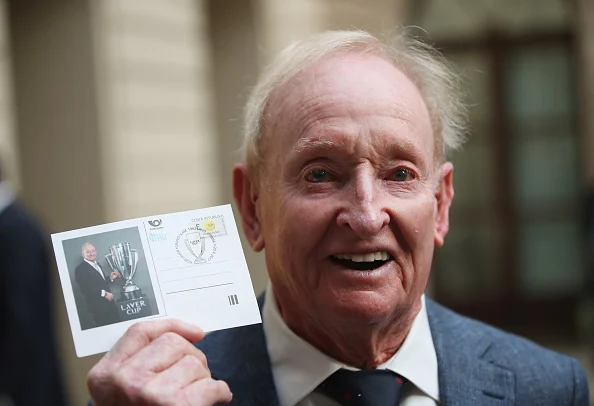
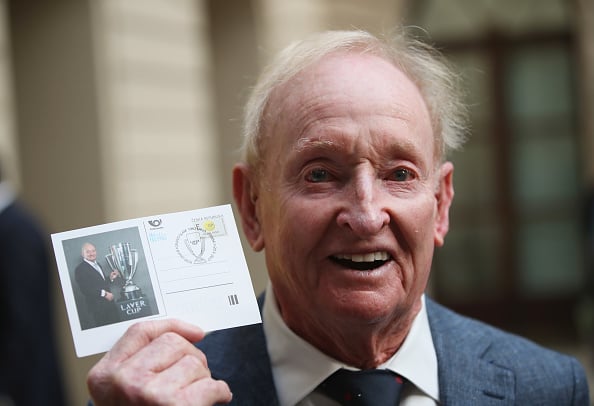
His name also lives on through the Laver Cup, an international team event launched in 2017. The tournament helped introduce Laver’s legacy to younger fans and regularly features the sport’s biggest modern stars.
Laver’s career is difficult to compare directly with today’s players because he spent key prime years outside the Grand Slam system and played through major structural changes in the sport. Even so, his two calendar-year Grand Slams, all-court dominance, professional major success, and unmatched consistency have kept him at the center of any serious debate about the greatest tennis player of all time.
Personal Life
Rod Laver married Mary Benson in 1966. The couple had a son, Rick. Mary died in 2012 after more than four decades of marriage.
Laver has lived for many years in California while remaining closely associated with Australian tennis. In 1998, he suffered a serious stroke but recovered and continued to appear at major tennis events. His presence at the Australian Open and other tournaments has made him a revered elder statesman of the sport.
All net worths are calculated using data drawn from public sources. When provided, we also incorporate private tips and feedback received from the celebrities or their representatives. While we work diligently to ensure that our numbers are as accurate as possible, unless otherwise indicated they are only estimates. We welcome all corrections and feedback using the button below.


