
Wimbledon has already ushered its line judges into the past by embracing automated technology — and attention is now turning to whether Rufus, the tournament’s much-loved hawk, might eventually face a similar future.
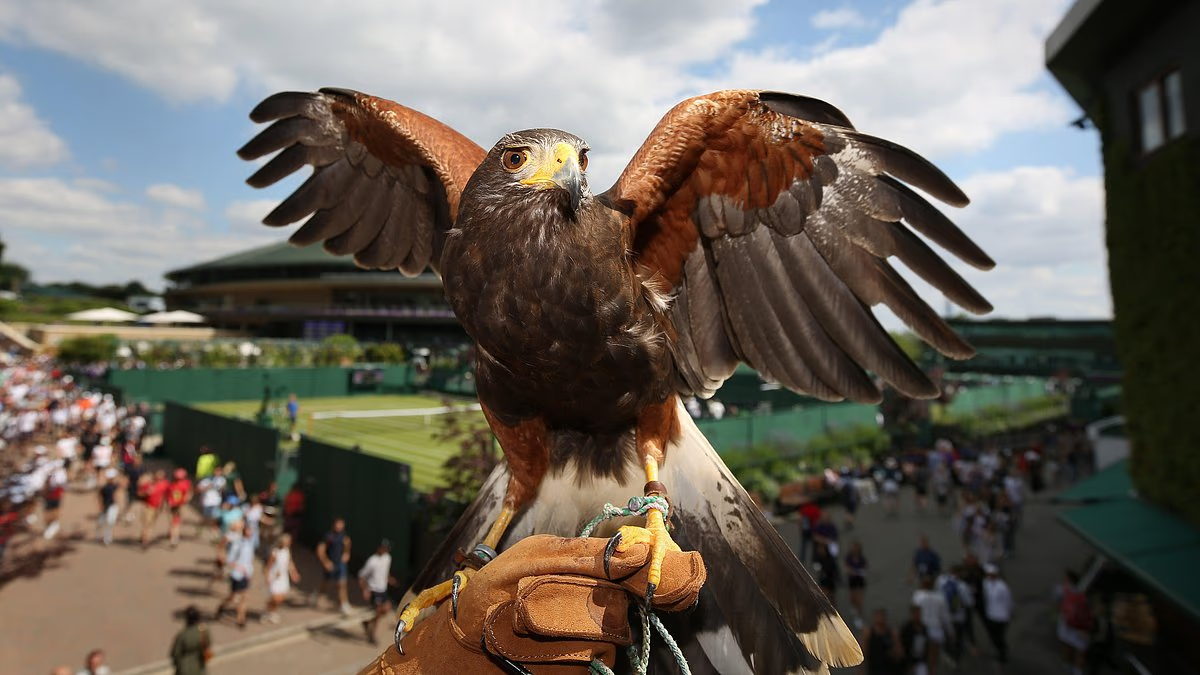
For the past 18 years, the celebrated bird of prey has been a familiar presence over SW19, helping to keep Centre Court and Court One clear of troublesome pigeons.
But with artificial intelligence reshaping areas from officiating to security, his handler Donna Davis this week would not completely dismiss the possibility that Rufus could one day be succeeded by a technological alternative.
‘You have to consider it, don’t you?’ she said, referring to rapid progress in mechanical deterrents such as drones, rotating owl decoys and battery-powered falcons designed to mimic flight.
Even so, Ms Davis was quick to stress that today’s pigeon-control gadgets are probably still not advanced enough to deceive the birds, which she said are far from gullible.
‘I think birds, they’re very highly intelligent, all birds, and they all know when a predator is around,’ she added.
‘You can put out dummy birds, or you can use a drone, but they know it’s mechanical.
‘They instinctively know it’s mechanical, so they are not so fast, they become very aware and used to something, and they think, “Oh, that’s not going to harm me”.

The hawk’s handler Donna Davis this week refused to rule out whether Rufus could one day be replaced by a high-tech successor

The revered bird of prey has patrolled the skies above SW19, keeping Centre Court and Court One free from pesky pigeons
‘Whereas a predator, they always know that it’s fight or flight, you either move off or you’re going to be the next meal,’ she added.
However, the handler who first started working the grounds at Wimbledon in 2000 with her hawk Hamish, Rufus’s predecessor, acknowledged that this could change in the future.
MORE STORY: Steven Seagal Unveils 400lb Physique at Russia's Victory Day Parade
‘Technology is very sophisticated, and who knows? I know that there’s some amazing engineering and incredible stuff going on,’ she added, concluding: ‘Poor Rufus’.
Wimbledon has said there are no plans to phase Rufus out or replace the bird, which can live up to 30 years, with technology.
Last year, chief executive Sally Bolton attempted to put speculation on the issue to bed by revealing that Rufus’ own fledgling will take up the mantle at the world’s most historic tennis tournament.
But Ms Davis said that Rufus, who was born in captivity, was struggling to find a suitable mate.
‘Unfortunately…in the wild, females are the alpha, so they’re more aggressive,’ she explained.
‘They are twice the size of Rufus and in the wild they (the males) can handle that, they know they’ve got to be submissive, they know they’ve got to get out of the way.

Decoys include the Robird ornithopter drone which is used at Southampton Airport to deter rela birds by mimicking a bird of prey
‘But if you’ve got them in an enclosure, the females can be aggressive, but they haven’t got anywhere to go.’
She said that an attempt to breed him failed as Rufus and his potential partner ‘didn’t respond too well’ to one another.
‘We only had the one female and that didn’t work out and I thought “I don’t want to chance it”. He got plucked about a bit, but he was fine,’ she said.
But the handler added that she ‘definitely’ planned to try to breed Rufus again.
Rufus also scares pigeons away from Westminster Abbey and Lord’s Cricket Ground, among other sites.
However, Ms Davis said that Wimbledon is Rufus’s ‘haunt’, adding: ‘It is his playground, I mean, he pretty much fledged here at 18 weeks old.’