
Two years ago, Carol believed her fortunes had finally turned when, after a string of interviews, she was told she had secured an office role in Thailand as a typist. The offer sounded generous: her airfare would be covered, meals included, accommodation provided free, and she would earn £600 a month.
At the time, she had just lost her hospitality job in Nairobi, Kenya’s capital, and was under intense financial pressure. Rent, groceries and school fees for her eight-year-old daughter were becoming increasingly difficult to manage. The overseas job looked like an answer to prayer.
Instead, it became a trap. After landing in Bangkok, Carol was driven for hours toward the Myanmar border before being smuggled into the conflict-ravaged country. Once there, armed guards forced her into a sprawling compound, where Chinese gangsters ordered her to help run online fraud schemes aimed at Americans, Britons and Canadians thousands of miles away.
The advert and interviews had been nothing more than a calculated deception. Carol had been lured into a huge “scam factory” controlled by Chinese criminal networks, where beatings and torture were used to compel workers to search social media for targets vulnerable to frauds involving property deals, cryptocurrency investments, romance cons and online shopping scams.
Even the smallest act of defiance, or a failure to hit daily quotas, could bring brutal consequences. Punishments included electric shocks to the head, blows from metal pipes, days locked inside a cramped, pitch-black room — and, in one particularly terrifying threat, being chained beside a cage holding a tiger.
“It has been total hell,” Carol told me from Myanmar, four days after escaping a 19-month ordeal that had taken her through three separate compounds. She was freed with 12 other Africans after receiving help from a network of Thai campaigners.
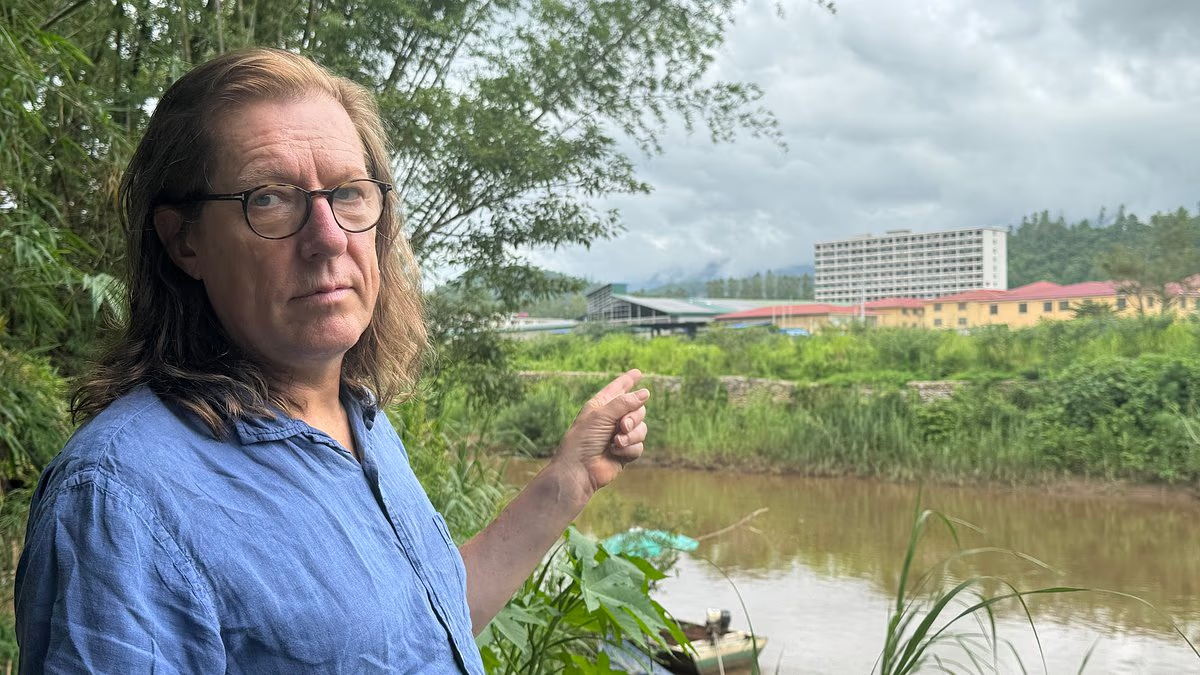
Dozens of these vast scam centres — many enclosed by grim coils of barbed wire and some overlooked by intimidating watchtowers — are visible from Thailand across the narrow, muddy Moei River, which marks the border between the two nations.

Ian Birrell gestures toward a scam compound across the Moei River in Myanmar, where workers — including some who were kidnapped or tricked — are used to extract huge sums from online victims

Many of the scam complexes there are surrounded by barbed wire and menacing watchtowers
They have been purpose-built over the last four years in lawless regions of Myanmar run by militia fighting the country’s endless civil war. They have a single aim: To hoover up vast sums of money online from greedy, lonely or unfortunate people around the planet.
The scale of these industrialised scam operations is staggering. The complexes hold tens of thousands of people from at least 78 countries – and one expert told me 135 nations have been hit by the scammers. ‘This is a global problem,’ said Mechelle Moore, chief executive of Global Alms, an anti-trafficking charity based in Thailand.
Many of those working here are taken to the complexes by ethnic Chinese gangs.
Most are conned like Carol – but some are kidnapped. They are made to sign bogus contracts – then told they must pay punitive sums to cover all their costs of travel, food and accommodation if they want to leave. ‘The idea is that once you’re in, there is no way out except by paying a big ransom,’ explained Moore.
Across South East Asia, where similar operations have sprouted up from Cambodia to the Philippines, it is estimated these factories extort up to £60billion a year. Some of the centres in Myanmar are also used to manufacture drugs such as crystal meth.
This is criminality in plain sight on an extraordinary scale.
From my vantage point on the border, I could see clearly the suburban-looking homes of the scam-factory bosses as well as accommodation blocks up to eight storeys high that held human-trafficking victims, often eight to a room in bunk beds.
I saw workmen building two compounds along a short stretch of the river, demonstrating that this is a rapidly growing industry.
The 60 compounds along this stretch of the border are run like well-organised business parks, with a main director, subordinates who rent out offices and dormitories to crime syndicates, supervisors monitoring performance and targets, and teams allocated differing tasks.
They contain brothels and gyms; some even have a basketball court, football stadium or swimming pool.

A Burmese woman prepares to take food to the compound… the 60 compounds along this stretch of the border are run like well-organised business parks, Ian Birrell writes

Thai activist groups that do deal with Myanmar militia, often struggle to help those who manage to escape the compounds
‘The better you are at scamming, the more access you get to their amenities,’ said Moore. ‘It’s all about controlling you.’ Yet these criminal enterprises have a veneer of business normality.
‘The operations work like companies – they have key performance indicators, quarters, bonuses if you perform well, but torture if you don’t perform well,’ said Ivan Franceschini, a lecturer in Chinese studies at the University of Melbourne and co-author of Scam: Inside Southeast Asia’s Cybercrime Compounds.
At one point I heard sounds of artillery fire, a reminder of the long-running civil war between the Myanmar government and various rebel groups – and of the risks for the trafficked workers trapped in a nearby compound. Later, I met a man whose finger had been blown off by shrapnel in an attack that killed fellow captives from China and Uganda.
This man, hired as a translator after studying for six years in China, was among the small group of Africans freed after they had used phones and computers to contact activists and diplomats in Thailand. Their release was negotiated with a local militia, whose leaders are sanctioned by the UK and US for links to scamming.
The 13 men and women came from Cameroon, Ghana, Kenya, Nigeria, Rwanda and Zimbabwe. Some were articulate and highly educated, others from simpler backgrounds. All had applied for jobs with good salaries offered by respectable-looking agencies on social media or through friends, before being interviewed.
‘I was running a business buying and selling clothes, making $300 [£225] a month, so when a friend in China called about work abroad offering $1,500 [£1,124] it was tempting,’ said the 37-year-old translator, who speaks fluent English, French and Chinese.
Another man was earning £37 a month as a barman in Lagos, Nigeria, when his wife became pregnant with their second child, so he was delighted to be offered a £637 monthly salary in Asia to work as a data engineer.
But when they reached Bangkok, the promised jobs turned out to be very different. Carol told me she was collected with others at the airport by a smart minivan and taken to a mall for food – then, after a 15-hour car journey, the group was dumped at midnight by the river, pushed on to boats and met on the opposite bank by gunmen in uniforms.
MORE STORY: Developer Says Coastal Path Users Must Buy Luxury Home to Keep Access
‘They were shouting, searching bags, throwing away our documents, then took us to a hospital where they tested us for HIV. I was so scared. I thought of my daughter [left back in Kenya with Carol’s sister] and how, if anything happened, my family did not even know where I was,’ she said.
The next day they were ordered to start working at midnight – to dovetail with California’s office hours – and began 15-hour shifts in which they built fake social- media identities and researched property markets in the US to target sellers.
‘You start making friends with them,’ she said. ‘When they become your friends, you start committing them emotionally and tell them how you make money out of crypto, that you have a good trade.’ As soon as anyone took the bait, her ‘client’ would be taken over by a Chinese supervisor. ‘I would send out up to 500 greetings a day – and you were meant to have three clients by the end of each day. If you don’t, you get punished,’ said Carol.
The punishments were horrific. She said beatings and electrocution were routine, along with being locked in the dreaded dark rooms for days. ‘It is very scary – like a very small cupboard with hardly any room to move and nowhere to use the toilet.’
Others talked of mock executions; being forced to stand still all day under fierce summer sun or monsoon rains; ordered to do 300 squats then beaten if wobbling when walking; having their heads half shaved as humiliation; and being sold like slaves between scamming companies.
Perhaps most feared was the ‘tiger’s cage’. ‘If you don’t have clients, they beat you mercilessly with pipes and then lock you on to the cage, so it is scratching your hand or your neck. Then they shock you constantly on the head with tasers,’ said Carol.
Others confirmed this hideous torture, several showing me their scars. One said they also used a caged white lion and huge python to terrify them into compliance. ‘They say they will kill you – every day they cock a pistol on your head to scare you.’

Each of the five scam centres I saw across the river reputedly held at least 5,000 people. And I heard of a Kenyan man who had been trapped for five years, Ian Birrell writes
These were not idle threats. A young Ghanaian said he saw a Chinese man killed after trying to help a friend escape. Others said Chinese workers, often from rural areas, were treated worst of all. Some were left unable to walk after their wounds from beatings became badly infected.
Women told of rape. ‘If some bosses like you, if they think you have a good body or are pretty, they call you into the office any time. Then they do what they want with you. It happened to me when I was new,’ said one East African in tears.
Each of the five scam centres I saw across the river reputedly held at least 5,000 people. And I heard of a Kenyan man who had been trapped for five years. ‘He’s given up the will to live – he is just a shell of himself,’ said a friend.
Power and telecoms cables from Thailand to the companies have been cut in attempts to stop the criminality – but the gangs simply switched to generators and the use of Elon Musk’s Starlink satellite systems.
Eric Heintz, a global analyst at the International Justice Mission charity who uses data monitoring to map their activities, called on Starlink to shut down their access. ‘Each dish has a subscription, so it should be possible to switch them off,’ he said.
Last year, his anti-slavery group issued a report suggesting that some of Myanmar’s compounds were taking part in child sex- tortion – engaging children in online coversations, posing as potential friends or doctors to persuade them to send nude or sexual images that would then be used to blackmail them into sending money.
The scamming operations are very sophisticated. They use artificial intelligence, deep fakes and the dark web to gather data along with social media platforms such as Facebook, Instagram, Telegram and WhatsApp to find and fool their targets.
One woman from Cameroon showed me lists of names and numbers she was given to call daily, offering remote work to them and even sending over a few dollars at the start to win their trust. Another said she had to juggle as many as 40 faked Facebook accounts.
They showed me the detailed scripts they had to follow and images of a Ukrainian model and German journalist used to construct alluring fake social media sites. One was even told to pose as the managing director of Goldman Sachs in New York.
Their task was to befriend people and slowly draw them into the net. ‘When I was doing Facebook dating, I spoke to a man in the UK every day, selling him the scam,’ said Carol. ‘They told us to target older people, from 45 years old, since if people are lonely, they believe anything. We could not help the people getting scammed.’

Workers were given detailed scripts to follow when making scam calls, and some used images of models and journalists to construct alluring fake social media sites
When she secretly tipped off one elderly American that he was being scammed – after he had handed over £10,500 then started taking out a second mortgage to give more cash to the crooks – she was caught and locked in the dark room for two weeks. ‘They are killing people,’ she told me. ‘One time the Chinese were posting in their group about an American guy committing suicide because he lost all his money, $300,000 [£225,000]. He was a young man, 33 years old, who had just got married, and the Chinese were all celebrating.’
Chalerm Duangchan, deputy headman of a Thai border village, said he had seen three Chinese women drown in the river after trying to escape a compound during a crackdown last year. ‘I felt very sorry for them.’
Another man told of lines of people being delivered to a river crossing beside his home in cars, motorbikes and vans. He said he had seen them beaten, handcuffed and poked with electric prods when resisting.
Local Thai communities warn people against working there. One young man said he signed a contract for an administrative job, only to discover he had agreed to join the scamming teams. His family was given until midnight to pay a £500 ransom for his release from the compound.
‘I saw a friend inside and I asked why he was there,’ said Pariwat, 25. ‘He said he had been tricked but did not have the money to ransom himself out so had to stay.’
The ransoms – or ‘compensation’, as it is termed by the crime gangs – are far bigger for foreigners. Experts said they averaged about £7,500, although one said she knew of a captured forensic accountant paying £101,000 to escape the horrors.
Pariwat added that his friend was still working there, earning money as a successful scammer with big commissions – showing how the gangs can turn people. ‘He makes a lot of money from doing this scam work.’
This underlines the problems for the authorities in dealing with people who do manage to get out of the compounds, whether as a result of successful escape attempts, pressure from diplomats and foreign nations, or the efforts of Thai activist groups that do deals with Myanmar militia, aided by sympathetic police.
Critics complain that the Thai authorities often fail to screen survivors properly, preferring to charge them with illegal entry to their own country and then deporting them back to their own homeland.
Jay Kritiya, co-ordinator of the Civil Society Network for Human Trafficking Victim Assistance, which aided rescue efforts for the group of 13 Africans, said it was vital to gather intelligence through in-depth interviews with victims and to expand global efforts to crack down on both the crooks and the online platforms enabling them. ‘The truth that would help rescue the victims and protect the world from these transactional criminals is not being told,’ she said.
‘At least I am out,’ said Carol, when we met as monsoon rain poured down after she crossed back over the river to Thailand. ‘But everyone must know there are many people inside those terrible places going through hell.’
Additional reporting by Max Pratch
* Carol’s name has been changed to protect her identity.