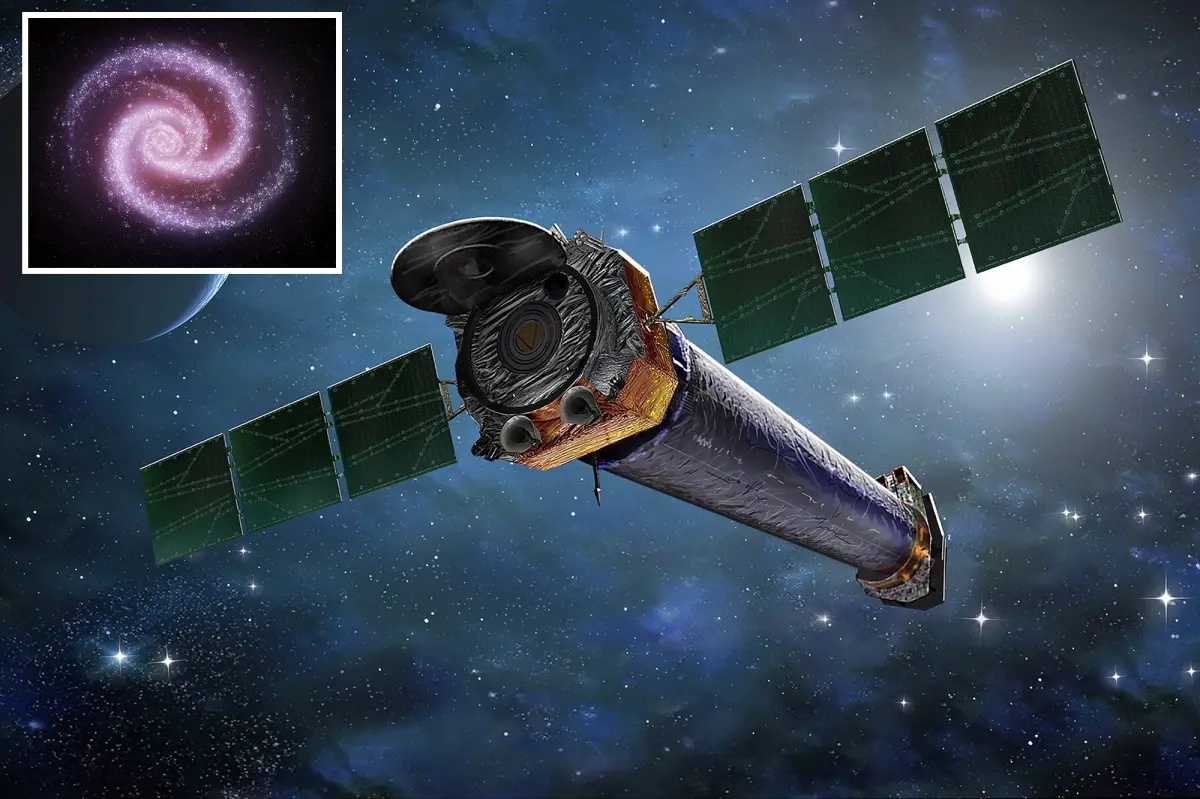

Astronomers say they have found new evidence that the Milky Way’s spiral arms may reach farther into space than scientists had previously recognized.
The team calculated highly precise distances to dust clouds embedded in the galaxy’s arms by using observations from two space-based observatories above Earth’s atmosphere: NASA’s Chandra, the most powerful X-ray telescope ever constructed, and the European Space Agency’s XMM-Newton.
To make the measurements, researchers used rare but extremely energetic gamma-ray bursts originating in faraway galaxies. As X-rays from those explosions passed through the Milky Way, a portion of the light scattered off dust clouds, forming measurable rings that allowed for unusually accurate distance estimates.
“This is a very direct way — relying only on geometry — to precisely measure distances to the Milky Way’s spiral arms,” said Beatrice Vaia, the Italian PhD student who led the study. “Most other methods rely on assumptions about how the Milky Way rotates, which become increasingly uncertain in the outer regions of our galaxy.”
Based on the team’s data, the dust cloud located in the Milky Way’s farthest known arm was estimated to span roughly 3,500 light-years.
Scientists have known for at least 100 years that the Milky Way has spiral arms, but charting their full extent has remained a major challenge because Earth sits within one of those arms.
This new use of gamma-ray bursts, however, offers a way around that limitation, potentially reshaping how astronomers map the galaxy and understand our place within it.

“The differences are small, but any revision of these distances is important because they are so fundamental for understanding our galaxy,” said Ilaria Fornasiero, a PhD student and co-author on the study. “For example, this could mean that astronomers have to revise estimates of the mass of the galaxy, because that affects how wide the arms stretch.”
The only downside to the technique is that suitable gamma-ray bursts are extremely rare.
Researchers have found only a handful over the past 25 years that were bright enough and positioned in a way that allowed them to measure the Milky Way’s spiral arms.
“We will continue to be on the lookout for more,” said co-author Andrea Tiengo.