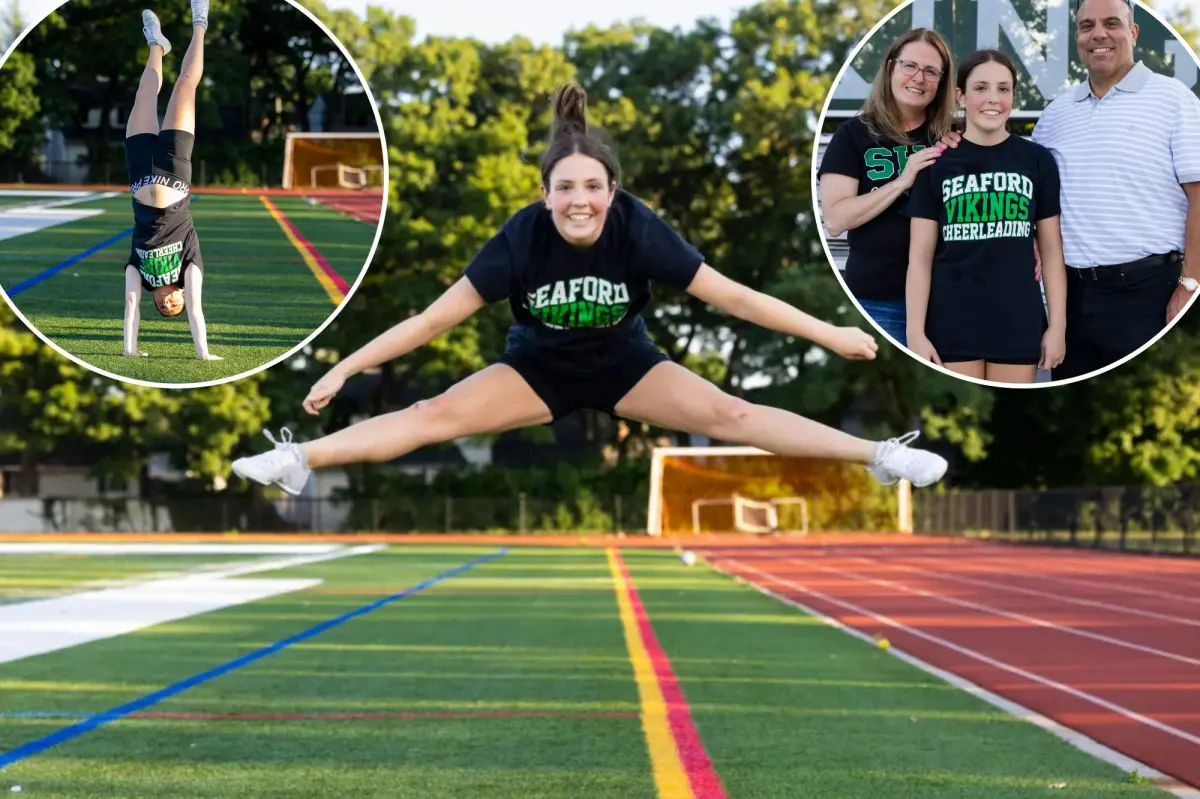
Christina Louca has shown remarkable courage — and a strong heart in more ways than one.
During her sophomore year, the Seaford cheerleader and runner was blindsided by a diagnosis of Wolff-Parkinson-White Syndrome, a heart condition that, in severe cases, can put the 16-year-old at risk of a heart attack.
“I had never gone through anything like this before and never had health issues in the past,” Louca told The Post.
Reflecting on the February diagnosis, she said she was “really shocked” and understandably anxious.
The frightening discovery came as a complete surprise to Louca and her family, especially because a standard physical had shown no warning signs of the condition.
Her condition was detected only after an EKG was performed through the Seaford school district’s free cardiovascular screening program, which was offered to more than 200 student-athletes.
“At first, I didn’t really think I needed to go,” Louca said. “I felt healthy, I’d never had any problems, so I wondered why it was necessary.”
Ultimately, Christina agreed to take the brief screening after encouragement from her mother, Tricia — a decision that may have saved her life.
Louca was able to keep competing in her sports on the condition that a portable defibrillator was on site and, in May, had a catheter ablation that corrected her issue.
She’s already back doing jumps at summer cheer practice.
“I never have to worry about it again,” said Louca, a rising junior who wants to pursue nursing.
“I feel super grateful because now I’m safe. … I’m just grateful I have this opportunity to live my life.”
Efforts not in vein
Louca learned throughout the ordeal that she was one of many young athletes with a heart condition hiding in plain sight.
The EKG she had was coordinated by two local moms whose athletic sons died from similar cardiovascular conditions.
They turned pain into purpose by launching Heart Screen NY and visiting schools across Long Island to test kids at no cost.
“We’ve screened over 8,000 children,” said Karen Acompora, who lost her high school-aged son, Louis, more than two decades ago when a lacrosse ball struck the Northport native in his chest. “We have about 166 findings.”
Acompora runs Heart Screen NY with Melinda Murray-Nyack, whose son, Dominic, had a cardiovascular episode while going for a layup at Farmingdale State College — after she lost her husband to a heart attack.
“It feels like we’re doing something right if we could send a child home to their parents,” Murray-Nyack said. “But it just can’t just be us doing what we do.”
Nobody understands that better than Louca and her mom, both of whom have become major advocates for the screenings.
“It can definitely save lots of lives in the future,” Louca said.
“My story could be very common for someone else, and I feel like if they see me, who found this out, they’ll be like, ‘Oh, if she had it, I could possibly have it.”
A heartwarming cause
Louca is partnering with the Connor Kasin Memorial Foundation, named for the nearby Massapequa hockey star who died during a 2024 charity game. Connor had a heart condition he and his family were unaware of that was also undetected in physicals.
The foundation’s goal, and that of Connor’s parents, Craig and Mary, is to pass Connor’s Law in Albany, making EKGs mandatory for student-athletes in New York through a bill introduced by local assemblyman Michael Durso.
“Maybe nobody else will have to experience the death and loss as Mary and Craig experienced,” Tricia said, calling it “a new mission” to work with the family one town over.
“It’s just a couple stickers, a five-minute EKG, and it could definitely change lives and keep many lives here.”
Connor’s story deeply resonated with Christina when she heard that he was similarly unaware of the fatal arrhythmogenic right ventricular cardiomyopathy in his heart.
“That’s why I feel like we should spread more awareness to it,” she said, “so something like that doesn’t happen to other people.”
Louca will be speaking at a foundation gala Aug. 6, sharing her story as living proof that teenagers should get screened.
“This is a perfect example of why we need Connor’s Law. If they didn’t happen to have a test here at the school, who knows?” Craig said of Louca’s heart exam.
Connor’s mom agreed.
“The EKG works,” Mary said, “and she’s going to have a great life ahead of her.”