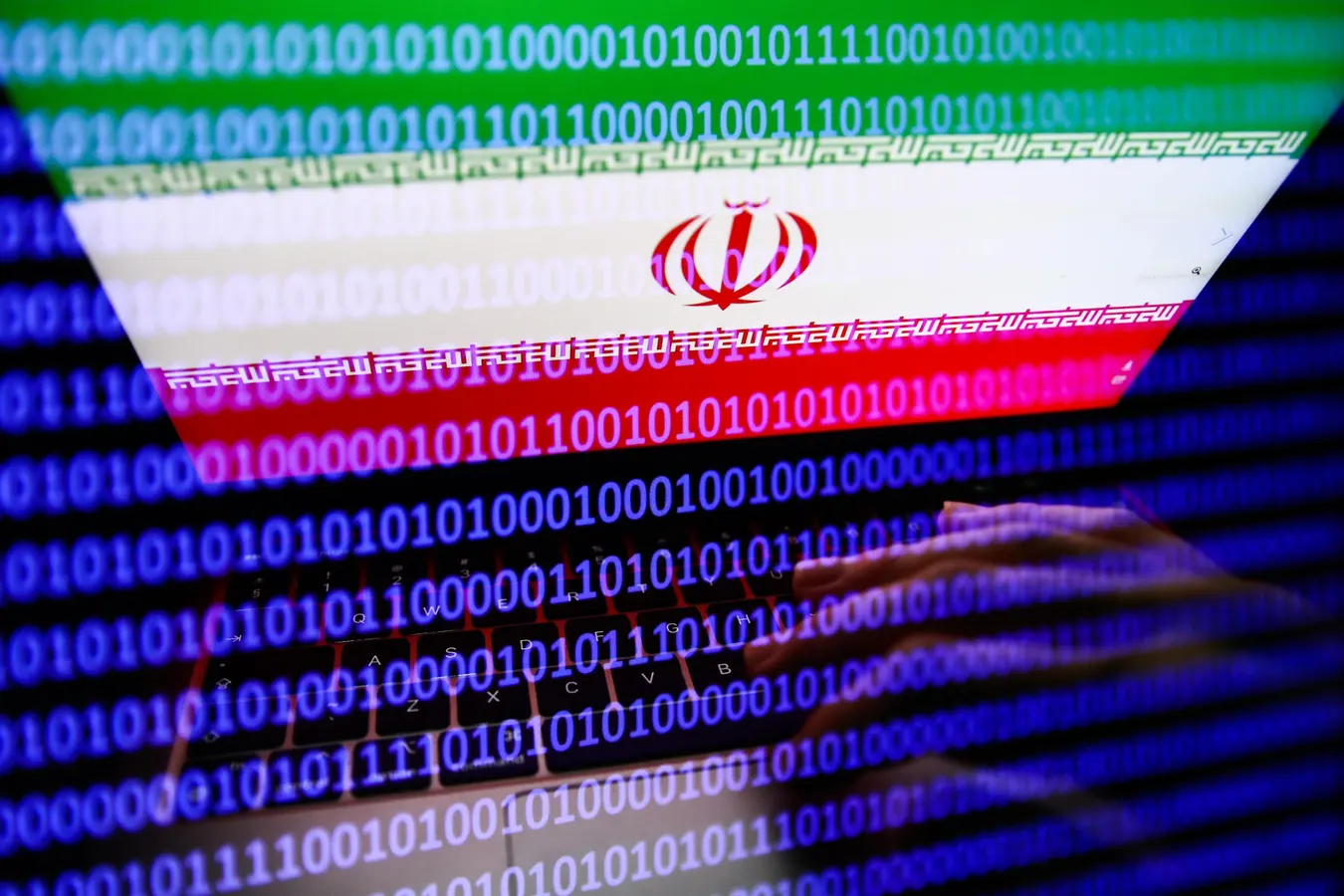


An image illustration shows the Iranian flag on a laptop screen alongside binary code, photographed in Krakow, Poland, on September 27, 2022. (Photo by Jakub Porzycki/NurPhoto via Getty Images)
NurPhoto via Getty Images
In December 2025, Russian state-backed hackers launched destructive “wiper” malware at Poland’s power grid, striking the digital connections between wind and solar farms and their distribution operators. The attack also hit two heat-and-power plants that serve about half a million homes. This was not a symbolic cyber operation or a distant military tactic. It was an effort to threaten ordinary Polish households with darkness during a winter cold snap.
That kind of attack illustrates a larger and increasingly urgent problem: as hostile governments turn malicious software against centralized power systems, global conflict is no longer confined to battlefields or government networks. It can reach directly into living rooms, kitchens and children’s bedrooms. When the public grid becomes part of the conflict zone, household energy security stops being an abstract policy concern and becomes a deeply personal risk.
For decades, the clean energy movement has often focused on persuasion—winning public support through arguments about climate change, pollution and long-term savings. But the force now accelerating interest in decentralized energy may be something far more immediate: fear of an unreliable and vulnerable grid. Rooftop solar panels and home batteries are increasingly being viewed not only as green technologies, but as tools for resilience in an age of cyberwarfare, geopolitical instability and shifting domestic politics.
That evolution marks a major change in the public meaning of clean energy. Solar panels on a roof and batteries in a garage once signaled environmental commitment or a desire to cut utility bills. Today, they can also represent a form of self-protection. In a more volatile world, distributed clean power offers homeowners a measure of control when outside forces threaten the basic systems they depend on.
“My premise is that many people don’t care at all about solar-plus-batteries being clean, or aren’t concerned at all about climate change. To them, it’s about having control and taking care of themselves and their families,” Alexis Abramson, dean of the Climate School at Columbia University, told me in an interview.
To grasp how significant this shift has become, it is worth looking at the longer history of the movement and how its priorities have changed over time.
It’s About Self-Defense
Alexis Abramson, dean of Columbia University’s Climate School
Colombia University
Abramson authored an essay in Time, in which she chronicles the development of the environmental movement. The first era, which spanned from 1970 to 2010, was defined almost entirely by values and moral imperatives. While it inspired a highly dedicated minority to champion ecological stewardship, solar energy still accounted for less than 0.1% of U.S. electricity generation after 40 years.
The second era was driven purely by market economics. Kicked off by the Investment Tax Credit in 2006 and supercharged by the 2022 Inflation Reduction Act, this period focused on driving equipment costs low enough for mass commercial adoption. By 2024, solar made up over 80% of all new electric generating capacity added to the grid, according to federal energy regulators.
Today, we have entered the third era, governed by a deep psychological need for control, set against the backdrop of aging grid infrastructure and a volatile international landscape. Consumer behavior reflects this anxiety: According to SolarTech’s “The State of Solar in 2025,” nearly 78% of U.S. homeowners express concern about grid reliability, and 64% explicitly state that recurring blackouts make them more likely to adopt solar within five years—concerns that, per Abramson, have deepened further amid renewed hostilities with Iran this year.
The threat is no longer confined to digital battlefields across the ocean; it is playing out on domestic soil. Federal agencies, including the FBI, EPA, and the Cybersecurity and Infrastructure Security Agency, have issued urgent warnings regarding active targeting of U.S. critical infrastructure by Iranian-affiliated threat groups like the Cyber Av3ngers.
For the average property owner, the risk isn’t a massive explosion at a distant power plant—it is the sudden, frustrating loss of basic services. When hackers disrupt the digital valves and controllers of local utilities, the immediate result is the water tap abruptly running dry, toilets failing to flush, or the lights going out.
These state-sponsored attacks have evolved from simple website defacements to the active exploitation of internet-facing operational technology in the water and energy sectors, forcing workers at compromised facilities—such as a regional municipal water authority in Pennsylvania—to abruptly disconnect from digital dashboards and manually operate critical physical pumps in 2023. When U.S. jurisdictions cannot fully shield baseline local infrastructure from foreign digital intrusion, consumers begin searching for a fail-safe option they can control.
Selling Resilience, Not Just Sustainability
Arvin, CA – April 16: Solar panels as part of the Pastoria Solar Project during a tour of the Pastoria facilities on Thursday, April 16, 2026 in Arvin, CA. (Eric Thayer / Los Angeles Times via Getty Images)
Los Angeles Times via Getty Images
This sense of vulnerability is changing how the energy sector pitches its services. Centralized utilities and green energy developers alike are finding that appeals to environmental ideals no longer carry the same weight as promises of resilience.
“Our goal is 100% clean energy, period. But it is not what we are talking about right now. Rates are going up. The rate of increase is outpacing inflation, and state leaders in red and blue states are feeling the heat,” says Heather O’Neill, CEO of Advanced Energy United, in a previous column written by this author. In other words, economics favors renewable energy—topped with climate benefits and greater energy security.
To be sure, the clean energy environment has grown increasingly hostile. The residential solar tax credit officially expired at the end of 2025, sharply driving up upfront capital requirements for homeowners. Concurrently, the Trump Administration has aggressively doubled down on fossil fuel production under its national energy priority frameworks, rolling back clean energy regulations and tax benefits, while prioritizing coal and natural gas capacity.
Yet, consumers are still buying in. While reports from the think tank Energy Innovation warn that rolling back clean energy regulations could cost American households a staggering half-trillion dollars in higher utility bills by 2040—a finding the group published just this month—the financial logic still holds. Rooftop solar systems pay off in three to 12 years, followed by decades of free electricity.
Furthermore, forward-thinking states are bypassing federal friction. California and Maryland now require automated, near-instant permitting for rooftop solar, and Florida uses private virtual inspections that can speed approvals in cooperating counties—all aimed at removing the installation hurdles that once took weeks.
The reality is that micro-level moves are dictated by macro-level events. “People want control over their energy to reduce anxiety about global issues they cannot influence,” Abramson notes. “Global instabilities are affecting individual decision-making.”
She notes that her broader mission focuses on equity: “I think the most important thing we can do is provide energy resources to the people who need them, helping them lead better lives. I don’t shy away from the climate piece, though; to me, this has more to do with energy prosperity than anything else.”
Ultimately, the mass adoption of distributed green energy is losing its emotional, idealistic veneer. As international cyber warfare and domestic political swings compromise the grid’s reliability, the rush toward rooftop solar and battery storage has morphed into something entirely practical. It has become the ultimate expression of personal independence and self-preservation in a chaotic century.
SEE ALSO:
Why The AI Grid Is The New Battlefield
Green Energy’s Back Door
Russia’s Grid Warfare Isn’t Confined To Ukraine