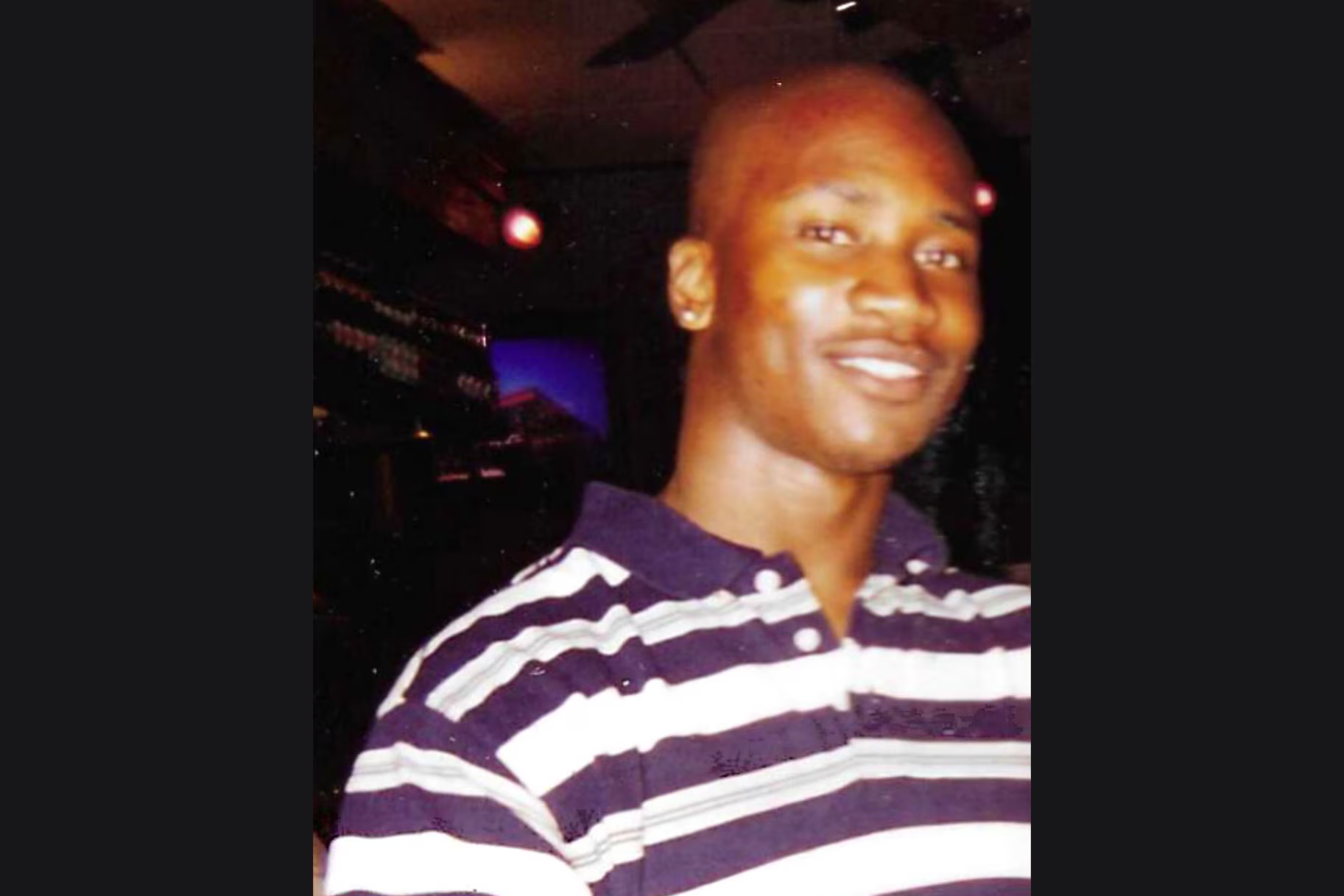
Fulton County Police Officer Aaron Blount was close to wrapping up his shift when he noticed a car moving erratically and made the decision to step in. At 26, he was a new father, a fiancé and a dedicated volunteer who had built his life around service.
Within minutes, that routine moment would turn deadly.
Blount’s fate was not uncovered until shortly after 10 p.m. on April 22, 2003, when fellow Fulton County Police Officer Reginald McCain came upon a troubling scene while patrolling his beat in Georgia’s South Fulton County.
“I’ll never forget what I saw that night and what I discovered when I approached that car,” McCain said in the Season 4 premiere of Oxygen’s The Real Murders of Atlanta. “I saw a police car with the blue lights on in the distance. This car’s off the roadway into a brushy area near some railroad tracks.”
McCain soon realized the cruiser belonged to Blount, his adjacent beat partner and friend. As he moved closer, he saw that the vehicle’s windows had been shot out. Inside, Blount was slumped over with his gun still in his hand. He had been shot multiple times in the body and head.
In the days after the killing, investigators worked to piece together Blount’s final movements. Their search eventually led them to a suspect with no prior criminal history, who would later present an unusual defense.
Who Was Aaron Blount?
For those who knew him, the loss was especially painful because Blount had deep roots in the very community where he died. He had grown up less than a mile from the scene and was devoted to giving back, both through police work and by coaching and mentoring young people on the basketball court.
“Aaron definitely was a community guy,” his fiancée, Nicole Manns, remembered, “and that was important to him to kind of give back to where he grew up.”
Blount—a one-time student at the Naval Academy—was also eager to make a difference in the life of his own 13-month-old son, A.J., whom he shared with Manns.
As she explained, “He was an amazing father.”
What Happened to Aaron Blount?
On the evening of April 22, Manns was waiting for Blount to get off work.
“I knew he would be coming home soon and I called him and he said, ‘I’m on my way home,’” she recalled. “And he said, ‘Hey, this guy is driving crazy in front of me, I’m going to call you back.’”
It would be the last time she ever spoke with her fiancé.
Later that night, McCain made the grisly discovery along the roadway and called for backup. Former Fulton County Police Officer Charles Cook—the squad’s medic—was one of the first to arrive.
“Aaron was covered in blood on his head,” Cook recalled. “He had what appeared to be a bullet in the back of his shoulder and shirt. This is when I noticed Aaron had his gun out [and] had his finger on the trigger.”
Though he was rushed to Atlanta’s Grady Memorial Hospital, Blount did not survive.
“I just broke down and I started crying,” former Fulton County Police homicide detective Glenn Kalish remembered of hearing the news. “Not just for Aaron and the rest of the Fulton County Police Department, but I felt a lot of personal pressure on me being assigned this case and the weight of the case.”
Investigators Piece Together Final Moments of Aaron Blount’s Life
As detectives began to their investigation, they learned that there had been multiple 911 calls that night about a silver vehicle driving erratically not far from the murder scene.
They were also surprised to discover a handgun laying on the ground in the parking lot of a gas station, just across the road from where Blount’s vehicle had come to rest.
They came to believe that Blount had been following a car down the roadway when the driver hopped out at the gas station and waited for Blount to come around the corner, then fired directly into his vehicle, before setting the weapon down and fleeing the scene.
Injured, Blount likely took his foot off the brake, causing the patrol car to roll across Roosevelt Highway into the grassy area by the train tracks.
An eyewitness who had been driving by the gas station also came forward to share what he knew about the fatal shooting.
“We see the police got his lights on at the gas station,” the witness told police. “And as I was approaching the light, I heard a gunshot. And I saw a guy standing…at point blank range shooting through the window.”
According to his account, the shooter then turned and calmly walked away before getting into a silver Ford Focus.
He described the shooter as a larger Black male, around 6’2” tall and around 250 pounds or more.
Though the medical examiner was able to connect the weapon found at the scene to the bullets in Blount’s patrol car and body, a second gun had been used to deliver the shots to his head, leading investigators to believe the cold-blooded killer had used two separate weapons.
Kenneth G. Reese Emerges As Suspect in Aaron Blount’s Death
Investigators caught another break in the case when they learned the weapon that had been recovered at the scene was registered to Kenneth Reese.
Though authorities initially believed the weapon was linked to a fire department captain and arson investigator with a stellar reputation—sending shockwaves through the law enforcement community—they learned after speaking with Kenneth that he had a younger nephew with the same name, who often went by the nickname “Little Kenny.”
Little Kenny had no criminal record, but did own at least one firearm. Even more telling, investigators were able to link him to a silver Ford Focus rental car. Yet, according to Little Kenny’s family, he had gone to Florida and now appeared to be on the run.
“He came from a good family,” former homicide detective Melvin Dean said. “A real solid family in the community.”
Little Kenny’s grandmother was the first Black woman to own a gospel television network and his father was a professional wrestler turned celebrated minister. But when Little Kenny lost his father just one year before Blount’s death, those close to him say his life began to fall apart.
“His father’s death was such an impact on him,” a family spokesperson shared. “He was grieving so bad that he could not handle coming to his father’s funeral.”
According to the spokesperson, Little Kenny started carrying a gun and began showing signs of paranoia, believing that someone may be following him.
Who Killed Police Officer Aaron Blount?
Five days after Blount’s murder, Little Kenny was taken into custody by the U.S. Marshals at a bus station in Miami and was charged with first-degree murder.
The district attorney announced that he was planning to seek the death penalty, but before the case could go to trial, his defense team came forward with evidence that he had been taking the diet drug ephedra—later banned by the FDA—which they argued had impaired his mental state.
After state psychiatrists also concluded that Little Kenny may have been suffering from drug-related psychosis at the time of the shooting, prosecutors decided to offer him a plea deal.
In exchange for removing the death penalty, Little Kenny agreed to plead guilty and was sentenced to life in prison without the possibility of parole.
Blount’s family—including Manns and his now adult-son A.J.—continue to keep his memory alive.
“I want the people in Atlanta to remember that he protected his community. He protected his family,” Manns said. “He was just…a really good guy, a great dad, a great partner, a great friend, and I think they would be proud and should continue to be proud of him.”