
New York City’s Legionnaires’ disease investigation has widened, with more than 40 additional buildings now linked to positive tests for the potentially deadly bacteria behind the outbreak.
Although the pace of new Legionnaires’ disease cases appears to be easing, health officials reported three more infections on Tuesday, raising the citywide total to 63. The illness, a serious form of pneumonia tied to inhaling contaminated water vapor, is fatal in about one in 10 cases. Twelve patients are currently hospitalized.
Last week, officials had named 31 buildings as possible sources of Legionella, the bacteria that causes Legionnaires’ disease. By Tuesday, that number had grown sharply, with 45 more locations added and 76 buildings now confirmed to have tested positive.
A building’s appearance on the city’s list means one or more of its cooling towers tested positive for Legionella bacteria.
The move marks a first for New York City during a Legionnaires’ outbreak: health officials have publicly released the names of buildings in the affected area whose cooling towers—systems that emit fine water mist into the air—were found to contain the pathogen.
The affected properties are spread across the 10128, 10029, 10075 and 10028 zip codes, covering parts of Manhattan’s Upper East Side, Yorkville and Carnegie Hill neighborhoods.
Authorities had initially flagged 10075, 10028 and 10128 as areas of concern after determining that nearly all confirmed patients either lived in, worked in or had recently spent time in those neighborhoods.
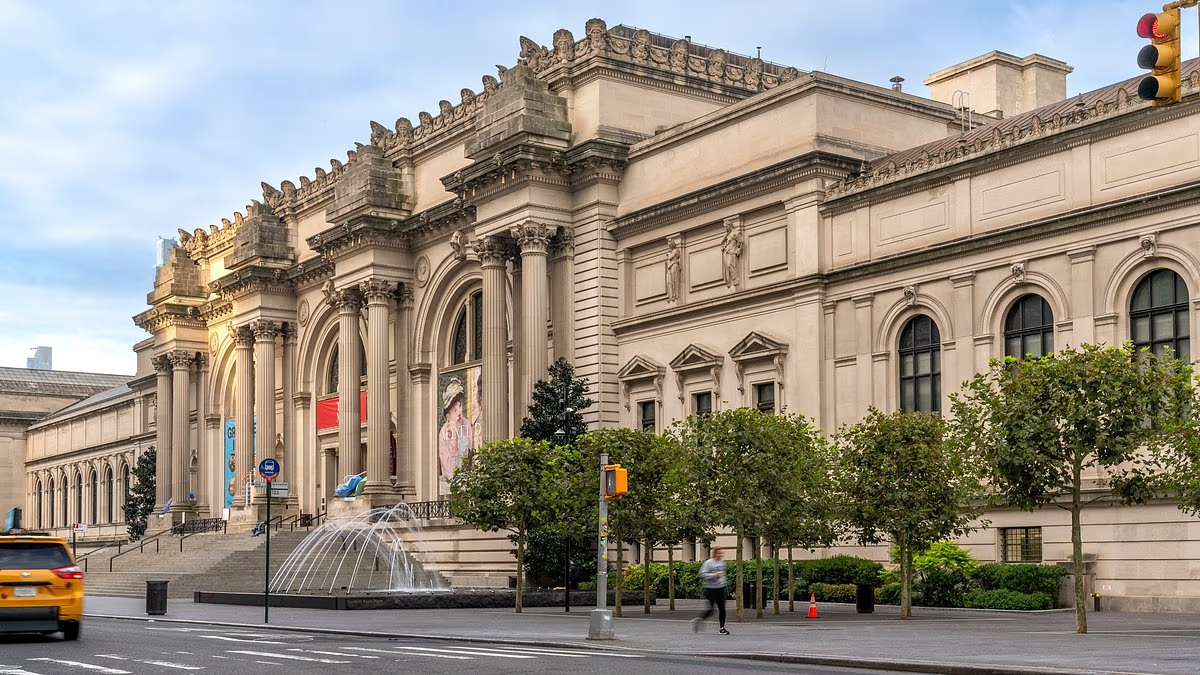
Among the notable sites named are The Metropolitan Museum of Art, the Guggenheim Museum, The Spence School, an elite private school with annual tuition nearing $70,000, a building that houses a Whole Foods Market at street level, Gracie Towers, a residential property across from the mayor’s official residence, and a fitness facility.

Of note among the buildings that have tested positive for the presence of the type of bacteria that causes Legionnaires’ disease is The Metropolitan Museum of Art

A case was first recorded on June 27 and an outbreak was suspected earlier this month as additional cases were reported
Most other addresses on the list are standard apartment, condo or otherwise residential buildings.
NYC Health officials said that ‘every building identified has been ordered to clean and disinfect its cooling tower immediately out of an abundance of caution.’
Hi, I’m Emma Bardwell, a nutritionist with more than 15 years’ experience helping people improve their health and lose weight.

I’ve been there. I was overweight, unhappy with my skin and stuck in a rut. Then I changed the way I eat. You can now do the same with my tried-and-tested healthy eating plan. And for DailyMail+ subscribers, it’s completely free.
Click here to sign up and start your journey
Officials added that additional testing is being conducted and more buildings may be added to the list.
Regardless of a positive test, only live Legionella bacteria can cause illness, so more in-depth testing is being done to determine if live Legionella were present when the samples were collected.
Those results can take up to two weeks.
Now, following new emergency orders from Mayor Zohran Mamdani, the owners of buildings whose cooling towers tested positive must clean and disinfect those towers immediately – rather than waiting for the live testing results to return.
A case was first recorded on June 27 and an outbreak was suspected earlier this month as additional cases were reported.
Legionnaires’ disease is caused by the Legionella bacteria that thrives in warm and damp locations. It can become airborne in water vapor and then be breathed in by people, potentially triggering an infection.
Common sources for the Legionella bacteria include centralized air conditioning systems, hot tubs, water fountains and large building plumbing systems.
Officials said it is safe to use air conditioners and cooling centers in the affected zip codes. It is also safe to shower and drink tap water and ‘there is no additional risk being inside one of these buildings.’
The disease does not spread person-to-person.
Infected patients initially suffer from a headache, muscle aches and fever, before the disease also triggers a cough, shortness of breath, chest pain, nausea, vomiting, confusion or other symptoms.

Of note among the buildings that have tested positive for the presence of the type of bacteria that causes Legionnaires’ disease is the Guggenheim Museum

Cooling towers and air conditioning units are seen in the Harlem neighborhood of Manhattan last year amid a Legionnaires’ disease outbreak in the area
In severe cases, patients can suffer from severe pneumonia and the potentially fatal complication sepsis, when the bacteria spreads to the blood.
Doctors can treat the disease using antibiotics, but say that these drugs are most effective during the early stages of the disease and before its spread in the body.
Those who are over 50 years old, smoke or vape, have a chronic lung disease or a weakened immune system are at higher risk from the bacteria.
Nationwide, infections with Legionnaires’ disease have soared over the last two decades, rising from about 1,100 cases in 2000 to more than 8,000 today.
New York City records between 300 and 600 cases every year, according to data from the city’s health department.
In August last year, seven people died and 114 people were sickened by a Legionnaires’ disease outbreak in Harlem. Ninety people were hospitalized.
Health officials linked the outbreak to the bacteria in 12 cooling towers across 10 buildings, including a city-run hospital and sexual health clinic.
About 90 percent of those infected had underlying risk factors, including being over 50 years old, being a smoker or having a chronic lung disease.