
A fraud network linked by U.S. authorities to some members of the Irish Traveller community is increasingly drawing scrutiny in America, where the FBI has described it as an organised crime group.
Investigators refer to the alleged network as the “Traveling Conmen Fraud Group,” also known as “Conmen Travellers,” and say it has been tied to a series of costly scams that have stripped some victims of huge sums — in certain cases as much as $1 million, including money set aside for their children’s college education.
The group’s alleged activities were pushed back into the spotlight this week after a man believed to be connected to the network was shot dead in Pennsylvania. Authorities have said he was in the U.S. unlawfully.
The alleged schemes, which span multiple states and involve construction fraud and money laundering, often appear to follow a familiar playbook: homeowners are persuaded to hand over hundreds of thousands for machinery, materials or repairs that are never properly delivered, with some properties reportedly left in even worse condition than before.
Victims who say they were targeted have described the aftermath as deeply traumatic, using words such as “humiliated,” “devastated” and “shattered.” Some have also said the experience left them fearful they could be found and victimised again.
While victims have been left counting their losses, alleged fraudsters have been accused of flaunting luxury lifestyles online shortly afterward, posting images of high-end jewellery and designer watches — including, in one instance, a 10-carat diamond ring.
Police said that last Wednesday, a British man suspected of links to the Conmen Travellers was fatally shot by an elderly Vietnam veteran at a Pennsylvania home where he had been carrying out work.
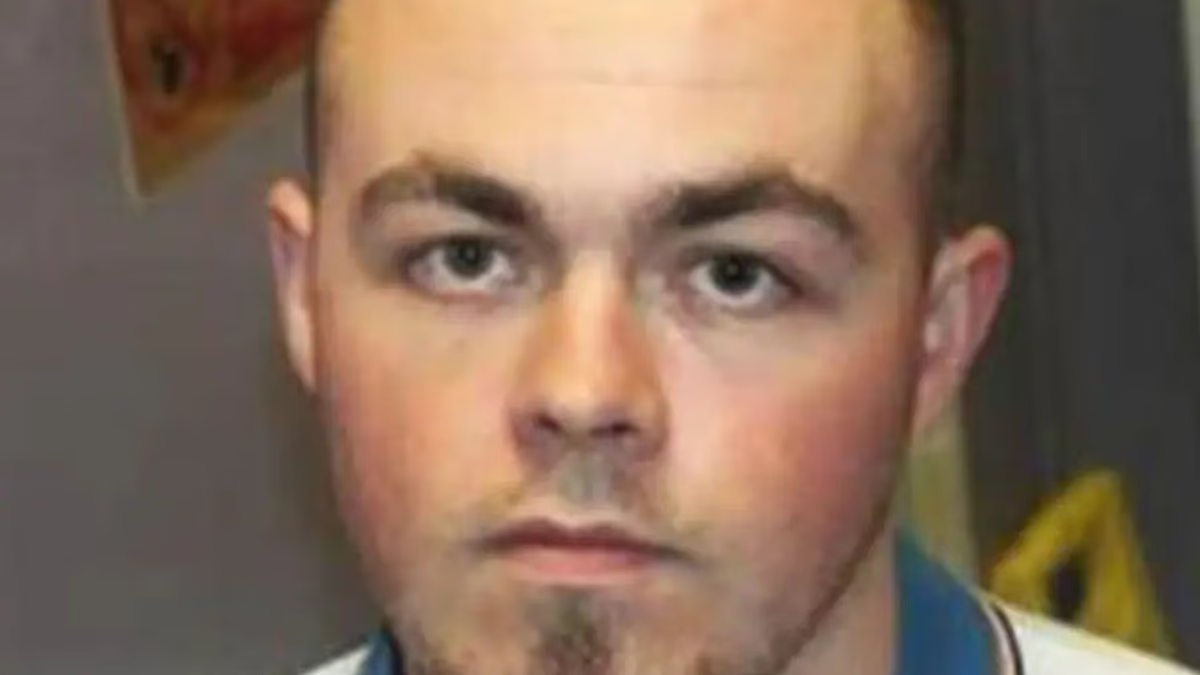
The man was identified as 20-year-old Salis Hanrahan, a member of the Irish Traveller community from Essex, England. He was reportedly part of a construction crew working at the home of George Barr when the shooting occurred, according to authorities.

Salis Hanrahan died last Wednesday after being shot inside a home in Philadelphia

Police said last week that contractors were out back putting siding on the home shortly after 2pm when a shot was fired from inside the home
Government officials confirmed to the Daily Mail on Wednesday that Hanrahan was in the country illegally and entered after being denied a visa.
Hanrahan was denied after officials determined he was affiliated with what they described as ‘The Travelling Conman Fraud Group’, a statement said. It is unclear where and when Hanrahan entered the United States.
The FBI says ‘Conmen travellers’ are groups of Irish or United Kingdom nationals who enter the US and travel from place to place soliciting construction work.
They frequently quote a low price, only to later demand much more money or convince the victims that their homes or businesses are in urgent need of major repairs.
The scammers often hire day labourers, lack work authorisation documents, do low-quality or unnecessary jobs, and sometimes damage properties, according to the FBI.
While police are making their best efforts to hunt down the scammers, they believe many more are still at large, in the US and elsewhere around the world.
FBI special agents receive phone calls every month from new, distressed victims, anxiously hoping to scrape back the money that was snatched from them.
Jane (not her real name) lost almost a million dollars to a scammer from Northern Ireland after she was approached at her New York home in the autumn of 2022 and asked if she needed any work done.

Within days, fraudsters are showing off expensive jewelry and watches on social media, in one case a 10-carat diamond ring

Darren Cunningham (who went under the name Patrick Dundon), disappeared after scamming Jane

One of James Dinnigan’s victims was Ginia Hines, who was scammed out of $50,000 (£37,000)
‘It’s not only humiliating and devastating and shattering – it also just crushes your soul,’ Jane told BBC Spotlight NI.
She described how a man with an Irish accent, who is understood to be called Darren Cunningham (then going under the name Patrick Dundon) began doing more construction than was agreed.
Cunningham demanded $65,000 (£48,000) for bricks, then never appeared again.
Jane claimed she contacted the brick seller, who showed her an invoice detailing that the bricks had cost only $25,000 (£18,600).
But the scam was far from over.
Another man – who the BBC has traced back to Northern Ireland – then turned up at her door.
‘He said the work on the driveway will get done, but everything’s on hold because there’s still this big issue that they have to take care of,’ Jane said.
‘He seemed like he was trying to be the responsible business partner.’
Jane eventually realised how wrong she had been.
She said the man told her he required $200,000 (£140,000) as a loan.
She also alleged he warned her children’s safety might be at risk if she did not hand over the money.
The woman subsequently wrote three cheques with the promise that the cash would be back with her by the following Sunday – but it was never returned.
In a desperate bid to get back what she had lost, Jane said she committed further funds.
‘He told me that I had to transfer the money to the parent construction company, Troy Construction.
‘Only last minute did he make the switch and say it’s actually going to be another company that’s like a front for Troy Construction and then he sent me the information of where I am supposed to send the money to,’ Jane said.
In reality, Jane had unknowingly transferred the money to an expensive jeweler on 47th Street in New York, the centre of what is known as the Diamond District.
Within mere days, the man’s family were flaunting flashy jewelry on social media, including a 10-carat diamond.
‘Lots of other jewelry, lots of watches that they all seemed so happy to flaunt,’ Jane said.
Several other victims were also told to send hundreds of thousands of dollars to jewelers in the Diamond District, according to the BBC’s investigation.
Ginia Hines was scammed out of $50,000 (£37,000) after trusting a man to work at her home in Connecticut.
The perpetrator, James Dinnigan, has defrauded victims of $1m (£747,000) in a string of construction scams.
Hines was persuaded to hand over her money to the Irish national, who introduced himself as the friendly ‘Charlie Ward’.
Hines says the scammer initially built rapport with her by pretending to be a Christian.
He would ask her things such as: ‘How’s your day going? Are you having a blessed day?’ Taking the time to win her over, he would often end conversations saying: ‘Have a blessed day, God bless you.’
But following 10 days’ work at a rate of $5000 (£3,700) a day, the state of Hines’ house had deteriorated.
‘They left my yard just a mud pile with all the boulders and rocks that they dug up from around the house,’ she said.
‘It had no value because they did something I didn’t need. It was no value – it was actually a negative.’
The money she lost could have been used to help her son through college, she told the BBC.
‘[The money] was very important. Single parent, head of household, doing this thing on my own,’ she said.
While Dinnigan was jailed, Hines did not get her money back.
Another victim, Michael Berard from Swansea in Massachusetts, was left bereft after losing $500,000 (£372,000) to fraudsters.
The perpetrators, who have since vanished, introduced themselves as Jack Murphy and George Adams.
‘These people took the money just as though they were John Dillinger or Billy the Kid,’ he said.
‘And they’re actually worse, cause when a guy points a gun at you, you know what you’re up against.’
After employing the pair for a small construction job, Berard said they informed him he had a crack in his foundation.
‘My whole adult life I’ve had struggles with anxiety, kind of walking the tightrope. At that point I think they sensed my anxiety and they said: “Mike, you’ve got a very big problem here. We need $15,000 (£11,000) right away.”‘
When Adams and Murphy convinced Berard that he would get his money back by suing the original builder of the property, he gradually handed over his life’s savings for unnecessary work.
‘They were like magicians. They were like Houdini and Copperfield and Blaine all rolled into one,’ he said. ‘What they said sounded so convincing.’

Elijah Gavin was jailed in November after pleading guilty to charges of wire fraud, conspiracy to commit wire fraud, money laundering, and making a false statement on a document used to gain entry into the US
As well as Dinnigan, other members of the Travelling Conmen are now in custody, including Elijah Gavin who was jailed in November.
He pleaded guilty to charges of wire fraud, conspiracy to commit wire fraud, money laundering, and making a false statement on a document used to gain entry into the US.
Gavin and his co-conspirators allegedly defrauded property owners in Rhode Island, Massachusetts, New Jersey, and New York over $1m (£742,000).
They misrepresented to property owners who they were, the qualifications of their construction businesses, and construction needs or repairs required on properties.
Co-conspirators billed property owners and collected funds for equipment that was not needed or used, according to US Immigration and Customs Enforcement.
One of the victims of this scheme included a 78-year-old Rhode Island woman who was fraudulently induced to pay over $850,000 (£631,000) for unnecessary foundation and basement repairs, including in checks written to Gavin and others.
Money collected through this conspiracy was transferred into bank accounts controlled by co-conspirators or deposited to other individuals who laundered the fraudulently obtained funds.
Gavin was sentenced to four years in prison.
As well as his prison sentence he has been ordered to make $1.1m (£816,000) in restitution.


