Each month, £14.95 leaves my bank account and heads straight to the BBC. I don’t resent it. The licence fee costs me more than Netflix, Amazon Prime or NOW TV, but I make heavy use of what the corporation produces.
For the fortnight of Wimbledon, my television was barely tuned to anything else. Like it or not, BBC news bulletins remain the ones I deliberately seek out. Then there is Question Time, The Traitors, the outstanding police drama Blue Lights and David Attenborough’s Secret Garden. These are programmes I would genuinely miss.
More recently, after the death of Penelope Keith, I have found myself revisiting old episodes of The Good Life on iPlayer and being reminded that Margo Leadbetter deserves a place among the great comic characters in British television.
So no, I am not claiming that this package of entertainment, sport, drama and news is poor value at around £15 a month. You will have your own list of BBC programmes that justify the cost, whether or not they overlap with mine.
What seems far less likely is that any of those favourites are being broadcast on the BBC Scotland channel.
Hardly anyone watches it. The channel has the air of a deserted Tube station glimpsed from a passing train: illuminated, maintained, but apparently serving almost nobody. You are left wondering why the power is still on.
According to figures in the BBC’s latest annual report, just one in eight people in Scotland watch the digital channel at any point during a typical week, despite its high-profile launch in 2019.
I am not part of that small audience — and, in all likelihood, neither are you. Yet over its first six years, more than £204 million in licence fee funding has been spent to keep this near-invisible station on air.
We can only guess at the running total for the full seven years. For reasons we will also have to guess at, the BBC did not publish the channel’s costs for 2025/26.

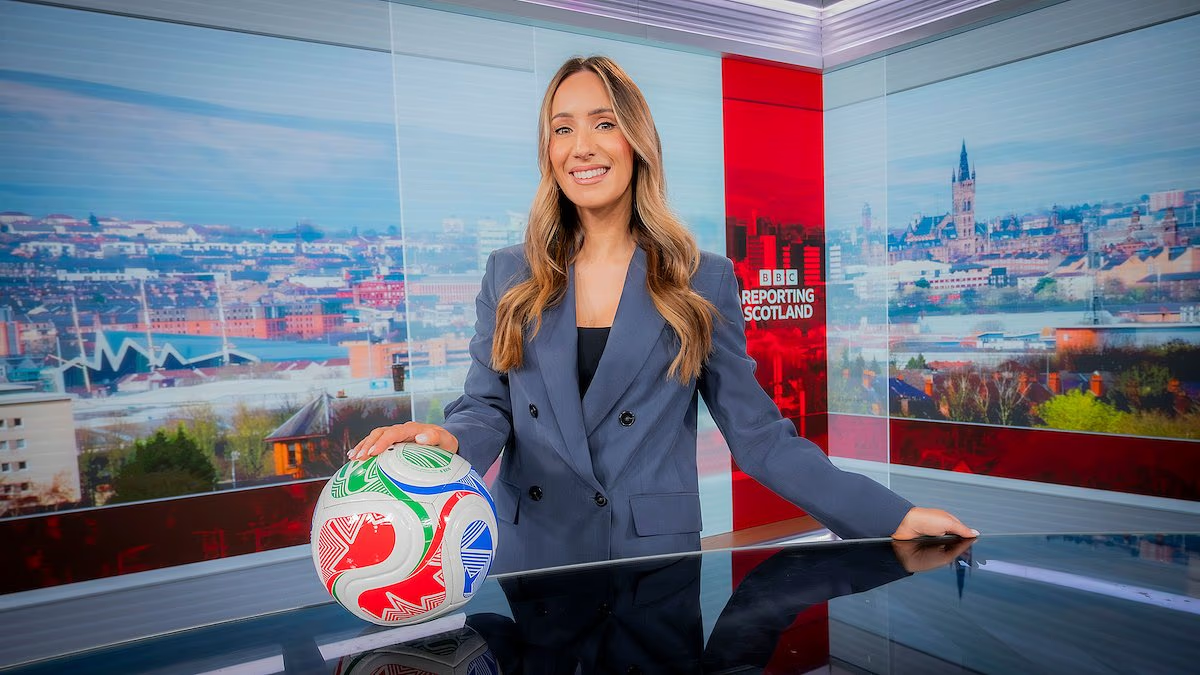
Amy Irons is one of the presenters who work on the BBC Scotland channel
You may be driven to wonder about the point of ploughing further millions into a corner of the corporation’s output that the viewing public has scant interest in exploring.
Is it a case of sunk cost fallacy, perhaps? The folly of throwing good money after bad because, well, we’ve come this far?
That may be part of the explanation. The humiliation of admitting the abject failure of this massive investment in Scottish content would be severe. But let’s face it, the writing has been on the wall from day one – back when I was a viewer.
Even then, on its opening night of February 24, 2019, the new channel was only the third most watched in Scotland after BBC1 and STV. Its audience share was just 13 per cent.
The premiere of the first episode of the final series of Still Game was broadcast that night and pulled in 700,000 viewers – to this day the highest figure any programme on the BBC Scotland channel has ever achieved.
And yet this still fell 600,000 short of the figure the sitcom routinely achieved when it was shown on BBC1 Scotland.
Since that underwhelming opening night, viewers have voted with their remotes. It was a ‘no’ from almost all of them. It was such a resounding ‘no’ that, within four months of the launch, 21 of its programmes registered as having no viewers at all.
That probably sounds worse than it really is. There would have been one or two watching. But we are talking about national viewership roughly on a par with attendance at your local community council or book club. There are Facebook posts about potholes in Plockton that get more traction.
Can sunk cost fallacy alone be driving the insanity of keeping this dead duck on life support? Of course not. The bigger driver is political terror.
The genesis of this channel is already well known to any Scot with even a passing interest in the constitutional question which underpins everything our party of government ever does or says.
It was conceived after a Nationalist mob marched on the BBC’s Scottish HQ on Pacific Quay in 2014 to complain about its then political editor Nick Robinson asking Alex Salmond a question that he did not care for.
How very dare he? This English journalist presuming to press a Scottish First Minister on a key issue relating to the biggest political story of the year.
I was always of the view the BBC should have told these idiots to go home and grow up. But no, they panicked and gave them a whole TV channel with a flagship nightly news programme called The Nine which lasted a whole hour.
You will note – or maybe you won’t because you haven’t had the BBC Scotland channel on since the last time you fell asleep and rolled over onto your remote – that The Nine is no longer with us.
At the time of its demise its viewership scraped along some nights with an audience share of 0.1 per cent. That’s around 1,700 souls. Its replacement was the 30-minute Reporting Scotland: News at Seven whose ratings plumb the same disaster zone.
But can the Beeb do the decent thing and pull the plug? Of course not – there would be uproar. Seething crowds would march around with effigies of BBC bosses on pikes proclaiming that the corporation had reverted to type, that it never gave a damn about Scotland, that it is Unionist to its rotten core…
The real reason our licence fees continue to fund this monumental waste of time, money and broadcasting talent is corporate cowardice. This is the price we pay for the BBC to make a show of walking the tightrope of impartiality here in Scotland. Through its own poor judgment in appeasing the 2014 mob it has now painted itself into an impossible corner.
It is here that I consider anew my monthly £15. Why should a single penny of it serve as protection money to buy off an SNP that will create merry hell if the BBC axes its Scottish channel?
I wouldn’t mind if any of their supporters watched the channel and valued what it is rather than what it represents, but they clearly do not.
There is no good reason why I should fund this absurdity. I am a licence fee payer with serious beef about the uses to which my money is put. But I am a pragmatist too. The BBC belongs in my life.
But others will look at institutional waste – and a plethora of others across the wider corporation – and reach a very different conclusion. Indeed, they are already doing so.
The number of British households paying for TV licences fell by half a million last year. Since 2019 the figure is down by 2.5million.
Who can blame them? By law, you cannot watch a single second of live television on any channel without funding the BBC’s corporate security blanket.
My guess is increasing numbers of viewers would rather flout the law than put up with this nonsense any longer.
I am also guessing – because the BBC has form here – that millions more will be sunk into defending an unworkable funding model when it is abundantly clear the lights should have gone out years ago.
j.brocklebank@dailymail.co.uk