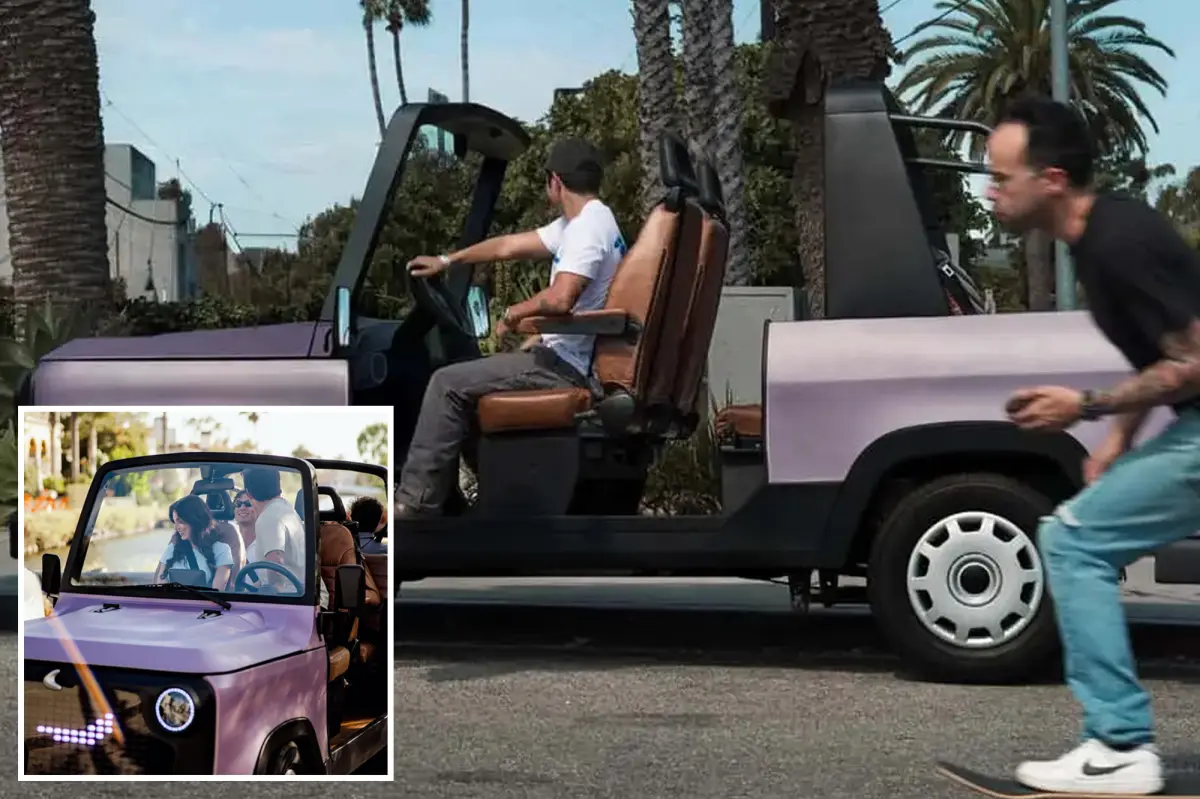

A $15,000 electric vehicle with a futuristic twist—one that can talk to its driver, stream television and handle parking on its own—might sound tailor-made for sunny California streets. There is, however, a major limitation: it is not allowed on freeways.
Chip Motors, a Miami-based company, has introduced its pint-sized “life utility vehicle,” a compact electric ride that resembles a toughened-up golf cart more than a conventional passenger car.
The small EV is aimed squarely at neighborhood travel and quick daily errands rather than long-distance driving.
With a maximum speed of 25 mph, the vehicle delivers an estimated 100 miles of driving range and can be plugged into a regular 110-volt home outlet or a quicker 240-volt charger.
In one demonstration, the built-in assistant tells the driver that about 40 miles of range remain, points out a fast charger three miles ahead on the right and asks whether it should reroute the trip while preparing the battery.
The smart system can also monitor the vehicle’s condition, including alerting the owner to potential problems such as a tire that is slowly losing air.
On the way home, the vehicle can connect with household devices too, asking whether the driver wants the living room air conditioning turned on and the garage door opened before arrival.
Its most eye-catching trick may be “Valet Mode,” a feature that allows the driver to get out and direct the empty EV to park itself—or, in some cases, send it back home without anyone inside.
The catch is that the Chip is not fully autonomous.
Download The California Post App, follow us on social, and subscribe to our newsletters
At launch in early 2027, remote human operators in the United States will control the empty vehicle using its onboard cameras and radar, and the feature only works when nobody is inside
The Chip is prohibited from driving on highways and freeways.
That makes it perfectly suited for neighborhood errands, school drop-offs, grocery pick-ups, and short local trips.
That also means it is unlikely to qualify for Gov. Gavin Newsom’s taxpayer-funded MyFirstEV rebate program, which is aimed at highway-capable passenger vehicles and trucks.
Tesla also does not receive the program’s special exemption for California-based Rivian and Lucid, leaving only base versions of the Model 3 and Model Y eligible under the pricing rules.


