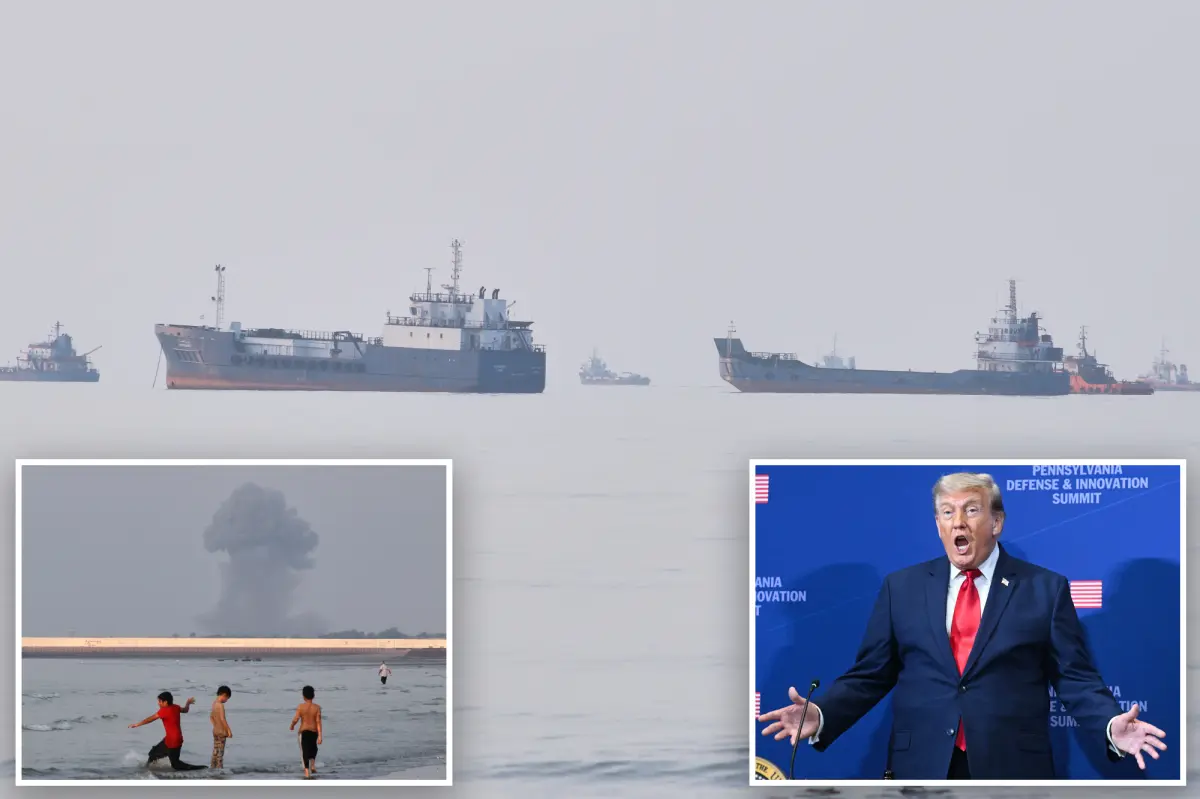

Frustrated sailors stuck in the Strait of Hormuz delivered a blunt rebuke to US forces after Washington offered vessels a protected route through the tense waterway amid repeated attacks linked to Iran.
“F–k off,” one crew member could be heard saying over marine radio in audio obtained by the Wall Street Journal, after the US military broadcast that the strategic strait remained open.
American forces had contacted ships traveling through the vital maritime corridor, urging them to use the Omani side of the Strait of Hormuz under US protection as a US blockade of Iranian ports went into effect Tuesday.
“US forces are prepared to maintain freedom of navigation and safeguard lawful commerce in accordance with international law,” the military said in the radio transmission, according to the recording.
“The southern route of the strait remains open,” the message continued.
The reply from at least one sailor was immediate and far less diplomatic.
Even as the United States continues striking Iran’s military infrastructure near the Strait of Hormuz, Tehran has reportedly kept up pressure on vessels attempting to pass through the crucial shipping lane without its approval, including warning shots and deadly attacks.
Maritime data firm Kpler reported that 21 ships crossed the strait on the blockade’s first day, but none chose the US-supported passage near Oman. Instead, 17 vessels traveled through the channel authorized by Iran.
One ship passed under a route approved by the International Maritime Organization, while the remaining three deployed shadow fleet tactics and sailed unseen through the strait.
Another 13 ships sailed through on Wednesday, with only a single ship, the Comoros-flagged Hero SD bulk carrier, traveling through the Omani route, according to Kpler.
Ten of the vessels, half of which are sanctioned due to their ties with Iran’s oil exports, traveled through the Tehran-approved route.
Maritime experts have previously warned that a majority of ships will not risk crossing the Strait of Hormuz under wartime conditions, especially so after Iran’s deadly attacks on vessels in recent days.
The US has said Iran had attacked seven commercial ships over the last week, leading to nearly a dozen crew members being killed, missing or injured.
But the US has proven some success in providing ships cover in the past, with more than 70 ships sneaking across the strait under American protection during the previous round of fighting.
That number, however, remains a drop in the bucket compared to the more than 130 ships that sailed through the oil choke point every day before the war.
Fully securing the Strait of Hormuz for safe travel would require far more military force and coordination than President Trump has been willing to deploy, Danny Citrinowicz, the former head of the Iran division of Israeli defense intelligence, said.
“The dilemma is quite simple: At the end of the day, if he wants to take control over the straits, he will need to take over the straits,” he told the WSJ. “He is not able to reach his military or strategic objectives with the force he has now.”
Brent crude oil remains stubbornly high above $84 per barrel on Thursday, about 22% higher than what it was a year ago.
The average price of gas in the US has also seen an uptick to $3.94 a gallon, about 10 cents higher than last week.