
A surge of hazardous wildfire smoke has pushed three major US cities to the top of the world’s worst air quality rankings, leaving residents breathing some of the most polluted air on the planet.
Detroit, Minneapolis and Chicago occupied the first three spots on IQAir’s live global list Thursday for major cities with the poorest air quality.
The dangerous haze is being driven by a dense plume of smoke from Canadian wildfires drifting south across the border.
Detroit led IQAir’s live global air quality ranking with a US Air Quality Index (AQI) reading of 566, making it the most polluted major city in the world at the time it was measured.
Residents described the air as smelling like “a bonfire that you can’t escape,” and said the smoke was making its way indoors.
Minneapolis followed in second place with an AQI of 289, while Chicago ranked third at 259. Under the US AQI system, any reading above 300 is considered “hazardous,” a level at which the air can pose serious health risks to everyone.
AQI readings from 201 to 300 fall into the “very unhealthy” category, with health officials cautioning that extended exposure can trigger harmful effects across the general population.
The US cities ranked ahead of places in South Asia, especially in India and Pakistan, where air quality is often among the worst globally and annual pollution averages can run 15 to 20 times higher than safe limits.

Detroit topped IQAir’s live global air quality rankings with a US Air Quality Index (AQI) of 566, making it the most polluted major city in the world at the time of the reading

Minneapolis ranked second with an AQI of 289
Officials have warned that wildfire smoke drifting into the US contains fine particulate matter, known as PM2.5, microscopic toxic particles small enough to penetrate deep into the lungs and enter the bloodstream.
State and local health officials in all three cities have issued air quality alerts, urging residents to limit time outdoors until conditions improve.
They recommend avoiding strenuous activities such as running, biking and yard work, staying indoors with windows and doors closed, and using a HEPA air purifier if available.
Residents are also advised to avoid burning candles or using fireplaces, which can worsen indoor air pollution, and to wear a well-fitting N95 or KN95 mask if they must go outside.
People at the highest risk, including those with asthma, chronic obstructive pulmonary disease (COPD) or heart disease, older adults, children, pregnant women and people with other chronic health conditions, are urged to avoid outdoor exertion altogether and follow prescribed medication plans closely.
The Southeast Michigan Council of Governments warned Thursday that the air quality alert has been extended into Friday, when pollutants are expected to range from ‘Very Unhealthy’ to ‘Hazardous.’
According to air pollution estimates, breathing the air in the Detroit metro area on Thursday was roughly equivalent to smoking a pack of cigarettes.
Dr John Frith of the Allergy and Asthma Institute of Southeast Michigan told FOX 2: ‘If you do need to go out, having a mask, potentially, the N95, the KN95 are some alternatives to that, just to minimize how much of that irritant you’re bringing in.

Chicago ranks third worst in the world at 259. On the US AQI scale, any reading above 300 is considered ‘hazardous,’ meaning the air poses serious health risks for everyone.

According to air pollution estimates, breathing the air in the Detroit metro area on Thursday was roughly equivalent to smoking a pack of cigarettes
‘Because that’s just trying to filter that out, so at least you can go do what you need to do. So taking a little bit of a break, less strenuous activity, things like that can also just minimize how that burden you’re putting on the airways can be helpful.’
Minnesota residents also reported feeling the effects of the smoke, with many saying they developed headaches after spending time outdoors.
Tammy Johnson wrote on Facebook: ‘Instant headache anytime I stepped outside, and then it would take 20 to 30 minutes to resolve [once] back in the house.
‘I have never experienced that before with wildfire smoke that we have had the last few summers.’

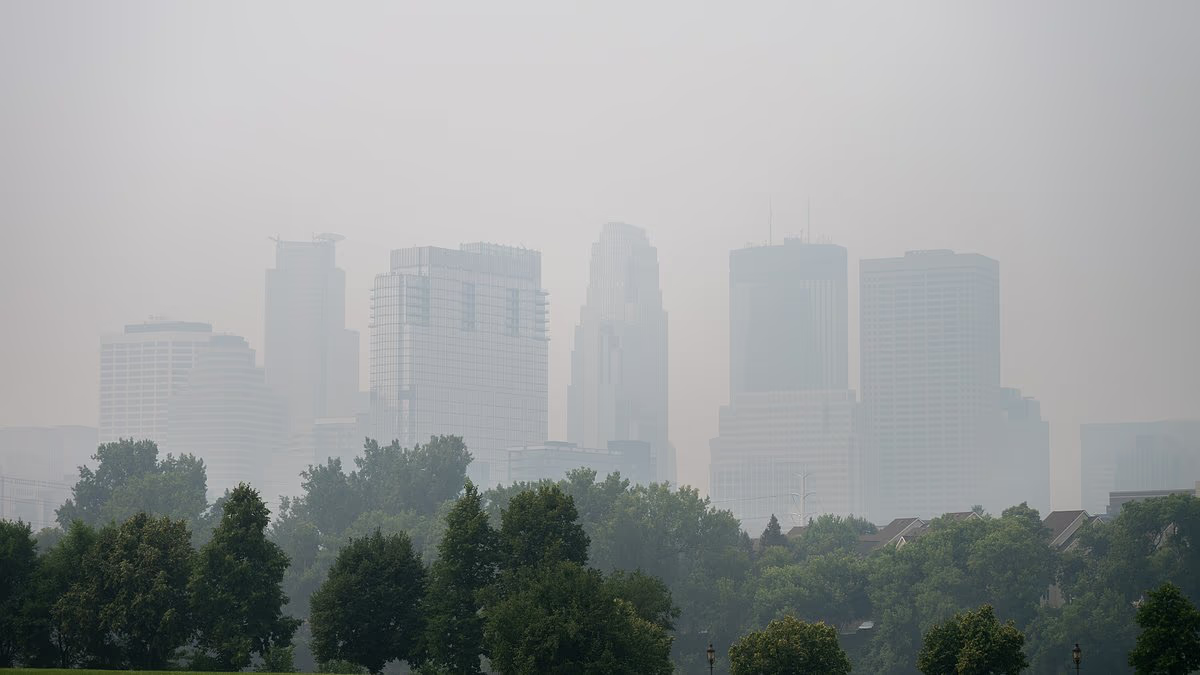
Skies over Minneapolis also appeared dark due to the wildfire smoke
Smoke from more than 100 wildfires burning across northern and western Ontario also blanketed the Chicago area.
Chicago resident Michelle Turner told ABC7: ‘This smoke that is in the air, it’s very irritating. You can hardly breathe.’
She said her eyes and throat had been burning throughout the day, even while wearing a mask.
Another local, Rachel Philips, wrote on Facebook that downtown Chicago had disappeared behind the smoke.
‘This is far worse than the summer two and three years ago,’ she said. ‘It hurts to breathe and I don’t have health issues!’