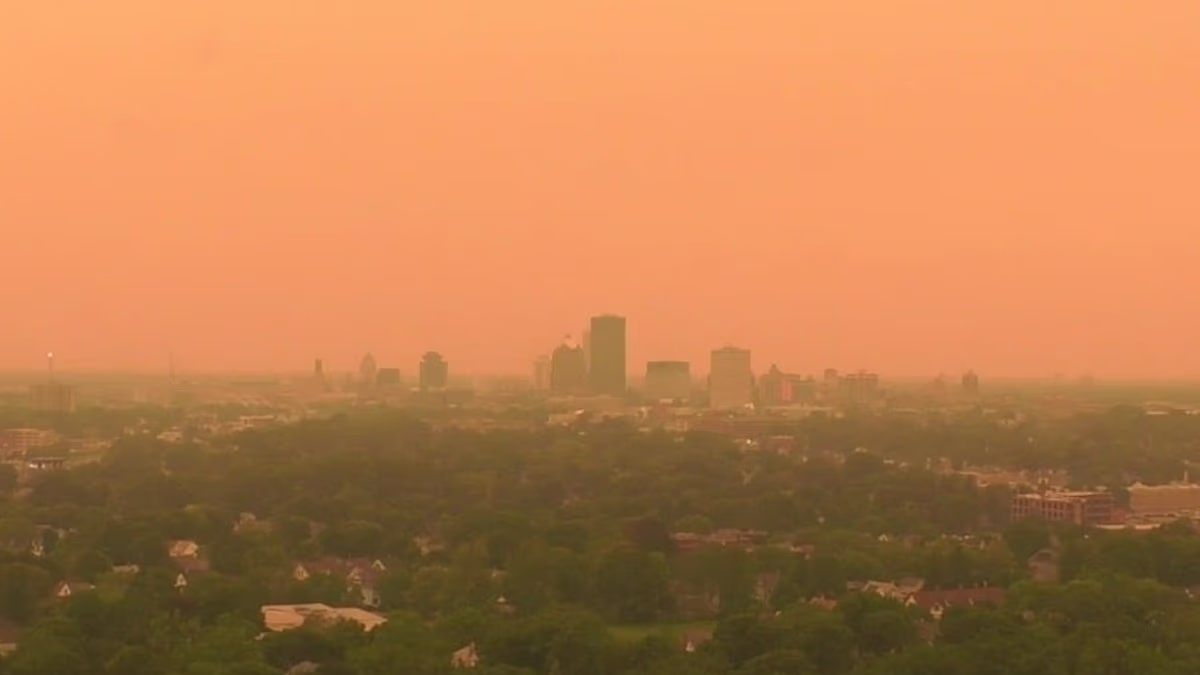


Millions of residents across the Northeast and Midwest are being told to remain indoors as dense smoke from Canadian wildfires pushes air quality into dangerous territory. Alerts are in effect in Connecticut, Illinois, Indiana, Michigan, New Jersey, New York and Wisconsin, where drifting smoke from large fires burning in Canada is filling the air with fine particulate pollution. Health officials say wildfire smoke carries PM2.5, microscopic particles made up of toxic compounds that are small enough to enter deep into the lungs and even penetrate human tissue, potentially triggering serious breathing problems. In some communities, air quality is expected to range from Unhealthy for Sensitive Groups to Very Unhealthy, and forecasters have cautioned that brief periods could reach the Environmental Protection Agency’s most severe category: Hazardous. Most alerts are scheduled to remain in place until midnight Wednesday, though Michigan and Wisconsin are expected to see hazardous smoke conditions continue through Thursday. Residents are being urged to cut back on outdoor time, avoid intense exercise and keep windows shut when possible. People with asthma, heart disease or other respiratory illnesses, along with older adults and young children, face the greatest risk. Several states are also recommending the use of air conditioning systems with high-efficiency filters and advising residents to watch for symptoms such as coughing, wheezing, chest tightness and burning eyes.
Smoke spreads as wildfires rage in Canada

The widespread warnings come as smoke from hundreds of wildfires in Canada continues to spill into the United States, affecting large population centers and rural areas alike. More than 800 active wildfires have burned across Canada this summer, with significant fire activity reported in the Northwest Territories, Saskatchewan, Manitoba, Ontario and Quebec. AccuWeather Expert Meteorologist Brandon Buckingham said in a statement that conditions are expected to deteriorate across several regions. “Smoke conditions are expected to get worse this evening and through Thursday across parts of southern New England, most of New York State, including the NYC area, then down into Pennsylvania and New Jersey,” he said. “It will also be quite smoky across much of lower Michigan and into northern Ohio.”
Major cities face unhealthy air alerts
![The AccuWeather Air Quality Scale forecasts ‘Dangerous’ air conditions in Rochester and Buffalo, ‘Very Unhealthy’ conditions on Wednesday in Boston and ‘Unhealthy’ conditions in New York City and Detroit. New York City Mayor Zohran Mamdani said on X: 'Air quality has reached unhealthy levels in parts of NYC due to smoke from Canadian wildfires moving through the city. 'Poor air quality affects everyone, but some people are more sensitive to it than others, including people with heart or lung conditions, older adults, pregnant New Yorkers, and infants and children. 'Avoid unnecessary outdoor activities [and] head to a cool space indoors with AC if possible.' PM2.5 is considered one of the most dangerous forms of air pollution because the microscopic particles are small enough to bypass the body's natural defenses and lodge deep inside the lungs. Exposure can trigger coughing, wheezing, shortness of breath, chest tightness and irritated eyes, nose and throat, while prolonged exposure has been linked to more serious cardiovascular and respiratory problems.](https://i.dailymail.com/1s/2026/07/15/19/110040783-0-image-a-233_1784139370154.jpg)
AccuWeather’s Air Quality Scale is calling for “Dangerous” conditions in Rochester and Buffalo, “Very Unhealthy” air in Boston on Wednesday, and “Unhealthy” levels in New York City and Detroit. New York City Mayor Zohran Mamdani warned residents on X that smoke from Canadian wildfires had pushed pollution to unhealthy levels in parts of the city. “Poor air quality affects everyone, but some people are more sensitive to it than others, including people with heart or lung conditions, older adults, pregnant New Yorkers, and infants and children,” he wrote. He urged people to “avoid unnecessary outdoor activities” and, if possible, go to a cool indoor space with air conditioning. PM2.5 is among the most hazardous forms of air pollution because the particles are so small they can slip past the body’s natural defenses and settle deep in the lungs. Exposure may cause coughing, wheezing, shortness of breath, chest tightness and irritation of the eyes, nose and throat, while longer-term exposure has been associated with more serious heart and lung complications.
Air quality alert as wildfire smoke spreads

In Michigan, the Department of Environment, Great Lakes and Energy, known as EGLE, issued a statewide Air Quality Alert through Thursday as smoke-driven fine particulate pollution spreads across the state. Officials said conditions are expected to range from Unhealthy for Sensitive Groups in southern Michigan to Unhealthy in northern areas, with hourly pollution levels potentially climbing into the Very Unhealthy or even Hazardous range, especially in northern Michigan. Smoke has already reached the Upper Peninsula and northern Lower Peninsula and is forecast to continue moving south toward the Michigan-Indiana border. Residents are being advised to avoid strenuous outdoor activity whenever possible, particularly those with asthma, heart disease or related health conditions. Officials also recommend keeping windows closed overnight and using central air conditioning with MERV-13 or higher-rated filters. In Wisconsin, the Department of Natural Resources warned that 24-hour air quality could reach Very Unhealthy levels, while short-term spikes may briefly enter the Hazardous category, the highest level on the Air Quality Index. Sensitive groups have been instructed to avoid all outdoor physical activity during periods of very unhealthy air, while the general public is being urged to reduce outdoor activity and go indoors if symptoms appear. The advisory is expected to last at least through Thursday and may be extended if smoke persists.
Air quality reaches very unhealthy levels

New York is also under an Air Quality Alert as higher concentrations of fine particulate pollution move across the state. The New York State Department of Health is advising residents to limit strenuous outdoor activity, especially children, older adults and anyone with respiratory or heart conditions. People experiencing symptoms are being told to contact their doctor. In Connecticut, officials have issued similar air quality alerts as wildfire smoke continues entering the region, warning that elevated fine particle pollution could increase the risk of breathing problems for vulnerable residents. Farther west, Illinois and Indiana are also feeling the effects as smoke pushes south across the Great Lakes. Air quality officials said fine particulate pollution may create unhealthy conditions, particularly for sensitive groups, and encouraged people to scale back prolonged outdoor activity until conditions improve. New Jersey has declared a Code Orange Air Quality Action Day for parts of the state, a classification considered Unhealthy for Sensitive Groups. The New Jersey Department of Environmental Protection said ground-level ozone and fine particulate concentrations are expected to become unhealthy for children, older adults and people with asthma, heart disease or other lung conditions. Officials advised residents to avoid strenuous outdoor exercise until the air clears.


