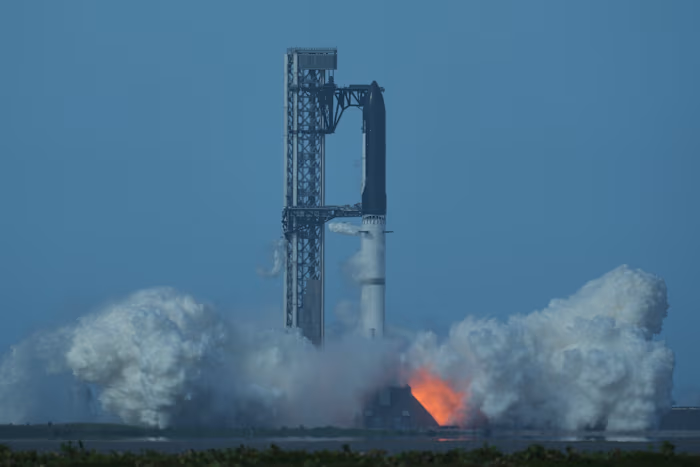


SpaceX’s towering Starship rocket was barely a heartbeat from lifting off Thursday when the countdown was suddenly stopped after several engines failed to ignite, forcing an automatic launch abort.
Elon Musk’s aerospace company said engineers now need to determine what caused the problem before trying again to send Starship on a high-altitude test flight that would carry it partway around the globe. The mission was set to be Starship’s 13th flight, using the 407-foot-tall (124-meter) vehicle powered by 33 main engines — a system widely regarded as the largest and most powerful rocket ever built.
During SpaceX’s live launch broadcast, drone footage from high above the pad showed engine ignition beginning about three seconds before the scheduled liftoff. The company did not immediately provide a detailed explanation, but data displayed on the webcast indicated that four engines did not light. The other 29 engines then shut down almost instantly, leaving the massive rocket secured on the launch mount. It marked the first last-second abort of its kind for a full-scale Starship vehicle.
Soon after the scrub, SpaceX’s launch team started draining propellant from the rocket.
“Next launch attempt hopefully in a few days,” Musk wrote on X.
Until the engine issue, conditions appeared to be lining up in SpaceX’s favor, including the weather. In the end, the rocket’s automated launch system did exactly what it was designed to do: stop the flight before an unsafe liftoff. Launching with too few engines could have put the mission at serious risk, especially given that some previous Starship test flights ended in dramatic explosions.
SpaceX had its latest, most advanced Starlink satellites aboard
Starship was carrying 20 of SpaceX’s newest and most advanced Starlink internet satellites, which were expected to be deployed during the planned hourlong test flight. The satellites were intended to test communications with Starlink spacecraft already circling Earth while also capturing images of Starship’s heat shield.
Neither the first-stage booster nor spacecraft were meant to be recovered, with both ending up in the sea.
The rocket’s automatic launch system worked as planned by halting everything. Too few operating engines could have resulted in a failed launch. Some earlier Starship flights, for example, ended in explosive fireballs.
World’s biggest rocket is key to putting astronauts back on the moon
NASA is counting on Starship to land its astronauts on the moon in the next few years. The space agency has hired SpaceX and Jeff Bezos’ Blue Origin to build and fly the lunar landers that will return humanity to the surface of the moon after an absence of more than half a century.
Both companies need to have their landers — Starship and Blue Moon — ready to fly by next year so that the newly named Artemis III crew can practice docking their capsule with them in orbit around Earth. The mission after that — Artemis IV planned for no earlier than 2028 — would use one of those landers to take two astronauts to the moon’s south polar region.
___
The Associated Press Health and Science Department receives support from the Howard Hughes Medical Institute’s Department of Science Education and the Robert Wood Johnson Foundation. The AP is solely responsible for all content.