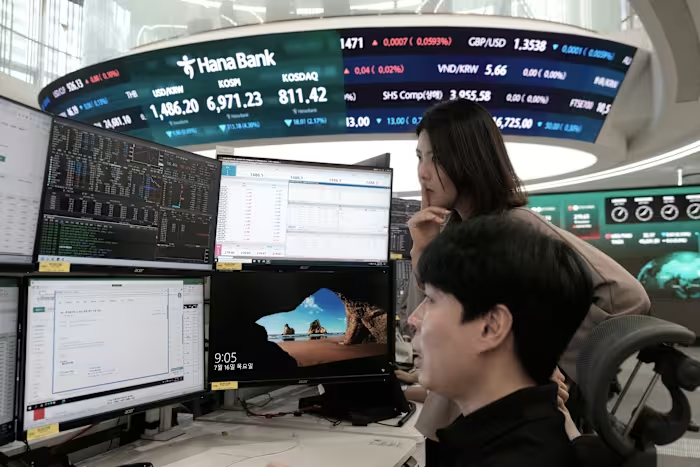


HONG KONG – Asian stock markets traded mostly in the red Thursday, while oil prices moved lower even as fresh U.S.-Iran strikes kept geopolitical tensions firmly in focus.
In early trading, U.S. futures pointed modestly higher.
Pressure was heaviest in technology, where a sell-off in artificial intelligence-linked stocks dragged down major indexes in South Korea and Japan.
South Korea’s Kospi sank 6.6% to 6,816.70 after the Bank of Korea raised interest rates for the first time since 2023. The central bank’s move was aimed at containing inflation pressures tied to the Iran war.
Major chip names led the retreat, with memory chipmaker SK Hynix sliding 11.2% and Samsung Electronics losing 8.2%.
In Taiwan, the Taiex slipped 0.3% as investors looked ahead to earnings from TSMC, the island’s semiconductor giant widely viewed as a bellwether for the global chip sector and the artificial intelligence boom.
Meanwhile, U.S. stock futures remained slightly positive, suggesting a steadier open on Wall Street.
Japan’s Nikkei 225 dropped 2.9% to 66,767.64, with semiconductor-related shares under sharp pressure. Kioxia, the Japanese memory chipmaker, plunged 13.5%, while chipmaking equipment supplier Tokyo Electron fell 5.2% and chip-testing equipment maker Advantest declined 5.6%.
SoftBank Group shed 6.4%.
Hong Kong’s Hang Seng was a regional outlier, gaining 1.7% to 25,111.22. Alibaba’s Hong Kong-traded shares climbed 4.4%, after China’s cyberspace regulator said Wednesday it had approved the Apple Intelligence AI tool for use in China. An Alibaba spokesperson said its Qwen model will be integrated into Apple Intelligence.
The Shanghai Composite index dropped 0.9% to 3,921.20.
Australia’s S&P/ASX 200 edged 0.2% lower, to 8,820.50.
India’s Sensex climbed 0.3%.
Oil prices were lower early Thursday but were still at elevated levels as the U.S. intensified its strikes against Iran, while Iran targeted missile and drone fire on Kuwait and Bahrain.
Brent crude, the international standard, dropped 0.4% to $84.55 a barrel. It was around $72 per barrel in late February before the war began.
Benchmark U.S. crude was down 0.2% at $79.34 per barrel.
“Oil prices managed to eke out a third day of gains amid few signs of de-escalation between the U.S. and Iran,” ING commodities strategists Warren Patterson and Ewa Manthey wrote in a commentary Thursday.
Rising U.S.-Iran tensions are “having a meaningful impact on vessel flows from the Persian Gulf,” they said, with tanker traffic through the Strait of Hormuz, a crucial waterway for global oil transportation, still under pressure.
On Wednesday, Wall Street’s benchmark S&P 500 rose 0.4% to 7,572.40. The Dow Jones Industrial Average climbed 0.3% to 52,658.64, while the technology-heavy Nasdaq composite added 0.6% to 26,269.23.
SpaceX, Elon Musk’s rocket company, slipped below its initial public offering, or IPO, price of $135 a piece, before recovering some of its losses.
A U.S. report showing inflation slowed in June and strong earnings results from American investment company BlackRock among other major firms also helped push the market higher. BlackRock’s shares rose 6.6% after it reported stronger-than-expected quarterly revenue and profit.
In other dealings early Thursday, the U.S. dollar fell to 162.09 Japanese yen from 162.19 yen. The euro fell slightly to $1.1467, from $1.1464.
___
AP Business Writers Stan Choe and Matt Ott contributed to this report.