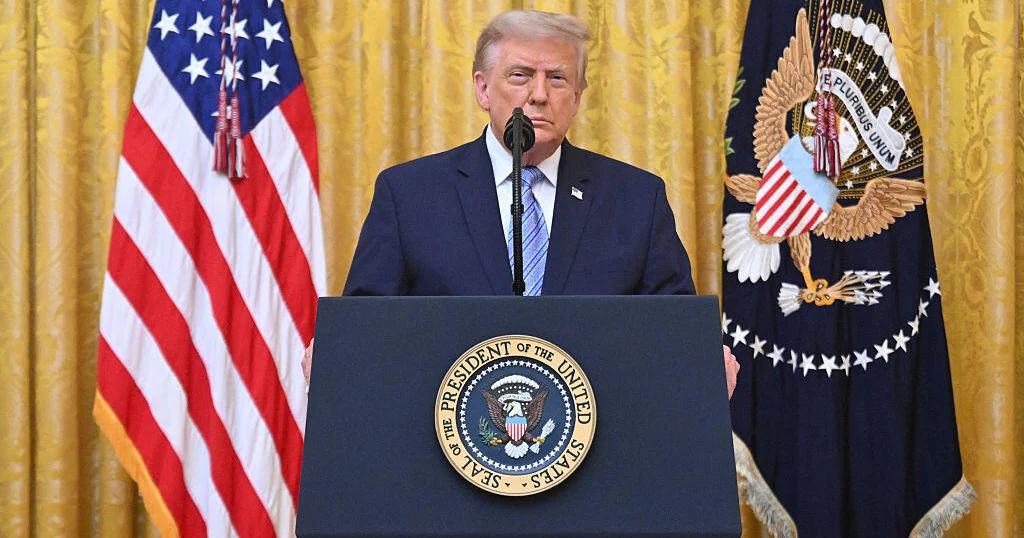
In a primetime address Thursday, President Trump again raised concerns about election technology, claiming that voting machines and ballot-counting systems are “extremely exposed to attack.” He cited intelligence declassified and released by the White House, echoing assertions he has made for years about the security of voting equipment.
But parts of the newly disclosed material center on a company whose systems are barely used in U.S. elections, while election security specialists say voting machines in the United States operate under strict safeguards.
“They’re vulnerable and they’re easily compromised, and people within our government knew that,” Trump said during the speech.
The president later referred to CIA intelligence about an alleged effort to use voting machines to “do a big number in favor of the corrupt Maduro regime in Venezuela,” pointing to election fraud concerns in that country.
The Venezuela-related intelligence released by the White House, however, concerns election systems produced by Smartmatic — a company whose technology is not used in the United States except in Los Angeles County.
Smartmatic has said it currently has no operations in Venezuela. The company worked there for roughly 13 years beginning in 2004, but says that in 2017, “our technology helped prove that the government was reporting false turnout numbers, so we blew the whistle on them and stopped doing business there at that time.”
Election experts broadly say U.S. voting machines are very difficult to manipulate because they are tightly supervised, kept offline and, in nearly every state, supported by paper ballots or voter-verifiable paper records that allow officials to audit and confirm results by hand.
“They’re under lock and key until they are publicly tested to make sure they haven’t been tampered with,” said David Becker, executive director of the Center for Election Innovation & Research. “And then they are used and we still don’t trust them. We have those paper ballots.”
For example, every 2020 general election ballot in Georgia was tallied three times: once by machines during the original counting process, once in an audit that involved a hand recount in every county statewide, and once in a machine recount requested by the Trump campaign. All three counts affirmed that former President Joe Biden defeated Mr. Trump.
Elsewhere in Thursday’s speech, Mr. Trump pointed to newly declassified intelligence that U.S. adversaries like Russia, China, Iran and North Korea have the ability to compromise U.S. election infrastructure.
The document that Mr. Trump appeared to reference — a National Intelligence Council memo from January 2020 — does state that U.S. adversaries have the “capability” to compromise election infrastructure. It points to voter registration databases as one possible vulnerability. But it later explains that systems used to tabulate votes or display results would be “difficult to manipulate on a wide enough scale to compromise election results.”
“The systems in each voting location are not connected to the Internet or to each other, and many methods for exploiting them rely on physical proximity,” the document said, adding that “conducting such a campaign would be difficult and that postelection audits and paper trails very likely would uncover such an effort.”
The National Intelligence Council also found in a long-public March 2021 assessment that no foreign entities attempted to “alter any technical aspect of the voting process” in 2020.
“We assess that it would be difficult for a foreign actor to manipulate election processes at scale without detection by intelligence collection on the actors themselves, through physical and cyber security monitoring around voting systems across the country, or in post-election audits,” the intelligence community said in the March 2021 report.