
Last year, Microsoft’s 13-inch Surface Laptop became one of the easiest thin-and-light Windows laptops for me to recommend. For $900, it delivered the kind of polished build quality and long battery life many people associate with the MacBook Air, but in a Windows machine. I liked it enough that I talked my sister into buying one when it went on sale.
A year later, the story has changed. Thanks to RAMageddon, the same Surface Laptop now starts at $950, and that higher price gets you only 8GB of RAM — half of what last year’s configuration offered. From the outside, it still looks and feels like the same excellent laptop. Inside, though, it is a meaningfully weaker deal.
It has been quite a while since we reviewed a Windows laptop with so little memory. For years, we’ve argued that 8GB of RAM is no longer enough for a modern Windows PC. Still, this is Microsoft’s own laptop running Microsoft’s Windows 11, so if any machine could make that configuration feel acceptable, you would think it might be this one.


$950
The Good
The Bad
The strengths I praised in last year’s Surface Laptop are still here. The keyboard has a satisfying, tactile feel, the trackpad is excellent aside from lacking true corner-to-corner clicking, the webcam is crisp and clear, and the battery life remains a standout, easily stretching past 10 hours. The eight-core Snapdragon X Plus processor is also nearly the same chip used in the Surface Laptop I tested last year, with a slightly faster boost speed this time around. In the previous model, it delivered strong everyday performance and could even manage light photo editing in Lightroom Classic. The key difference is that last year’s version had 16GB of RAM, and that turns out to matter a lot.
- Screen: B
- Webcam: B
- Keyboard: B
- Trackpad: B
- Port selection: C
- Speakers: C
- Number of ugly stickers to remove: 0
For simple web browsing and video streaming, the 8GB Surface Laptop was usually fine. But it did not take much real-world multitasking to expose its limits. During a Microsoft Teams call in the desktop app, the host played a short video, and the entire laptop froze for several seconds. At the time, I had roughly 10 Chrome tabs open across two desktops, plus Slack and Signal running in the background. That is hardly an extreme workload, and none of us even had our webcams turned on.
The Surface Laptop would hang for a few seconds like this several times a day, even when I thought I wasn’t pushing it too hard. I’ve had these temporary freezes while just working in some Google Docs — no Teams call running or anything streaming in the background. It’s only a couple times a day on average, but that’s still too often.

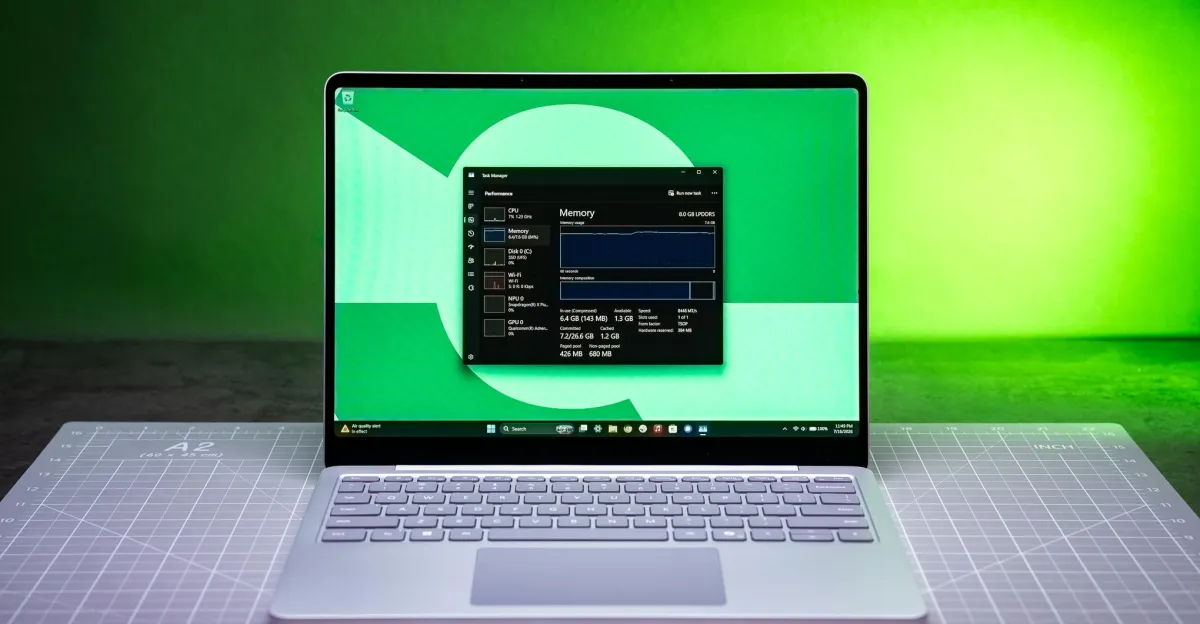
Keeping the Performance tab open in Task Manager showed I was almost always using around 6.7GB of the available 7.6GB of available memory. After a fresh reboot with bare minimum startup apps running, Windows was using 4.2GB of RAM. That’s around the minimum Microsoft requires just to run Windows 11, highlighting how little headroom there is with 8GB of RAM. Limiting myself to about six Chrome tabs, closing Signal, and refraining from using any virtual desktops kept the memory usage to about 5.5GB.
Is this all workable for light loads? Yes. Do I want to live my life being super cautious about how many apps I’m running and how many tabs I leave open on a brand-new $950 laptop? Absolutely not. And if it’s choking on day one, how usable is it going to be in five years?
The same concerns can be said of the MacBook Neo, which also has just 8GB of RAM. But macOS is a bit better with RAM — and more to the point, in my testing, the Neo could handle more multitasking. A Neo won’t have the shelf life of a MacBook Air, but it also costs $250 less than the Surface Laptop (even after Apple’s recent price increase).
Microsoft has claimed its focus this year is improving the performance of Windows 11 and making it more reliable, especially for lower-cost hardware, to compete with the Neo. But if we’re really going back to 8GB as the starting point for Windows laptops, there’s a lot more work to be done. It’s of course ironic that Microsoft needs to address this problem when it’s one of the major perpetrators of the ongoing RAM crunch. Perhaps Microsoft doesn’t care that its flagship Surface line will suffer for its AI obsession, but it still sucks to see.
We haven’t reviewed a Windows laptop with just 8GB of RAM in more than three years. Unfortunately, the Surface Laptop won’t be the last. The recent Computex show also brought announcements for upcoming laptops with 8GB of memory from Dell, Acer, and Asus. With the RAM shortage likely to last years, we’re going to see more and more 8GB offerings so manufacturers still have something “entry-level” to offer.
But if even Microsoft can’t make a Windows laptop that runs well on 8GB RAM, what hope do OEMs have? 8GB is not enough for a Windows laptop in 2026. Barring Microsoft actually de-bloating Windows 11 enough to accommodate lower-spec computers, your best bet is to spend more and get something with 16GB of RAM — like the same Surface Laptop for $1,150, something from another manufacturer that still sees some decent sales, or look into refurbs and open-box models from reputable sources. Or just cop out and get a MacBook Neo.
Prices could still go up. The $950 8GB Surface Laptop of today could very well be the $1,050 8GB Surface Laptop of next year, or the $1,200 8GB Surface Laptop of the following year.
This is our new normal for computing. The 13-inch Surface Laptop initially offered respectable tradeoffs for a fair discount — “a little less for a little less,” as I put it then. Now the new base model offers even less for more. RAMageddon has altered the deal. It’ll probably get worse.
2026 Microsoft Surface Laptop 13-inch (8GB) specs (as reviewed)
- Display: 13-inch (1920 x 1280) 60Hz touchscreen
- CPU: Qualcomm Snapdragon X Plus X1P-46-100
- RAM: 8GB LPDDR5X (non-replaceable)
- Storage: 256GB UFS
- Webcam: 1080p
- Connectivity: Wi-Fi 7, Bluetooth 5.4
- Ports: 1x USB-A 3.1, 2x USB-C 3.2, 3.5mm combo audio jack
- Biometrics: Fingerprint sensor in power button
- Weight: 2.7 pounds
- Dimensions: 11.25 x 8.43 x 0.61 inches / 285.8 x 214.1 x 15.5mm
- Battery: 50Wh
- Price: $949.99
Photography by Antonio G. Di Benedetto / The Verge
Benchmark comparisons
Microsoft Surface Laptop 13-inch (2026) / Qualcomm Snapdragon X Plus X1P-46-100 / 8GB / 256GB
|
Microsoft Surface Laptop 13-inch (2025) / Qualcomm Snapdragon X Plus X1P-42-100 / 16GB / 512GB
|
MacBook Neo / Apple A18 Pro / 8GB / 256GB
|
MacBook Air 15 / Apple M5 / 16GB / 1TB
|
Acer Aspire 14 AI / Intel Core Ultra 7 256V / 16GB / 1TB
|
Lenovo IdeaPad Slim 3x / Qualcomm Snapdragon X X1-26-100 / 16GB / 256GB
|
|
|---|---|---|---|---|---|---|
| CPU cores | 8 | 8 | 6 | 10 | 8 | 8 |
| GPU | Adreno X1-45 | Adreno X1-45 | A18 Pro (5 GPU cores) | M5 (10 GPU cores) | Intel Arc 140V (8 GPU cores) | Adreno X1-26 |
| Geekbench 6 CPU Single | 2348 | 2437 | 3402 | 4175 | 2769 | 2137 |
| Geekbench 6 CPU Multi | 9421 | 11427 | 8508 | 16567 | 10930 | 9728 |
| Geekbench 6 GPU (OpenCL) | 9554 | 9391 | 19798 | 47661 | 28556 | 9689 |
| Cinebench 2026 Single | 442 | 417 | 518 | 727 | Not tested | Not tested |
| Cinebench 2026 Multi | 2458 | 2643 | 1466 | 3413 | Not tested | Not tested |
| PugetBench for Photoshop | 2887 | 4773 | Not tested | 11513 | Not tested | Not tested |
| PugetBench for Premiere Pro (2.0.0+) | Crashed | Crashed | Not tested | 61861 | Not tested | Not tested |
| Blender classroom test (seconds, lower is better) | 509 | 486 | Not tested | 46 | Not tested | Not tested |
| Blender cosmos test (seconds, lower is better) | Not tested | Not tested | Not tested | Not tested | Not tested | Not tested |
| Premiere 4K Export (lower is better) | Crashed | Crashed | 8 minutes, 30 seconds | 2 minutes, 53 seconds | 7 minutes, 28 seconds | 12 minutes, 59 seconds |
| Sustained SSD reads (MB/s) | 3804.31 | 3840.78 | 1735.91 | 7049.45 | 6391.51 | 5738.86 |
| Sustained SSD writes (MB/s) | 3310.94 | 3476.62 | 1684.05 | 7480.55 | 5524.22 | 2801.02 |
| Price as tested | $949.99 | $1,249.99 | $699 | $1,799.00 | $1,049.99 | $749.99 |