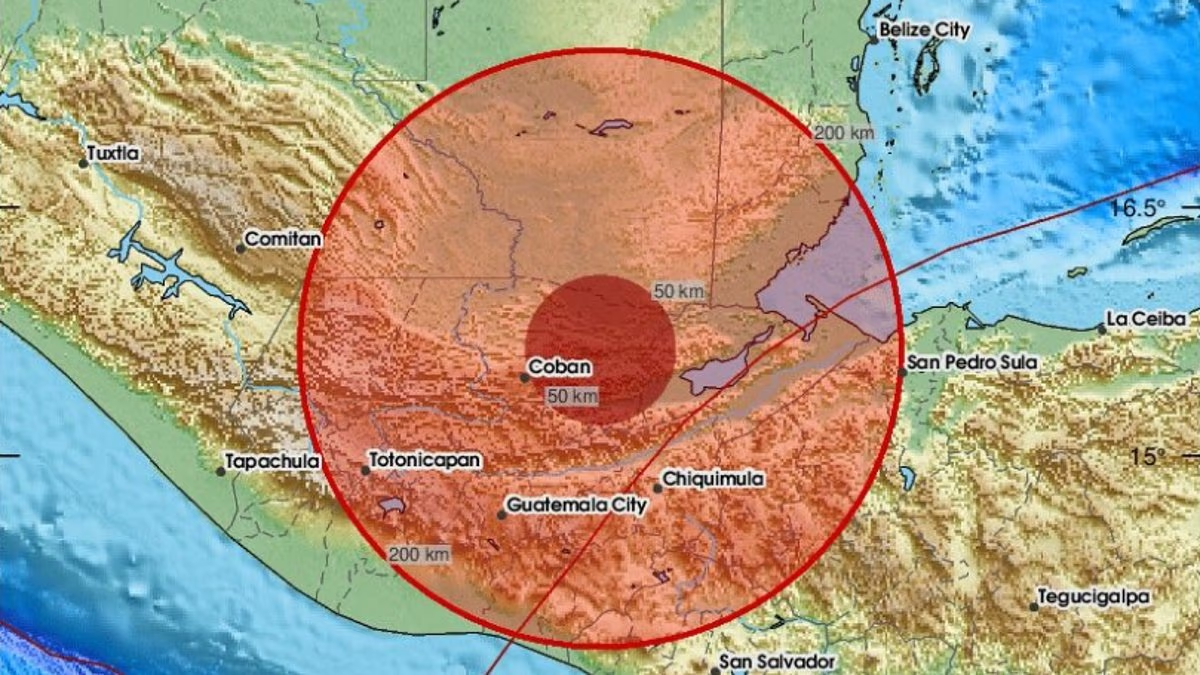

A powerful 7.4-magnitude earthquake struck Mexico on Friday, prompting tsunami concerns for roughly one million people along vulnerable coastal areas.
The quake hit near the coast of Chiapas, a southern Mexican state located on the Pacific Ring of Fire — the vast, 25,000-mile horseshoe-shaped zone that circles the Pacific Ocean, holds about 75 percent of the planet’s active and dormant volcanoes and is responsible for nearly 90 percent of the world’s earthquakes.
A tsunami threat was issued soon after the earthquake hit at 10.48am ET, with officials warning that the undersea disturbance had the potential to produce dangerous waves capable of flooding nearby shorelines.
Residents in coastal communities were urged to stay alert and prepare for possible flooding, powerful ocean currents and large waves moving toward land.
The National Tsunami Warning Center said there was no tsunami danger for the US West Coast, British Columbia or Alaska.
In Chiapas, sirens rang out as shaken residents gathered outside, trying to process the force of the earthquake.
Seismologists cautioned that the strength of shaking can differ sharply from place to place depending on the ground conditions and local construction, while shallow earthquakes are often felt over broader areas. They also warned that aftershocks could follow in the coming hours and days.
The region, already known for frequent seismic activity, has recorded 22 earthquakes in the past 30 days, with Friday’s 7.4-magnitude event marking the strongest during that stretch.

The seismic activity struck near the coast of Chiapas, Mexico, which sits along a 25,000-mile horseshoe-shaped belt around the Pacific Ocean that contains about 75 percent of Earth’s active and dormant volcanoes and produces roughly 90 percent of the world’s earthquakes

Sirens were heard blaring through Chiapas as people stood outside, reeling from what had just occurred
Locals in the area are being told to drop, cover and hold on if indoors, and then check on neighbors to ensure they are safe.
Chiapas is Mexico’s southernmost state, bordering Guatemala to the east, the Pacific Ocean to the southwest, and the Mexican states of Oaxaca, Veracruz and Tabasco.
Eyewitnesses told Reuters news agency that in Guatemala and El Salvador, ‘buildings shook.’
One local said on X: ‘It felt like an earthquake in El Salvador, guys, soft and swaying in the city of Usulután. Santa Tecla was strong.’
In Mexico City, more than 500 miles away from the epicenter, people felt their homes shake and saw lights blinking.
It remains unclear if there was any significant damage or injuries caused by the earthquake.
Salomón Jara Cruz, the governor of the southern Mexican state of Oaxaca, has urged citizens to ‘remain calm’.
He added the earthquake was felt with ‘moderate intensity but said ‘no significant damage’ has been reported.

People near th eepicenter exited buildings and crowded the streets
‘To date, no significant damage has been reported. Citizens are urged to remain calm, follow the authorities’ recommendations, and stay informed solely through official channels,’ he wrote on X.
However, those living in the region said they never received alerts about the earthquake.
One person shared on X: ‘The ‘presidential alert’ is useless; it never even rang.’
‘Why didn’t the seismic alert sound, and last time in Oaxaca nothing even happened, but here it did sound,’ another shared.
This is a developing story… More updates to come.