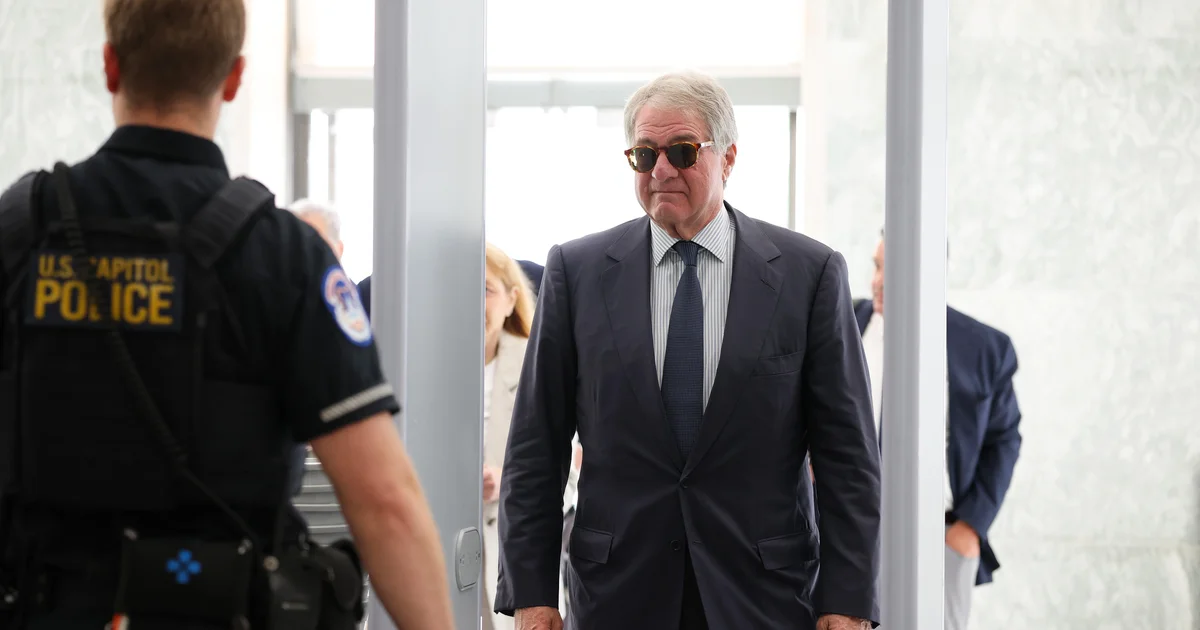
Billionaire financier Leon Black’s June 26 voluntary appearance before the House Oversight Committee came to an unexpected halt after lawmakers served him with subpoenas during the session, according to a newly released transcript. The subpoenas sought copies of nondisclosure agreements and compelled Black to sit for a second interview.
The committee made the transcript public on Friday, showing that Black’s interview lasted under an hour before his legal team ended the questioning.
Following the session, Susan Estrich, one of Black’s attorneys, criticized the move, calling the subpoenas “a planned political stunt.”
Investigators are pursuing copies of certain nondisclosure agreements Black has signed. Emails previously released by the committee indicate that Jeffrey Epstein offered input on aspects of Black’s personal affairs. According to court records, Black had a six-year affair with Russian model Guzel Ganieva. As Black negotiated an NDA with her, Epstein sent him advice in a Sept. 21, 2015, email.
Black acknowledged to the panel that he had told Epstein about the affair and about what he described as the woman’s alleged “blackmail and extortion.” After signing the NDA, Ganieva later sued Black for rape and defamation, while denying his allegations that she had extorted him. Her lawsuit was unsuccessful.
“Black has never been ‘extorted by Ms. Ganieva,’” her lawyers wrote in the lawsuit.
Black told the committee that Epstein did not take part in the NDA negotiations and said Epstein was not aware of any other nondisclosure agreements he had signed. He also said the agreements’ terms barred him from discussing them on the record unless he was compelled by subpoena.
In his opening statement, Black denied any involvement in or knowledge of Epstein’s alleged abuse of women, sex with underage women or sex trafficking, beyond what he learned from Epstein’s 2008 plea deal for solicitation of prostitution from a minor. Black also said he never paid Epstein to gain access to women.
Black testified that he was introduced to Epstein by a mutual friend in the 1990s and continued to associate with him because of the influential connections Epstein provided. According to Black, Epstein introduced him to numerous high-profile figures, including Elon Musk, Bill Gates, and former Israeli Prime Minister Ehud Barak.
A 2021 report commissioned by Apollo Global Management, the firm Black founded, concluded that he paid Epstein approximately $158 million for tax and estate planning services. The report found that the work was legitimate. In the interview, Black defended the payments but said that Epstein had misled him into believing the fees were tax-deductible, causing him to underestimate the total cost.
READ MORE: Clearest Jellyfish UAP Image Released in Latest Trump UFO Files
He said he initially believed he would pay about $95 million but still suggested the higher amount was a bargain, estimating Epstein’s advice saved him between $1 and $2 billion. In 2023 he paid the U.S. Virgin Islands a $62.5 million settlement after he was sued over his financial support of Epstein.
Committee members also questioned Black about a poem he wrote for a book compiled by Ghislaine Maxwell to commemorate Epstein’s 50th birthday. The book included letters, drawings and messages from dozens of Epstein’s friends and business associates, many of which referenced his relationships with women. Black’s contribution included the lines, “Blond, red, or brunette spread out geographically, with this net of fish Jeff’s now the old man and the sea.”
Asked what he meant, Black testified, “Because he seemed to know women all over the world. He traveled. He was in Paris. He was in Santa Fe. He was in his island. And he enjoyed the company of good-looking women, and he was a bachelor.”
Although Black referred to Epstein in the book as his “best friend” and signed the note, “Love and kisses, Leon,” he denied that the two were as close as the message suggested. Black told the committee, “We were never best friends. Was I friendly with him from the point of view of enjoying his Rolodex? Yes. Did I think he was very smart as a professional adviser? Yes.”
Epstein had been appointed by Black to the board of directors of his family’s foundation in 1997, but Black told the committee that he removed him from that role after Epstein’s arrest and conviction in 2008. Prior to that, he said that he saw Epstein roughly once every three to four weeks and regularly attended gatherings at Epstein’s townhouse. However, it wasn’t until 2018 that Black and Epstein completely broke ties, which Black attributed to Epstein’s “relentless pursuit of more and more money from me for professional services, his mistruths and misrepresentations” as well as “his failure to repay most of a $30 million loan.”
Black is scheduled to return before the committee under subpoena in September.