
CHICAGO () — As immigration arrests increase across the Chicago area and around the country, the ABC7 I-Team is examining what federal agents are told to do when members of the public record immigration enforcement operations.
The scrutiny follows the account of a Chicago woman who said she was confronted by agents last fall after filming an arrest, with one agent allegedly aiming a long gun directly at her.
A recently filed federal lawsuit alleges that Department of Homeland Security agents have taken similar actions in incidents across the country. In some cases, attorneys claim, agents went further by tracking down the home addresses of people who recorded ICE enforcement activity and appearing uninvited outside their residences in what the lawsuit describes as “blatant acts of intimidation.”
“If we don’t document, it didn’t happen,” said Jo-Elle Munchak, who recorded immigration agents in Chicago’s Edgewater neighborhood last fall. “It was a demonstration to show to my alderperson and my members of Congress… that this is happening in my neighborhood.”
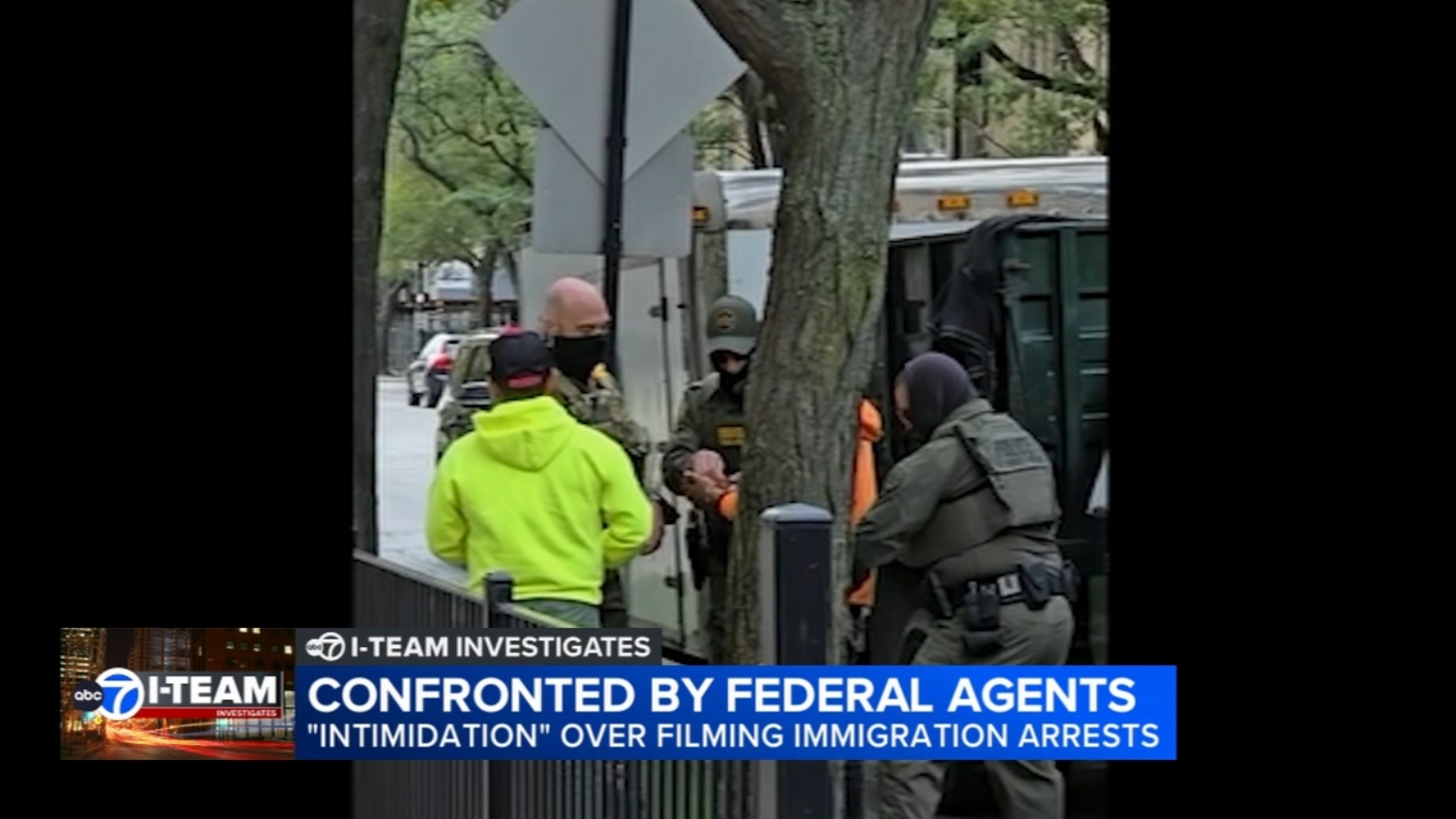
Munchak said the encounter happened on Oct. 10, 2025, as Operation Midway Blitz was underway across Chicago. She said she was driving that morning when she saw federal immigration agents detaining a landscaper who was working in the neighborhood. She pulled over, she said, and began recording the scene.
“There was no one gathered around protesting,” Munchak explained. “I [stood] quite a distance away as to not to interfere and I tape it for about five minutes… It was without incident.”
Bystander videos of immigration enforcement have become an important tool in establishing what happened during controversial encounters.
After immigration agents shot and killed Renee Good and Alex Pretti, DHS initially described them as “domestic terrorists” who had threatened agents. Video recorded by members of the public later contradicted the government’s account.
A government that targets people who are filming has something to hide.
Jonathan Manes, Senior Counsel at MacArthur Justice Center
After Munchak filmed federal agents that October morning, she said she got back into her car, turned onto her street, and experienced one of the most terrifying moments of her life when agents in two SUVs boxed her car in.
“One came to my driver’s side window. The other one came to the passenger side, front window. And one came to the hood of my car aiming a long gun,” Munchak told the I-Team. “They then start pounding with their elbow, pounding the door, demanding I get out of my car.”
Munchak said she stayed in her car and showed agents her driver’s license to prove she lived there on that street. She said agents took photos of her license and vehicle identification number.
Nine months later, Munchak said she has no idea what they were doing, or what they did with her information.
“It still affects me to this day,” said Jo-Elle Munchak. “I get very triggered, and I know that’s an overused term, but especially with the Minneapolis killings of Mr. Preti and Ms. Good, because literally, they were observing, like they were me.”
What happened to Munchak and many other Americans is now the subject of a federal lawsuit demanding the policies and directives behind federal agents’ actions.
Attorney Jonathan Manes is with the MacArthur Justice Center.
“We have the right to record our government doing its work on the streets,” Manes told the I-Team. “This is core First Amendment protected activity. Everybody has the right to record what agents are doing on the street.”
The MacArthur Justice Center and ACLU have recently filed a federal Freedom of Information Act lawsuit asking a judge to force immigration authorities to produce internal records that shed light on the “policies and practices of threatening, surveilling, prosecuting, and otherwise taking action against people who photograph, film, or publish footage of immigration enforcement happening on the streets,” according to the lawsuit.
“These statements are echoed on the ground by the widely reported DHS practices aimed at stifling journalists, bystanders, and others who photograph and record immigration enforcement actions,” the lawsuit states.
Manes and other attorneys are trying to find out what agents have been told to do if they see bystanders recording enforcement actions, and whether any bystander data is being stored in federal systems.
“A government that targets people who are filming has something to hide,” Manes said. “We’ve even seen examples of where somebody is circulating footage on social media… and the DHS is sending subpoenas to Facebook trying to get information about the person.”
As the I-Team previously reported, court records revealed in the case of Marimar Martinez, a Chicago woman who was shot by federal agents last fall and survived, agents had already compiled information on Martinez prior to the shooting after she reshared a post online about immigration enforcement.
This week, attorneys representing DHS officials asked a judge for more time to respond to the lawsuit.
DHS did not respond to the I-Team’s request for comment for this story.
A spokesperson for DHS previously said it considers the recording of ICE agents as “doxing”, and that the agency “will prosecute those who illegally harass ICE agents to the fullest extent of the law.”
Munchak fears what happened to her, and others across the country, is meant to have a chilling effect on recording immigration enforcement.
“I was not interfering,” Munchak said. “And when I hear reports of these federal agents saying, ‘They were interfering and we feared for our lives,’ I can’t trust it because I was in that same position and I wasn’t doing anything wrong.”