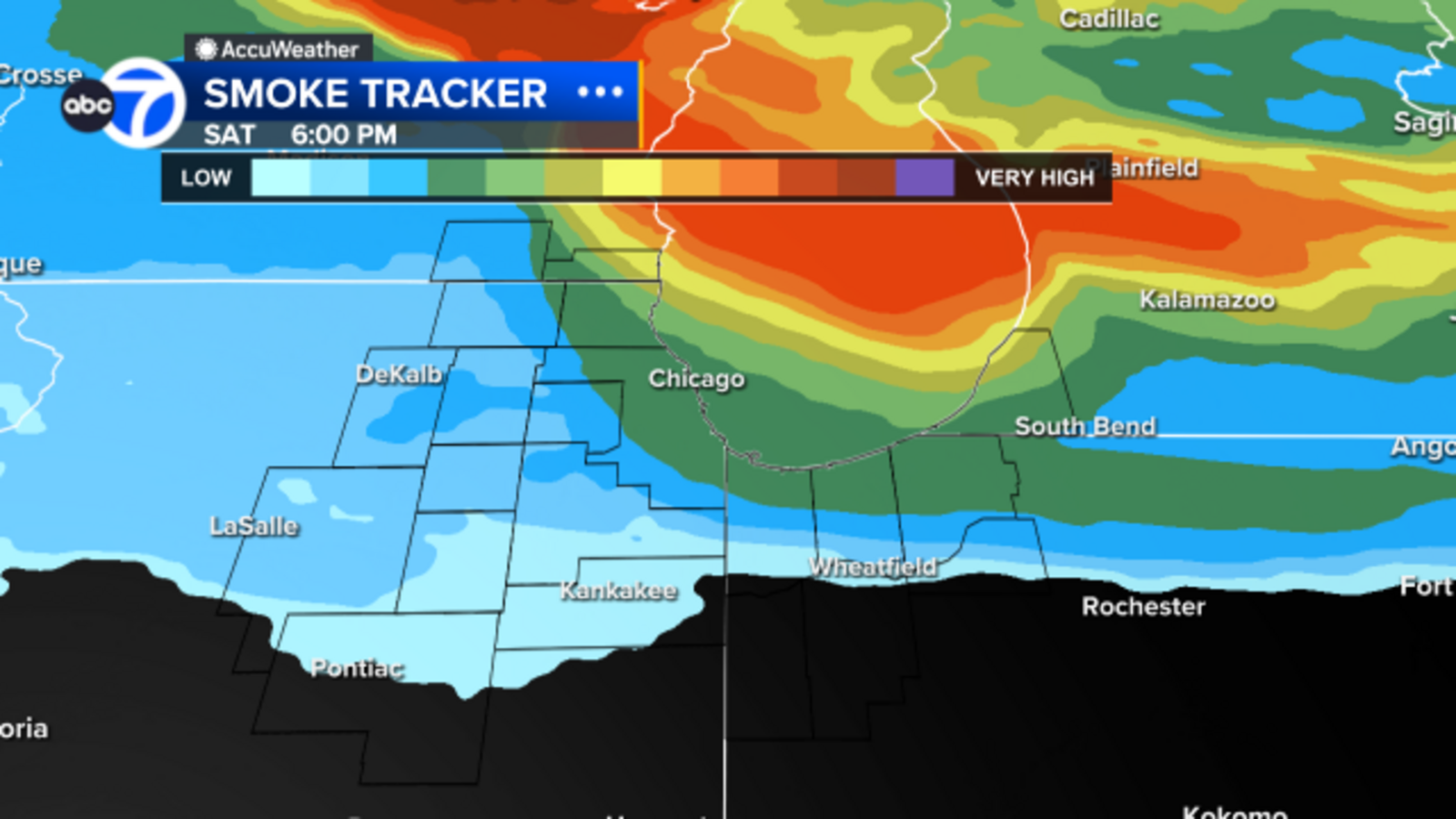

CHICAGO () — An Air Quality Alert remains in place across the Chicago area Saturday as smoke from Canadian wildfires continues to affect conditions.
ABC7 meteorologist Jaisol Martinez said air quality was rated “moderate” Saturday morning, but conditions could worsen later in the day to “unhealthy for sensitive groups” as ozone levels rise.
While residents were seeing a brief break from the smoky air, Martinez said shifting winds are expected to carry the haze back into the region Saturday afternoon.
Forecasters said the smoky haze could return to Chicago as early as 5 p.m., or closer to sunset.
Martinez noted that Chicago will likely see “unhealthy” air quality again, though the incoming smoke plume is not expected to be as intense as the one that moved through on Thursday.
The wildfire smoke is expected to remain in the area into Sunday.
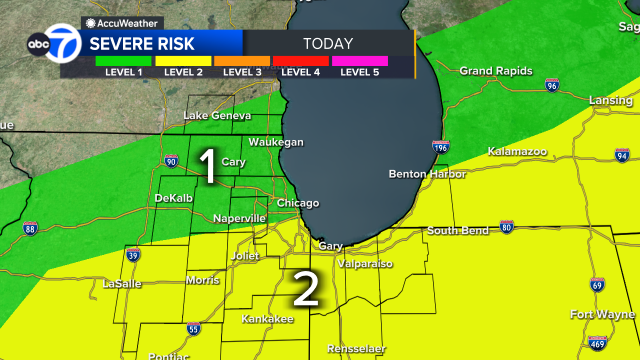
In addition to the air quality concerns, storms are expected to bring rain to Chicago between noon and 5 p.m. Saturday.
Most of the Chicago area, including the north and west suburbs, is under a Level 1 risk for severe weather. The southern suburbs and northwest Indiana face a Level 2 risk.
TRACKING AIR QUALITY | Click here to check air quality in Chicago area
Stan’s Donut Run is expected to go on Saturday after the city saw many events canceled due to the “hazardous” air quality.
Organizers at the Tacos y Tamales festival in Pilsen say they are keeping a close eye on weather conditions throughout the weekend.
However, opening day for Roscoe Village Burger Fest was postponed until Saturday because of the wildfire smoke.
MORE STORY: NYC Squatter Accused of Violent Attacks on Condo Residents in Lawsuit
The National Weather Service extended the alert until Monday for parts of northwest Indiana.
Martinez said wind direction changes on Monday, which could help with air quality.
Health impact
Health experts warned that wildfire smoke contains harmful pollutants.
Dr. Soledad Cortina, a cornea specialist with the Illinois Society for Eye Physicians and Surgeons and University of Illinois Chicago Department of Ophthalmology, said the tiny particles in the smoke could have lasting health effects.
“Some of the components of wildfire are similar to those of like smoke and tobacco, and we know how damaging that is to the eyes and certain chronic conditions,” said Dr. Cortina.
Patricia Ward, the Head Scientist at the Griffin Museum of Science and Industry, said that weather patterns like these could continue to happen in the future.
“I think we are seeing that more and more across the U.S., North America, in general and around the world in other places too. The expectation is this climate change is going to continue to contribute more extreme weather,” Ward said.
READ ALSO | As smoke from Canadian wildfires blankets the US, can wearing a mask help?
Experts also cautioned that poor air quality can affect people indoors. HVAC technicians are encouraging homeowners to inspect their air filters as smoke and airborne particles remain a concern.
“Even if the filter looks white – nice, white and clean, if you hold it up to a light and you can’t see the light through it, that means that it’s clogged up,” said Karol Derezinski, a technician with Shavitz Heating and Air Conditioning.
AAA also recommends using a vehicle’s air conditioning in recirculate mode to reduce smoke exposure inside a car by limiting the amount of outside air entering the cabin.
The smoke and haze blanketing the Chicago area caused low visibility and was expected to create some delays at O’Hare airport.
Health experts said the air is unhealthy for everyone to breathe and are encouraging people to avoid or limit time outdoors until the air quality gets better.
“If you can see it, and you can smell it, you’re breathing it in…so recommendations right now: if you don’t have to go out, then stay home,” Dr. Juanita Mora of the American Lung Association, said.
Doctors also recommend that people stay hydrated, which can help the respiratory system in these smoky conditions.