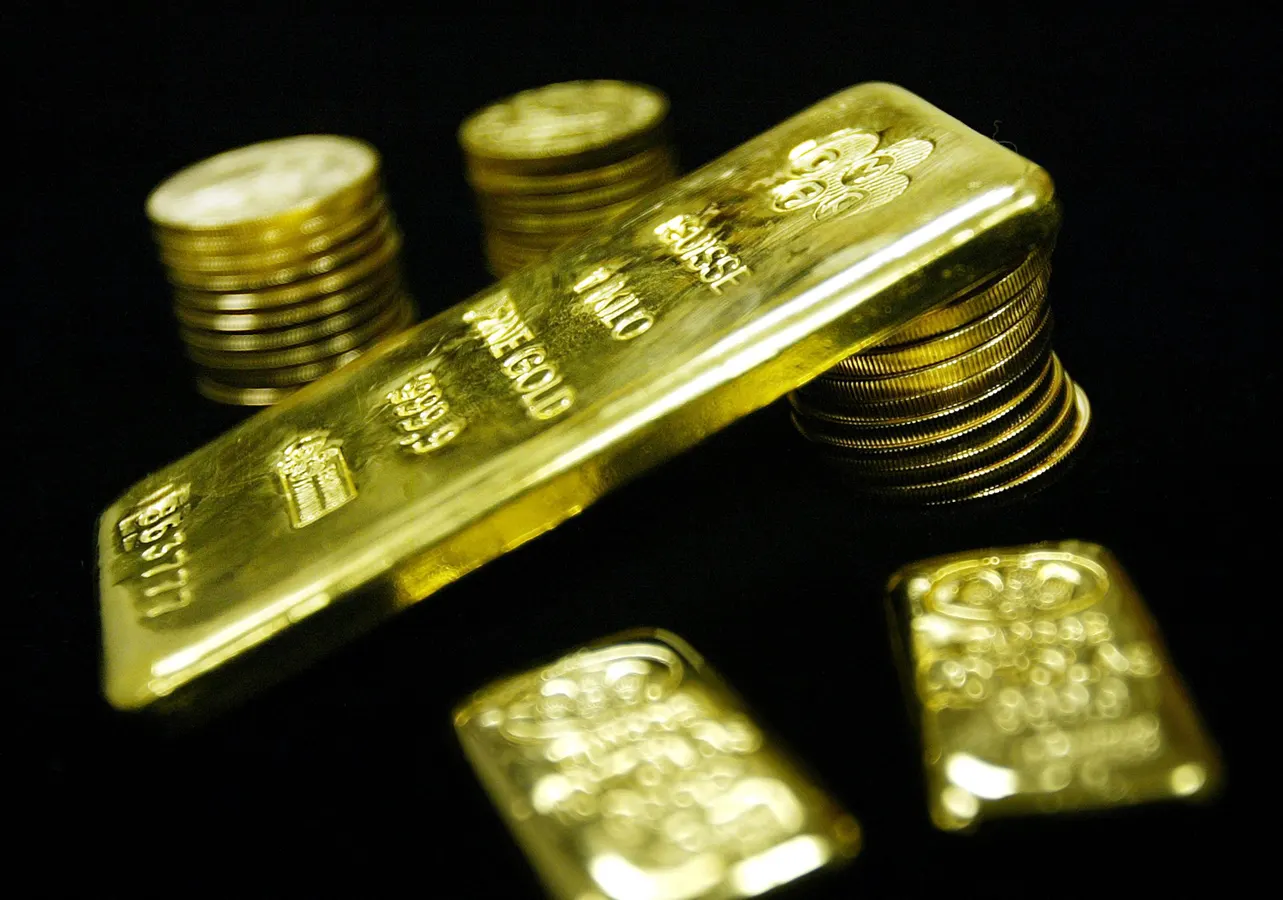


NEW YORK – JANUARY 9: Gold bullion bars and coins are displayed for sale at Manfra, Tordella and Brookes, Inc. on January 9, 2003, in New York City. Gold prices had climbed nearly 30% over the previous year as investors sought safety amid growing expectations of war with Iraq. (Photo by Mario Tama/Getty Images)
Getty Images
Gold itself does not really rise or fall in the way many investors often describe. Instead, changes in the gold price reveal what is happening to the currencies used to price it.
In that sense, gold analysis is largely analysis of something else. That is precisely why, across centuries and continents, markets gravitated toward the yellow metal. Because of its unusually stable stock-to-flow profile, gold is less vulnerable than most commodities to sudden outside distortions, making it especially useful as a benchmark for measuring currency value.
Money’s basic purpose is to make it easier to exchange goods and services for other goods and services. Producers, in turn, want to receive comparable value for what they create. When money is defined in terms of gold, trade can function with greater clarity because gold’s enduring constancy gives it power as a low-entropy standard for defining money.
So why is gold falling now — or, put another way, why is the dollar strengthening? Before considering a speculative answer, it is worth challenging one of the most persistent myths in financial commentary: the idea that gold should automatically climb when consumer or market prices rise, a trend many mistakenly label “inflation.” The argument does not hold.
Again, gold is not the thing moving. If gold is rising, that means the dollar is weakening — and that currency weakness is the inflation. Higher market prices are, at most, a consequence of inflation rather than inflation itself. Claiming gold must rise because prices are rising is like arguing that wet sidewalks cause rain. Rain is the cause; wet pavement is the result. Likewise, inflation is the shrinking value of the monetary unit, while rising prices are only one possible effect.
That is why it is entirely possible for gold to decline even as so-called “inflation pressures” appear in the form of higher prices. Markets are forward-looking, for one thing. For another, prices can move up or down for countless reasons that have nothing to do with monetary inflation. And finally, every rising price points to a falling price somewhere else. Economics, at its core, is about tradeoffs.
Why the gold-price decline? One speculation is that forward looking markets corrected the dollar downward (rising gold) on the expectation of much worse about what would happen in Iran, or for that matter simply re-priced the dollar based on a portion of worst-case scenarios born of conflict with Iran. This could include a world war in worst case, a nuking of Iran, Israel or both in another worst case, or possibly a substantial loss of American lives in a drawn-out conflict that, for being lengthy and bloody, would perhaps reflect in the dollar.
Without getting into the good or bad of the war, markets price possibilities and probabilities to varying degrees. The worst-case scenarios described have so far not come about, and this has arguably been good for the dollar. Call the decline in the price of gold a dollar relief rally.
Next, consider the reaction of Treasury secretary Scott Bessent to President Trump’s mistaken comments from early in the year about a weak dollar being “great.” That’s when the dollar hit an all-time low reflected in $5,300 gold. Notable here is that Bessent didn’t parrot Trump, rather he reversed course with a comment that “the U.S. has always had a ‘strong dollar policy.’” Presidents get the dollar they want, and Treasury is the mouthpiece. Throw in the various people close to Trump who disdain a weak dollar, and it’s possible Bessent’s comments were no mere coincidence.
As always, markets reflect infinite decisions taking place every millisecond every day around the world. Which means there’s no certain answer for market prices. Still, it’s not unreasonable to point to the two examples provided as dollar positives reflected in the falling gold price.
At the very least, the hysterical commentary suggesting gold is failing as a “safe haven” amid allegedly rising “inflation pressures” is just silly. Gold, like markets, just is. Readers can decide what’s implied in the is.