
California’s extensive footprint of military bases, federal offices and immigration enforcement locations could emerge as potential protest targets under a nationwide rapid-response strategy drafted by activists with links to Cuba, according to a new State Department report.
The plan calls for “coordinated nationwide actions” to begin within 24 hours in the event of an “imminent threat” to Cuba or any U.S. military action involving the island nation.
According to the documents, organizers would prioritize demonstrations at military installations, recruiting centers, federal buildings, ICE facilities and even major sports venues during high-profile events.
The rapid-response framework was developed by the National Network on Cuba, a coalition of more than 50 organizations that includes the Democratic Socialists of America, Communist Party USA and CODEPINK.
The Democratic Socialists of America has a visible presence in California politics, particularly in Los Angeles, where its local chapter has backed multiple elected officials serving at City Hall.
The report also points to former Los Angeles Mayor Antonio Villaraigosa and current Mayor Karen Bass, citing their long-running connections to Cuba. Bass, in particular, has been associated with the Venceremos Brigade, an organization that brought Americans to communist Cuba for work programs, educational trips and political exchanges.
Bass first traveled to Cuba with the Venceremos Brigade in 1973 as a young activist and later played a role in organizing the group’s efforts in Southern California.
Decades later, Bass returned to Cuba as a member of Congress, including a 2016 trip with President Barack Obama and a congressional delegation during his administration’s effort to reopen and normalize diplomatic relations with Havana.
When longtime Cuban dictator Fidel Castro died later that year, Bass drew criticism for referring to him by the honorific “Comandante en Jefe” and describing his death as “a great loss to the people of Cuba.”
The 99-page report — published Monday — paints a much broader picture of what officials describe as a decades-long Cuban influence network operating through activist organizations, political movements and other groups inside the US.
The National Network on Cuba’s plan states its goal is to make it “politically and materially costly for the U.S. government to wage war on Cuba” and lays out potential actions that could be launched rapidly across the country.
California’s large number of military sites makes the state especially important to this strategy.
The state is home to major Navy, Marine Corps, Air Force, Space Force and Army installations stretching from San Diego County through Southern California and into the Central Coast and Northern California.
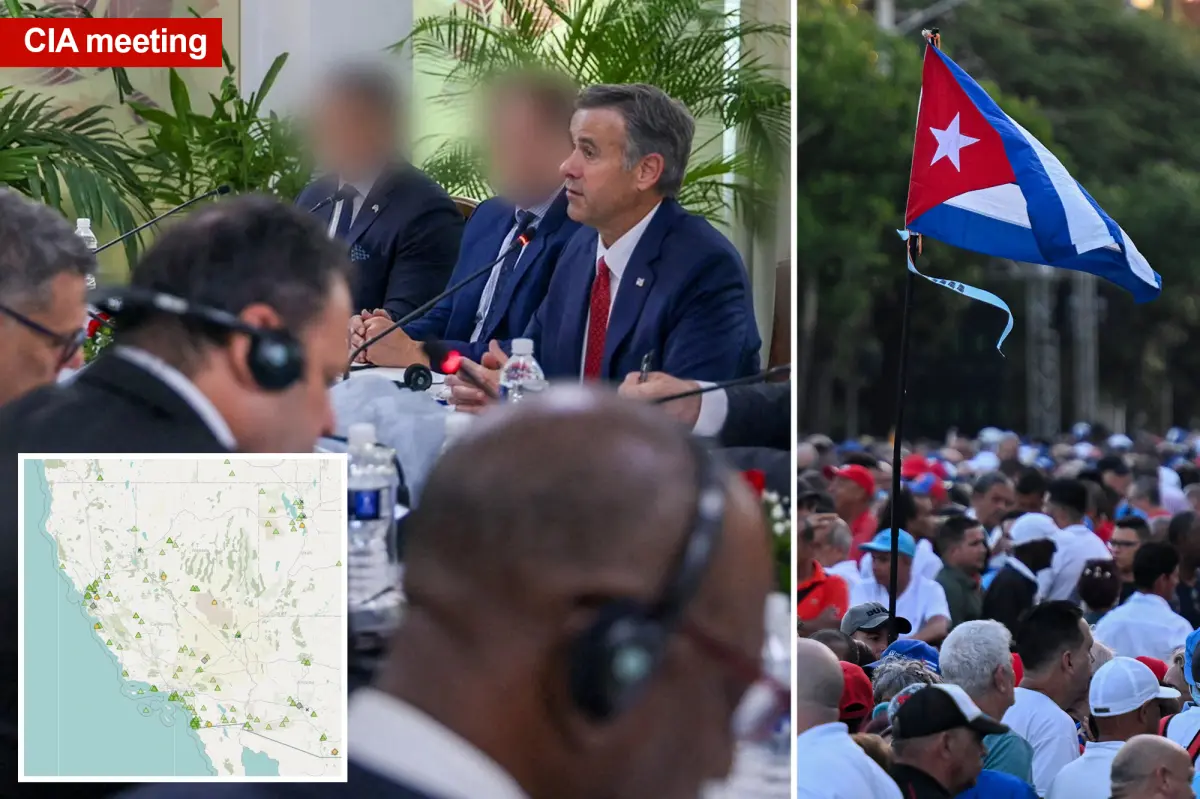
A separate resource shared by Black Alliance for Peace, which the State Department report calls a frequent “collaborator” with Havana, maps 1,335 military and law enforcement sites across the Americas.
The State Department described this resource as a “target guide.”
Black Alliance for Peace calls it the “Map of U.S. Militarization in Our Americas” and says it shows US military commands, operational bases, military training facilities, and other sites.
The group urges activists to use the map to find facilities in their communities and “strategize how and where to organize and agitate.”
The National Network on Cuba’s separate rapid-response plan, however, specifically identifies categories of locations where actions could take place, including military bases, recruitment offices, federal buildings and courthouses, ICE detention centers and field offices.
It also raises the possibility of actions at “sports arenas during high-visibility events.”
A State Department official said domestic law enforcement and counterterrorism agencies “are looking carefully” at what the officials are calling a “very serious and distinct threat.”
The official also noted that some organizations engaged in the broader network “have been involved in violent action in the past.”
The revelations come as tensions between Washington and Havana have intensified and President Trump has publicly floated the possibility of US military action against Cuba.
The report traces Cuban influence over American activist movements through organizations including the Cuban Institute of Friendship with Peoples, known as ICAP.
Secretary of State Marco Rubio sanctioned ICAP in June, describing it as “a political subdivision, agency, or instrumentality of the Government of Cuba” that supports Cuban intelligence and counterintelligence activities.
The organization was founded during Fidel Castro’s rule and has maintained relationships with universities, student organizations and activist movements in the US.
CODEPINK and other US groups belonging to the National Network on Cuba have also sent delegations to the island in recent years.
The funding streams for some of those groups are already being targeted by the Treasury Department and Department of Justice, including Code Pink, whose centimillionaire backer Neville Roy Singham is under scrutiny for potential financial crimes by the Southern District of New York.
The report also states that Cuba’s ties with hostile US adversaries have made the potential threat more serious.
“As Cuba has become, you know, more ideologically isolated, they’ve continued to actually give Russia, China and Iran more influence, to control more of their economy, to do more spying from their territory, to put more foreign intelligence agents and foreign terrorists on their soil just 90 miles from the United States,” a State Department official said.
“So it is a growing and significant threat.”
Download The California Post App, follow us on social, and subscribe to our newsletters