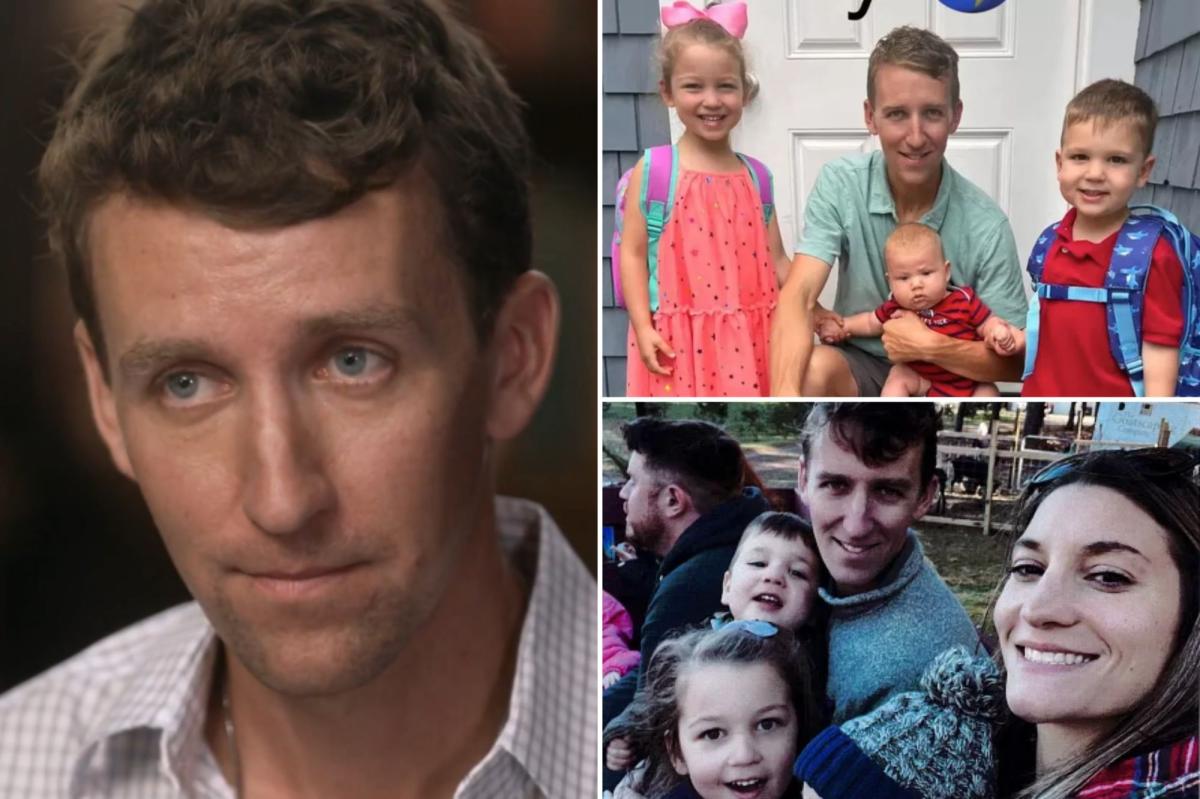

Patrick Clancy says a therapy technique he used to cope with the trauma of losing his children worked “like a miracle.”
In extended clips from the newest episode of “60 Minutes,” the 36-year-old said eye movement desensitization and reprocessing, or EMDR, helped him confront his trauma “head on.”
“It’s unpleasant, but they get you used to dealing with that,” Clancy said. “Eventually, you’re better at processing it … After I did it — all of those sessions — the waking up screaming, the horrible dreams, they mostly stopped. I mean, it was like a miracle.”
Clancy spoke publicly for the first time since his ex-wife, Lindsay Clancy, went on trial over allegations that she killed their three young children — 5-year-old Cora, 3-year-old Dawson and 8-month-old Callan — at their home in Duxbury, Massachusetts, on Jan. 24, 2023.
He described the “traumatic” memories surrounding the event as sometimes “overwhelming.”
“I think the thing that helped the most was EMDR,” he told CBS correspondent Ross Douthat. “It’s a little unusual. They put you right back in that place that you’ve been trying to avoid for years, and you face it head-on.”
Here’s what to know about EMDR therapy and how it is used to treat psychological trauma.
What is EMDR therapy?
EMDR stands for eye movement desensitization and reprocessing. The trauma-focused psychotherapy uses bilateral stimulation — most often guided eye movements from side to side — to help patients process and recover from distressing experiences.
The EMDR Institute says that when the therapy is effective, traumatic and distressing memories can be “transformed on an emotional level.”
“For instance, a rape victim shifts from feeling horror and self-disgust to holding the firm belief that, ‘I survived it and I am strong,’” the institute explains.
What happens in EMDR therapy sessions?
EMDR is typically conducted through an eight-phase process. The stages include:
How does EMDR therapy work?
During EMDR therapy, patients focus on a traumatic or distressing memory while engaging in bilateral stimulation — an activity that alternates from one side to the other.
This often involves moving one’s eyes to follow a therapist’s fingers or, in teletherapy, might involve watching an icon move back and forth on a screen. Bilateral stimulation can also be auditory, meaning listing to sounds that switch between the left and right ears.
This can help patients feel less distress in response to those memories.
There are a few theories as to why this works, though scientists aren’t completely sure. One is that those back-and-forth movements help patients focus on traumatic memories without become emotionally overwhelmed by them. Their brains are then able to change how the memories are stored, making them feel like less of an immediate threat.
Another theory is that the bilateral stimulation impacts working memory, making the trauma less vivid or emotionally intense.
Who is EMDR for?
It’s most often used to treat Post-Traumatic Stress Disorder (PTSD). Mental health practitioners also use it to treat anxiety, depression, panic disorders and addiction.
How long does EMDR take to work?
The length of treatment time varies by patient. Some can see improvement after just a few sessions, while others need months or years.
Is EMDR therapy legit?
Several major organizations recommend EMDR, including the US Department of Veterans Affairs and Department of Defense, the American Psychological Association and the World Health Organization.
There is also scientific research that supports its benefits. A 2025 systematic review of 17 studies found evidence that EMDR can improve PTSD symptoms, while a 2023 meta-analysis found that EMDR significantly reduces PTSD symptoms.
What celebrities have done EMDR?
Prince Harry opened up about using EMDR in the Apple TV+ documentary series “The Me You Can’t See,” even demonstrating on camera.
In 2025, Valerie Bertinelli said it had helped her with her own trauma.
“EMDR and talk therapy has helped me immensely, and now I can walk through certain streets without being retraumatized,” she said. “I encourage you to get help if you need it and I want you to know, it gets better.”
Miley Cyrus called it “so helpful” in an interview with British Vogue in 2023: “Essentially, you delete the physical sensations associated with these painful memories. The EMDR really helped me.”
Other stars who have spoken out about the therapy include Sandra Bullock, Jameela Jamil, Evan Rachel Wood, Whitney Cummings and Paris Jackson.