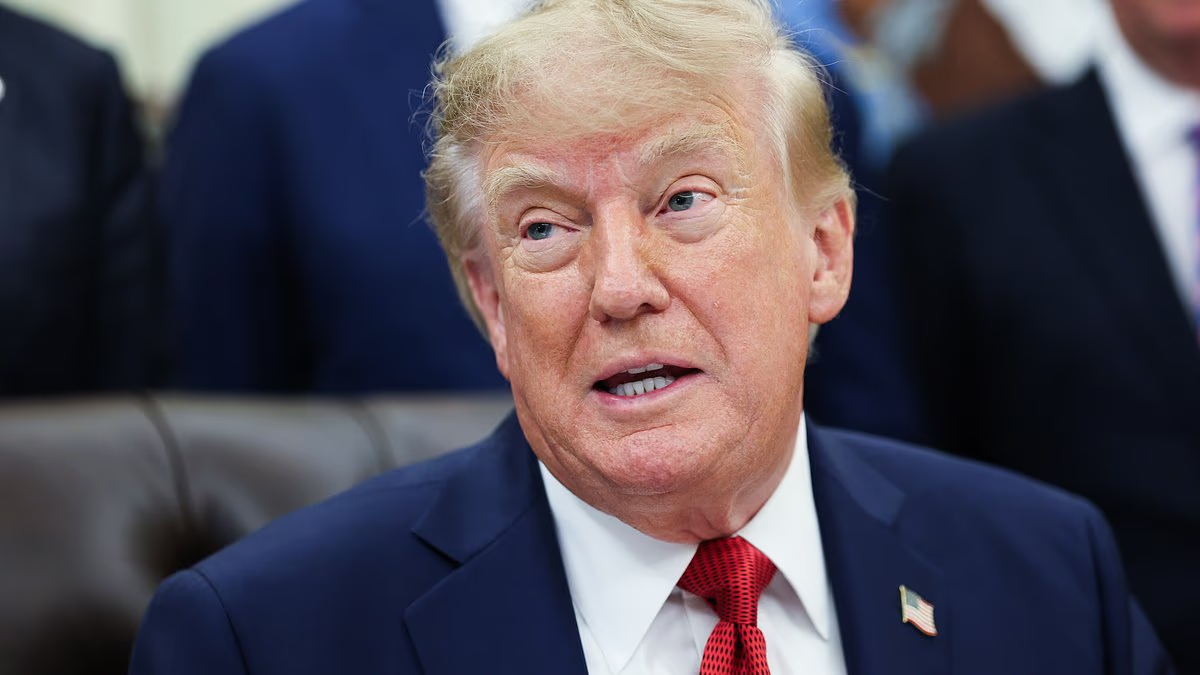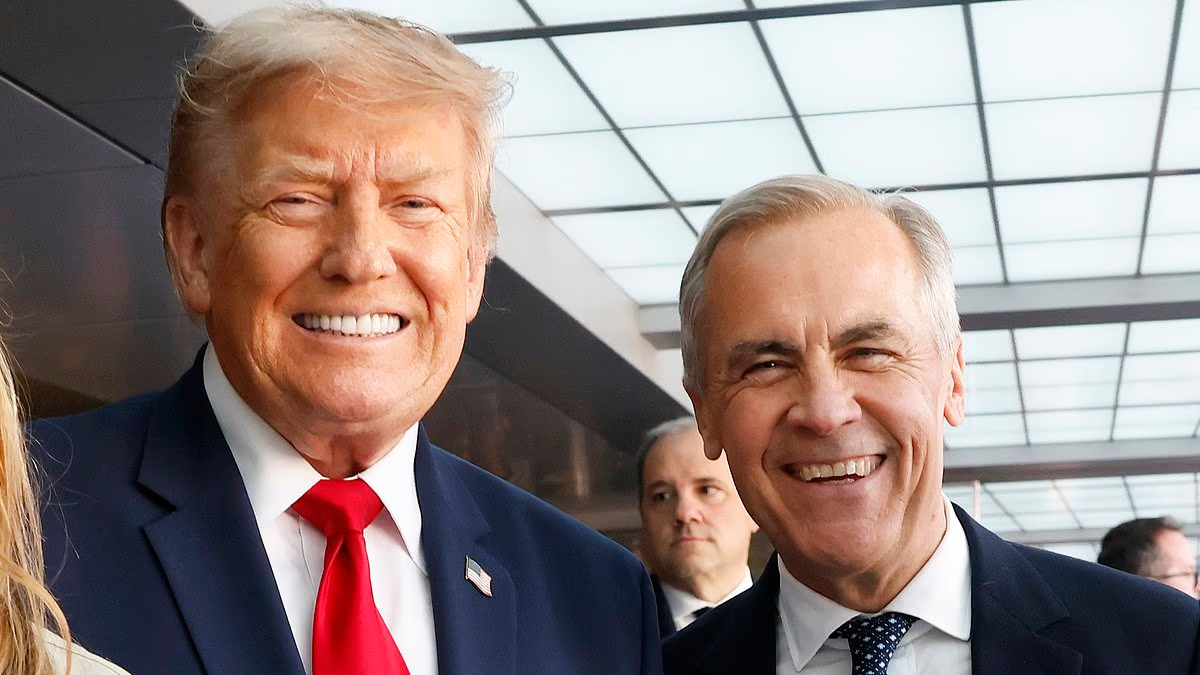


President Donald Trump has escalated his warnings to Canadian Prime Minister Mark Carney as thick wildfire smoke from Canada continues to spread across major US cities. Speaking Sunday night, Trump said he had discussed the Ontario wildfires with Carney after massive smoke plumes drifted south and blanketed communities across the United States. The president described the call as positive, but said he told the prime minister: “You’ve got to stop these fires from coming in and poisoning our air. Our air’s being poisoned.” Trump added that he has “a good relationship with Mark Carney,” while insisting that “we got to stop the fires up there.” He then raised the possibility of US assistance — and retaliation — saying, “If we can help them, we’ll help them – but maybe they should pay us some damages or something, or [we] should do some tariffs.” Trump called the smoke “terrible,” singling out Detroit, Michigan, where Ford Motor’s Michigan Assembly Plant workers were taken by ambulance to nearby hospitals on Thursday, according to the Detroit Free Press. The deteriorating air quality was not limited to Michigan, with smoky skies also reported Thursday evening in Washington DC and New York City.
Trump blames Canada for smoky air

Trump likely encountered the haze himself in the capital and again while traveling to New York City for a work dinner Friday evening, as the National Weather Service placed at least 16 states under air quality alerts. That same day, the president first threatened new tariffs against America’s northern neighbor. “We are holding Canada responsible for the fact that they are not properly maintaining their forests and brush,” he wrote Friday on Truth Social. He claimed the US was being “invaded by filthy, polluted, and unhealthy air, the quality of which is dangerous, and totally unacceptable.”
Trump pushes tariffs over wildfire costs

Trump said he would contact Carney to demand answers, arguing that the financial toll was “incalculable.” “This is willful negligence, and becoming a yearly occurrence, costing the United States billions of dollars, which cost of this pollution must of necessity be added to the tariffs Canada is currently paying,” he wrote. Some Republican allies quickly backed the idea of using tariffs in response to the fires. “Americans will not pay the price for the negligence of Canadian leaders,” Ohio Republican Senator Bernie Moreno posted on X.
Ambassador highlights US-Canada wildfire teamwork

Moreno continued: “Four years in a row of record fires that have produced decades of environmental damage. Further proof that you don’t have to be very smart to get elected as a liberal, you just have to be woke.” But Pete Hoekstra, Trump’s ambassador to Canada, took a more cooperative approach in a post earlier in the week. “I commend the outstanding cooperation between the United States and Canada as we confront these fires together,” Hoekstra wrote Wednesday on X. “Our two governments are monitoring and sharing information in real time – coordination that reflects our partnership at its best.”
Carney urges US climate action amid wildfires

By Thursday, Carney responded to complaints from US officials by urging the United States to do more on climate change. “We need a contribution from the Americans in the fight against climate change … climate change is everyone’s responsibility, including the US,” he said at a press conference. The fires began after a July 6 thunderstorm produced more than 1,000 lightning strikes across Northeast Minnesota and Canada, according to the Minneapolis Star-Tribune. The blazes have now burned just under 68,956 acres and remain active, raising the risk that more smoke will drift into the US this week.
Air quality alerts and evacuation orders expand

The Minnesota Pollution Control Agency has already issued an air quality alert through 11am Monday for large parts of the state, warning that fine particle pollution from wildfire smoke is expected to reach the red category, considered unhealthy for everyone. Some areas are also under evacuation orders. In Illinois and Indiana, an Air Quality Alert remains in effect through Monday night for Chicago and northwest Indiana. Many residents under the smoke plume have reported an odor resembling burning plastic, which atmospheric scientist Matthew Cappucci said comes from longer-lasting compounds such as benzene and formaldehyde that remain after smoke ages during its long journey.
Microscopic particles raise cancer risk

Benzene and formaldehyde are both classified as Group 1 human carcinogens, meaning there is sufficient evidence that they can cause cancer in humans. Cappucci warned on X that “the smoke isn’t just annoying – it’s legitimately dangerous,” explaining that it contains microscopic PM2.5 particles, which are less than 2.5 micrometers wide — roughly 30 times thinner than a human hair. “Breathing them in is bad – it increases [the] risk of heart attack, respiratory issues, etc. You may also notice your eyes stinging,” he wrote.
Smoke and tariffs strain US-Canada ties

As hazardous air persists, the wildfire smoke is also threatening to worsen already strained relations between the United States and Canada. Tensions had been building over Trump’s repeated threats to make Canada the 51st state, as well as trade friction tied to his tariff policies. Last year, the Republican imposed a 25 percent tariff on most Canadian imports and later raised it to 35 percent. Although most of those fees were rolled back after the Supreme Court limited the president’s executive authority to impose tariffs, Canada now pays about 10 percent on most goods imported into the US.