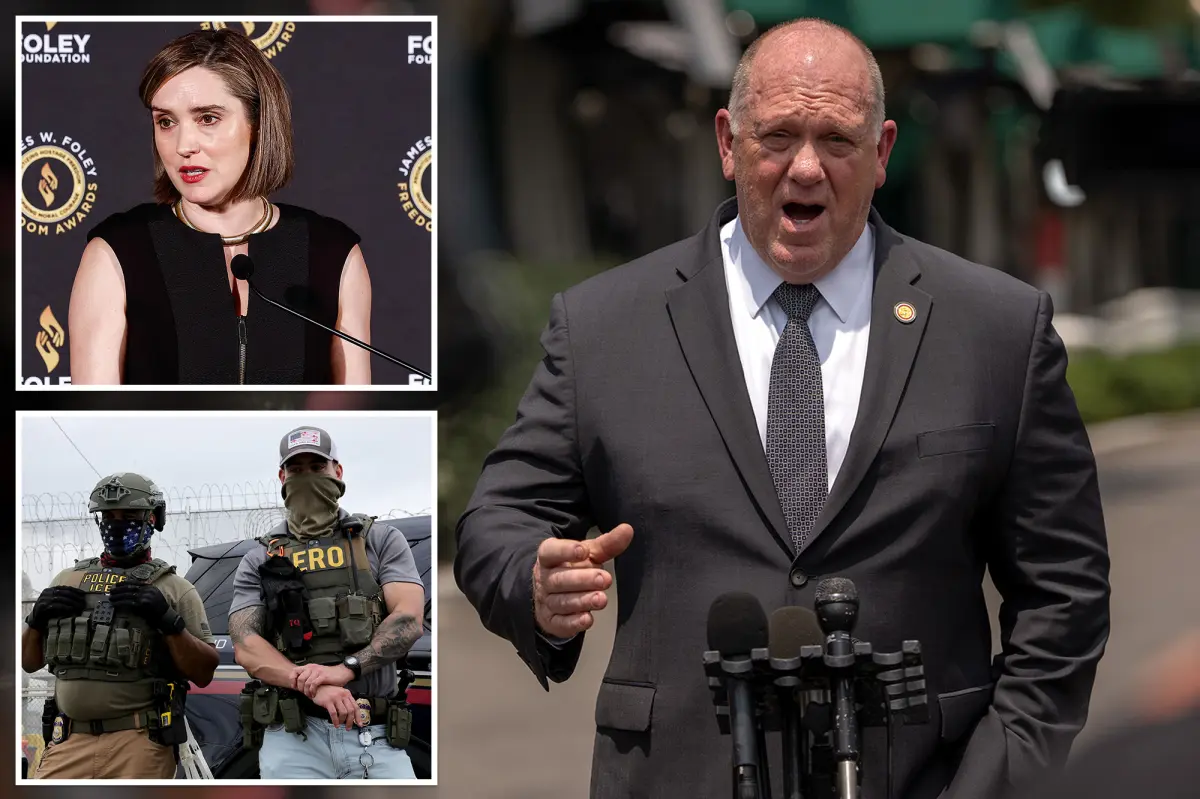

White House border czar Tom Homan on Sunday defended U.S. Immigration and Customs Enforcement’s use of unmarked vehicles during an appearance on CBS’ “Face the Nation,” where he sparred with moderator Margaret Brennan over whether agents had activated emergency lights while pursuing a Houston man who was later fatally shot.
Homan said unmarked ICE vehicles are a necessary tool that helps officers find and approach suspects, and he suggested the recent deadly encounters might have been prevented if the individuals involved had followed officers’ commands.
“But bottom line is, we’ll see when the investigation plays out, but they’d be alive today if they simply complied with a vehicle stop by federal law enforcement officer. Just comply,” Homan said.
Brennan pressed Homan on the circumstances surrounding the fatal shooting of 52-year-old Lorenzo Salgado Araujo, specifically questioning the use of an unmarked vehicle before the incident.
Relatives of Salgado have said he did not realize he was being followed by federal law enforcement and instead thought robbers were chasing him.
“Well, the family of the man in Houston said that he thought he was being robbed because it was an unmarked vehicle,” Brennan said.
“Not that it was law enforcement at all.”
Homan pushed back, saying ICE vehicles are equipped with devices that allow officers to identify themselves when conducting vehicle stops.
“They had emergency lights. They activate emergency lights. Blue lights,” Homan said.
“You know, in my vehicle I drive, where I’m with my security detail, we have emergency lights.”
Brennan challenged Homan to substantiate that claim, noting that publicly available videos did not appear to show emergency lights and the officers involved were not wearing body cameras.
“That there were lights, because the videos that we’ve seen there aren’t, and because there weren’t body cameras,” Brennan said.
“It is hard to substantiate some of what you are saying.”
Homan acknowledged that he had not reviewed the videos of the Houston incident.
“OK, well, I have not seen the videos,” Homan said.
The border czar qualified his earlier claim, saying the vehicles should have contained lights and sirens but acknowledging that he could not confirm whether officers used them.
“Now, if they didn’t activate the lights, again, I haven’t seen that video,” Homan said.
“If they didn’t activate the lights, then there’s an issue there, right?”
“A lot of police departments, I’m in New York City right now, a lot of NYPD officers are driving unmarked vehicles, and that helps them find people that don’t want to be found, right?”
He backed the nationwide deployment of body cameras, arguing that the footage would allow the public to see encounters from an officer’s perspective.
“I think body cameras are the way to go,” Homan said.
“I think body cameras let the American people know what that officer sees when he takes that action.”
Homan said ICE had purchased cameras and was training personnel to deploy nationwide.
The agency will require officers to record vehicle stops with at least one body camera.
Salgado was not the intended target of the Houston operation, federal officials acknowledged.
ICE initially said he rammed a federal vehicle and attempted to run over an officer, prompting the officer to fire in self-defense.
Witnesses in Salgado’s van disputed the agency’s account.
Six days later, an ICE officer fatally shot a Colombian driver in Biddeford, Maine, who also was not the operation’s intended target.
DHS said the officer opened fire while “fearing for public safety” as the driver attempted to flee.
Investigations into both shootings remained underway.
A third man, a 28-year-old Mexican national, was struck and killed by a tractor-trailer after fleeing federal immigration agents in St. Augustine, Florida.