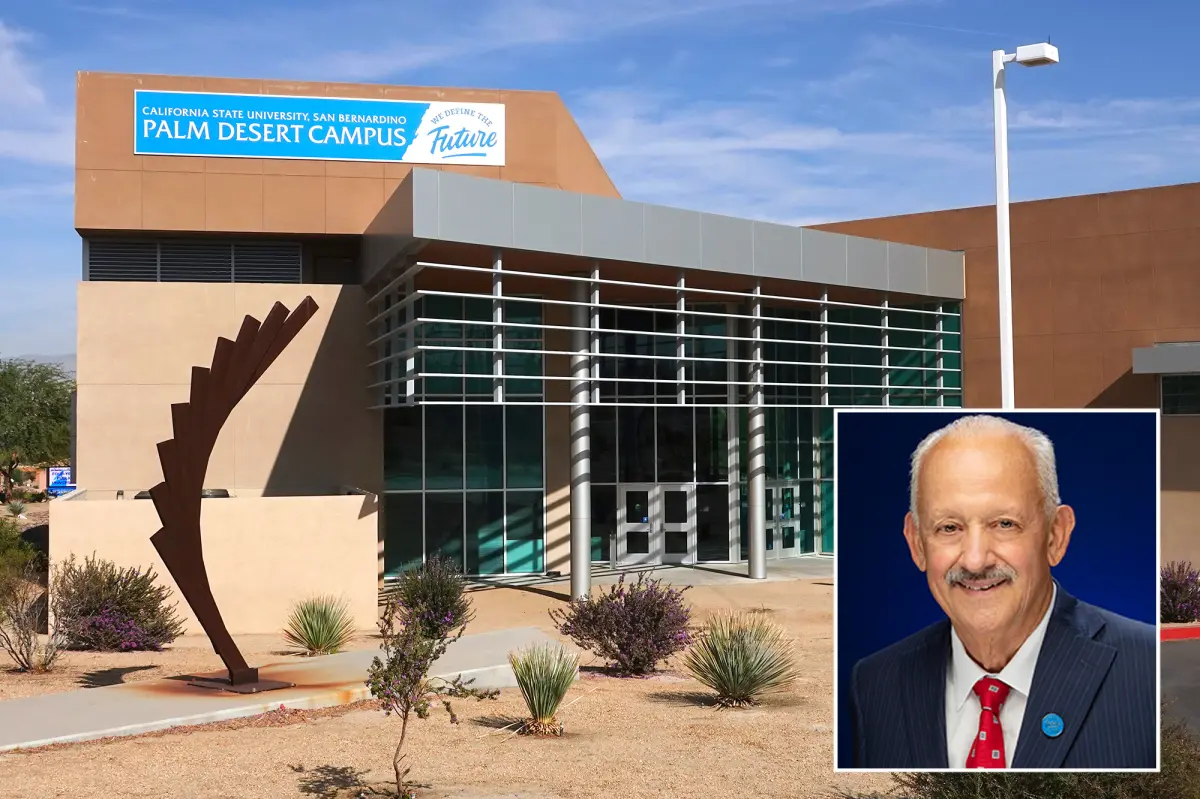

Even after a $12 million settlement stemming from serious allegations of workplace misconduct, outgoing Cal State San Bernardino President Tomas Morales appears set to leave with a generous next chapter secured.
Because Morales is still classified as being in “good standing,” he remains eligible for an executive transition package that could keep him paid by the university before he potentially moves into a faculty role.
The California State University Board of Trustees is expected to take up another honor for Morales on Wednesday: whether to grant him the title of president emeritus.
CSU has not disclosed what Morales’ next position will be, saying only that details about his role and compensation will be made public during Wednesday’s meeting.
In 2024, Morales received $655,626 in total salary and benefits, according to Transparent California.
The proposed transition comes in the wake of CSU’s agreement to pay $12 million to resolve claims from former administrators Clare Weber and Anissa Rogers, who accused Morales and former Palm Desert campus dean Jake Zhu of enabling a workplace culture marked by sexism, retaliation and bullying.
As part of the settlement, the university denied any wrongdoing.
The move has drawn sharp criticism from faculty leaders, whistleblowers and Weber and Rogers, who argue Morales should not be rewarded after the conditions they described in court filings as a “cesspool of gender harassment and discrimination.”
“The lawsuit raises serious questions about whether President Morales should be regarded in good standing for those benefits,” Thomas Corrigan, communications coordinator for the Cal State San Bernardino chapter of the California Faculty Association told LAist.
“Dr. Rogers’ and Dr. Weber’s case really stands out as a moral outrage with exceptional financial, reputational and human costs.”
The faculty union had already urged the CSU system in 2024 to deny Morales certain retirement-related benefits.
“We just feel that under his leadership, he has not been an effective leader, therefore, should not ultimately be rewarded,” union chapter president Tiffany Jones told The Sun.
Weber and Rogers have also submitted a public comment urging trustees to scrutinize whether Morales should remain in “good standing” before approving the transition package or emeritus title.
READ MORE: US Strikes Pummel Iran’s Military Infrastructure, CENTCOM Says
According to the lawsuit, Weber was fired after raising concerns about what she believed was a gender pay gap among CSU vice provosts.
After requesting a 12% equity raise, she said she was asked to resign and fired when she refused.
“I explicitly raised concerns that these female Vice Provosts were being paid less because of their gender,” Weber wrote in an email to Morales before her termination.
Rogers, then associate dean at the Palm Desert campus, said women were routinely screamed at, belittled and interrupted while men were treated with respect.
“When I interviewed, it was perfect,” Rogers told CalMatters. “Then I quickly realized that I had just been immersed in hell.”
She said she was later given an ultimatum.
“I call it fired,” Rogers said. “They told me, ‘Either leave or you will be fired.’”
The lawsuit also alleged Morales routinely berated and intimidated women and held them to harsher standards than men.
Criticism of Morales predates the lawsuit.
A 2016 campus survey found more than 60% of employees believed conditions had worsened under his leadership, and the faculty senate later approved a vote of no confidence citing bullying, favoritism and retaliation.
Morales had also faced a no-confidence vote while serving as president of the College of Staten Island before arriving at Cal State San Bernardino.
During testimony, Zhu defended his management style, saying, “I raised voices to make a point, to change the tones, not in the malicious way or discriminatory way.”
The legal battle ultimately split into separate proceedings.
Rogers won a $6 million jury award in October 2025, while Weber accepted a separate $6 million settlement before trial.