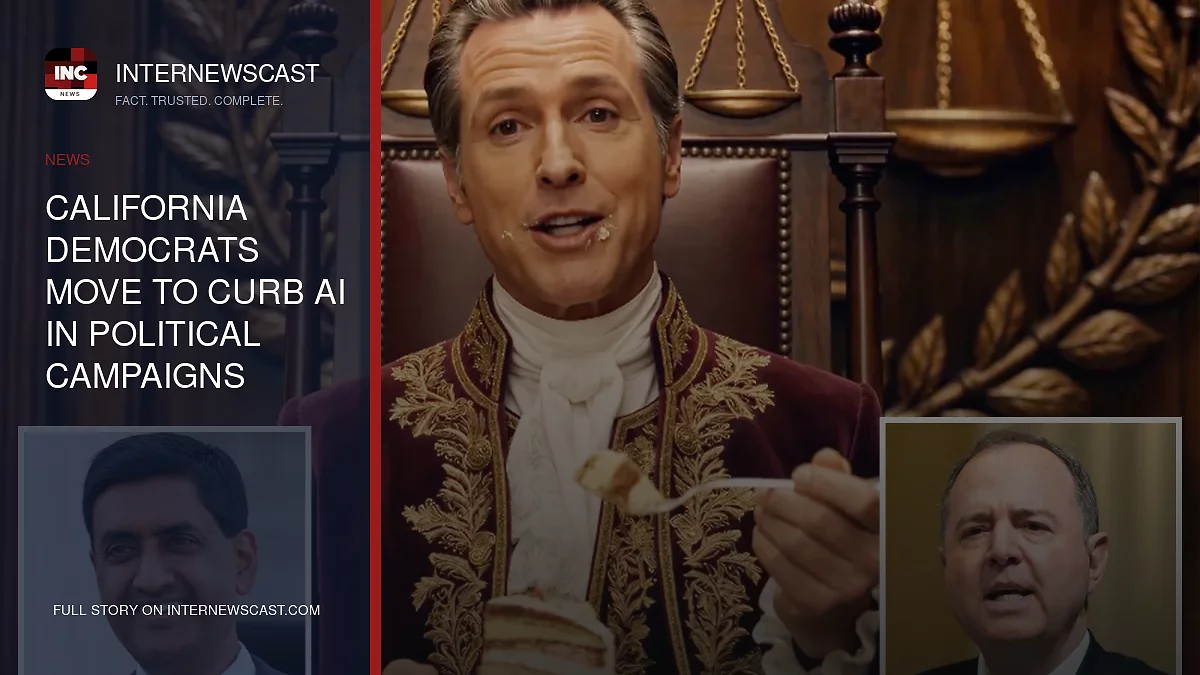

Two California Democrats are urging Congress to put new limits on Hollywood-style artificial intelligence campaign ads, warning that the technology is moving into mainstream political advertising faster than federal rules can keep up.
U.S. Sen. Adam Schiff and Rep. Ro Khanna, D-Fremont, on Monday reintroduced the “AI Ads Act,” a bill aimed at prohibiting the fraudulent use of artificial intelligence to impersonate political candidates or campaign committees in federal elections as AI-generated political content grows increasingly convincing.
Their renewed push comes only days after Republican gubernatorial candidate Steve Hilton released two AI-generated campaign ads targeting Gov. Gavin Newsom, former Vice President Kamala Harris and Democratic nominee Xavier Becerra.
One of Hilton’s videos borrowed the look and drama of the “Gladiator” franchise, while the other cast him in a fight against a “machine” meant to symbolize what his campaign portrayed as the Democratic Party’s control of California politics.
The ads arrived after a wave of viral AI videos produced for the campaign of former Los Angeles mayoral candidate Spencer Pratt.
Pratt, the former reality TV antagonist turned political candidate, got a major boost from Los Angeles director Charles Curran, whose “Pratt Man” video played off the “Batman” franchise and racked up millions of views online.
Schiff, who first introduced the legislation while serving in the House of Representatives, said the threat cuts across party lines, even as Republicans have appeared to use AI-powered campaign videos with particular success.
“AI-generated fraudulent advertising which uses the likeness or voices of candidates to misrepresent their positions, campaigns, or causes, or otherwise misrepresents a candidate’s point of view is not only wrong — it poses a serious threat to our democracy that should concern all Americans regardless of their party,” Schiff said.
Download The California Post App, follow us on social, and subscribe to our newsletters
The bill would amend the Federal Election Campaign Act to explicitly prohibit fraudulent misrepresentation through content generated wholly or partly by artificial intelligence.
It would also broaden existing federal prohibitions by applying them to anyone falsely claiming to represent a candidate or political organization — and eliminate the requirement that a misrepresentation be shown to be “damaging” before enforcement could occur.
The proposal closely tracks bipartisan recommendations issued by the Federal Election Commission in 2022 to modernize campaign fraud laws.
Khanna, a likely presidential candidate in 2028, said artificial intelligence should not be “used to mislead voters or undermine our democracy.”
Unlike many of the “deepfake” concerns driving lawmakers, the Hilton and Pratt videos relied on clearly fictional, stylized animation rather than realistic fabricated footage designed to appear authentic.
The AI Ads Act targets fraudulent impersonation of candidates or political organizations, including AI-generated content used to deceive voters or solicit campaign donations under false pretenses, rather than banning AI-generated political advertising altogether.
The legislation is backed by Common Cause, Citizens for Responsibility and Ethics in Washington, Campaign Legal Center, Protect Democracy and Public Citizen.
More than 30 states have adopted laws addressing deceptive AI-generated election content, according to supporters of the measure, but Congress has yet to establish comparable nationwide standards for federal campaigns.
The bill’s prospects remain uncertain in a closely divided Congress, where lawmakers have repeatedly struggled to agree on broader AI regulations despite bipartisan concerns over the technology’s growing role in elections.