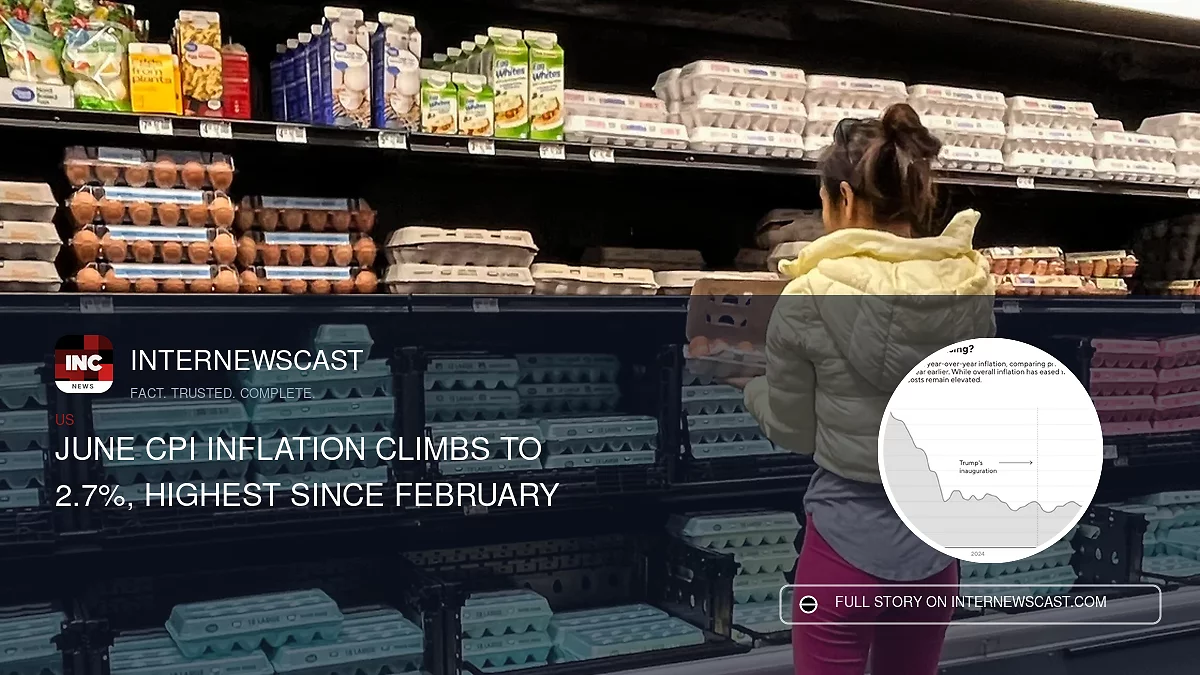

Inflation in the U.S. picked up again in June, with the Consumer Price Index rising 2.7% from a year earlier after cooling during the opening months of 2024.
By the numbers
The annual increase matched economists’ expectations, according to FactSet, and came in above the prior month’s 2.4% pace. It also marked the strongest CPI reading since February, when consumer prices were up 2.8% year over year.
Compared with May, consumer prices climbed 0.3% in June, the sharpest monthly gain since January and also in line with Wall Street forecasts.
The Consumer Price Index measures how the cost of a broad basket of everyday goods and services purchased by households changes over time.

Core inflation, which strips out more volatile food and energy prices, increased 2.9% over the last 12 months, the Bureau of Labor Statistics reported. That was just under the 3% rise economists surveyed by FactSet had anticipated.
Grocery costs continued to pressure household budgets, with food prices up 3% from a year ago, outpacing the overall inflation rate. Some staples saw especially steep jumps, including eggs, which surged 27.3%, roasted coffee, up more than 12.7%, and ground beef, which rose 10.3%.
Energy costs also helped drive June inflation higher, rising 0.9% from the previous month after falling 1% in May.
Prices also moved higher across several other spending categories, including household furnishings and operations, medical care, recreation, clothing and personal care, according to Bureau of Labor Statistics data.
Early signs of tariff impact
June’s CPI reading indicates that tariffs might be starting to drive up prices in certain categories. Everyday items, from produce to apparel, could be susceptible to new levies if they are imported from abroad. Fed Chair Jerome Powell last month predicted that tariffs could start to push up prices in the second half of the year.
President Trump recently announced he would issue a flurry of new tariffs on over 20 countries, which he said will take effect on Aug. 1, extending the deadline of a 90-day pause on country-specific tariffs that ended earlier this month.
Adam Crisafulli, head of investment adviser Vital Knowledge, said in a report that certain categories exposed to tariffs — ranging from apparel, home furnishings and appliances to footwear and toys — saw some upward pricing pressure. But other products vulnerable to higher levies, such as vehicles, remained stable.
EY-Parthenon Chief Economist Gregory Daco estimates that roughly a third of the June rise in the CPI is attributable to higher tariffs.
MORE STORY: Jacob Freytas, 12, Cop’s Son, Fatally Shot Outside NYC Bodega
The muted CPI data from previous months indicates that companies have taken steps to offset the costs of tariffs, largely shielding consumers from price shocks. However, that could change.
“Strategies used by companies to avoid passing on cost increases to consumers are not eternal,” Daco noted in a report.
July Fed cut unlikely
Despite the June increase, Wall Street analysts say inflation mostly remains in check.
“While today’s CPI release showed some early signs of tariff impact, on the whole underlying inflation remained muted,” said Kay Haigh, global co-head of fixed income and liquidity solutions in Goldman Sachs Asset Management. “Price pressures, however, are expected to strengthen over the summer and the July and August CPI reports will be important hurdles to clear.”
Analysts say the latest inflation data points to the Federal Reserve standing pat on interest rates at its meeting later this month. Investors see a more than 97% probability that the Fed will keep the federal funds rate in its current range of 4.25% to 4.5% when officials meet on July 29-30, according to The CME Group’s FedWatch tool.
“Today’s inflation report all but dashes any remaining hopes that the Fed may cut interest rates at its meeting later this month,” said eToro U.S. investment analyst Bret Kenwell in an email. “However, if subsequent inflation readings reiterate the rise in inflation, it could jeopardize future rate cuts as well.”
Anne Marie D. Lee