
A public art project in Saskatoon, Canada, is drawing sharp criticism after the city spent close to $212,000 in taxpayer funds on three oversized artificial rock sculptures — a purchase some residents and watchdogs are calling “ridiculous.”
The City of Saskatoon paid C$297,490, or about US$211,942, for the massive faux boulders, which were created from more than 10,000 pounds of recycled plastic. The artists behind the installations say the work is designed to spark conversation about recycling and waste, CTV News reported.
Still, the cost has become the center of the controversy, with critics noting that the total is roughly equal to the combined yearly municipal property tax payments of more than 100 households.
“So 118 families, their entire property tax bills went to building large plastic rocks instead of providing services that people want in the city,” Gage Haubrich, prairie director of the Canadian Taxpayers Federation (CTF), told the outlet.
City leaders, however, have pushed back against the backlash. Community Services General Manager Celene Anger defended the installations, saying the recycled plastic sculptures were delivered under budget.
Anger said the project fits into Saskatoon’s broader effort to create a more “vibrant and welcoming” community, arguing that public art can strengthen quality of life, shape civic identity and support economic vitality.
But the Canadian Taxpayers Federation, along with at least one Saskatoon city councillor, says the plastic rock installation reflects a wider pattern of questionable spending on projects they argue residents never asked for, according to a news release from the advocacy group.
“I can’t believe I need to say this: Taxpayers shouldn’t be paying hundreds of thousands of dollars for plastic rocks,” Haubrich said. “It’s ridiculous and disrespectful to taxpayers that anyone at city hall thought this was a good idea.”

The City of Saskatoon, in Canada, paid C$297,490 (US$211,942) for giant rock sculptures made from more than 10,000 pounds of recycled plastic
In June, residents visiting Forestry Farm Park, Diefenbaker Park and even the city’s landfill were greeted by the unusual sight of an enormous boulder – each crafted from a different form of plastic.
The artwork, created by Calgary-based artist duo Sans façon, is dubbed ‘Modern Erratics.’
The sculptures were modeled after rocks carried across the prairies by ancient ice sheets and crafted using ‘post-consumer plastics’ recovered from across the city.
‘The sculptures are built from different plastic waste material related to their site: grain bags, bottles tops, and broken waste carts,’ a description on the city website read.
During the process, the artists said they were shocked to discover that 87 percent of plastic waste in Canada ends up in landfills or the environment.
More than 10,000 pounds of plastic waste was used over 5,500 hours of collaborative work involving artists, engineers, fabricators and municipal partners, according to an article about the project.
‘Each little piece of plastic has passed through our hands many times and been given the care and attention a stonemason might give to selecting and working stone, a ceramist to clay, or a foundry to bronze and yet it’s plastic,’ the artists said.
But the mounting controversy erupted after the release of public art commissioning documents revealed the jaw-dropping price the city paid for its newest installation.

Gage Haubrich, prairie director of the Canadian Taxpayers Federation (CTF), said: ‘It’s ridiculous and disrespectful to taxpayers that anyone at city hall thought this was a good idea’

According to the city website, ‘the sculptures are built from different plastic waste material related to their site: grain bags, bottles tops, and broken waste carts’
‘The city should be helping Saskatoon residents by making their lives more affordable, not hiking taxes and making them pay for big plastic rocks,’ Haubrich said in the news release.
The CTF, which advocates for government accountability and reducing wasteful spending, said the artwork was funded through a city policy that allocates up to one percent of the budget to public art. The city’s budget was $310,000, CTV reports.
This year, property taxes in Saskatoon were hiked by 6.7 percent.
‘The city needs to cancel this one per cent of spending on art policy so it’s not tempted to do anything like this again. It’s a clear waste of money,’ Haubrich added.
On Tuesday, Haubrich argued the city could have bought ‘genuine rocks from local businesses’ for a fraction of the price, with each costing between $17,000 and $50,000.
City Councilor Randy Donauer discussed the rocks at a meeting on Wednesday, where he revealed that he only learned about the project after residents reached out to him with complaints.
Though he noted that the city’s Public Art Advisory Committee, not council, approved the project, Donauer said he shares the same concerns raised by residents.

The sculptures were modeled after rocks carried across the prairies by ancient ice sheets and crafted using ‘post-consumer plastics’ recovered from across the city

Community Services General Manager Celene Anger argued that the new installation is helping build a more ‘vibrant and welcoming’ city


The money spent on the three fake rocks is equivalent to the annual property tax bills of 118 homes
‘I’ve spoken about this program in the past. I think the frustration and the response from the community is valid,’ he said, according to The Star Phoenix.
While saying he was not an ‘art guy’ and would not judge the artwork itself, Donauer said the funding allocated to the art program should be looked at more closely.
‘I would like to see the percentage coming down,’ he added, according to CTV.
The councilman said that during budget discussions, officials are forced to make tough choices over much smaller sums of money needed for essentials like parks and road repairs.
‘Sometimes we’re trying to find $50,000 to $100,000 just to bring the budget down a little bit,’ he noted.
In defense of the project, Anger said the previous city council approved funding through a separate $37.5 million budget allocation – not through the 2026 property tax increase.
She said the artwork was commissioned through the city’s Public Art Policy under the Civic Capital Project (CCP) funding stream, according to SASKToday News.
Under the policy, public art for eligible capital projects may be allocated up to one percent of the city’s capital dollar contribution, with a cap of $500,000.

City Councilor Randy Donauer said: ‘I think the frustration and the response from the community is valid’

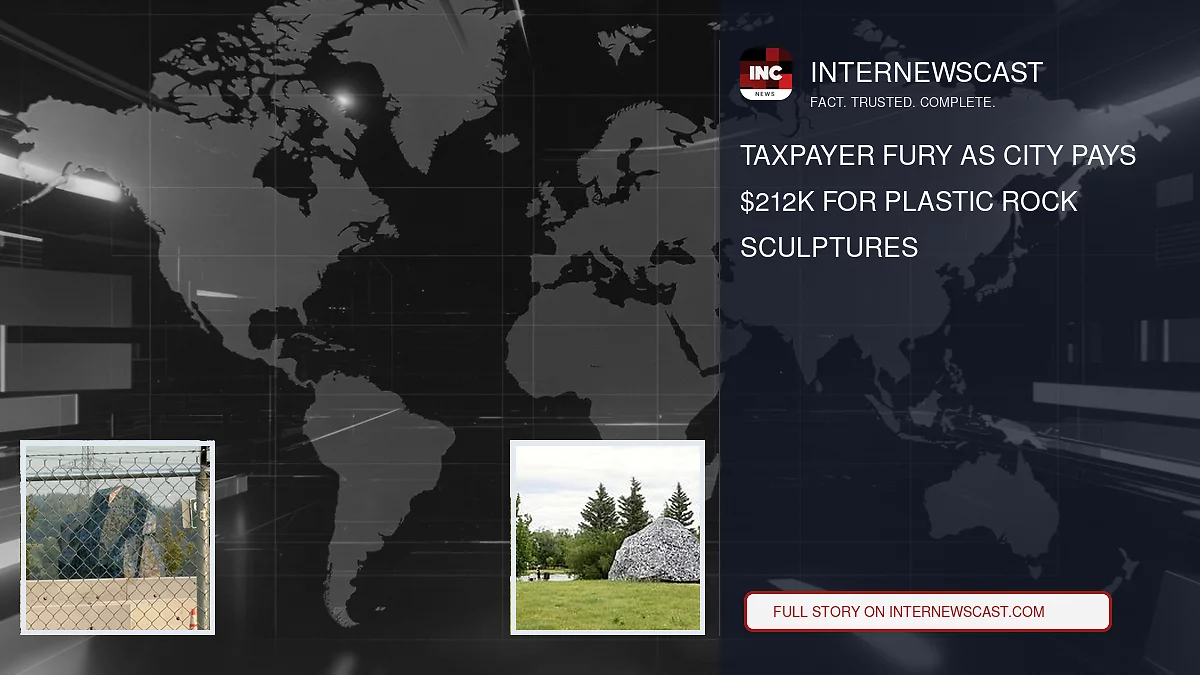
The rocks are located at Forestry Farm Park, Diefenbaker Park and even the landfill (pictured)
‘Designated civic capital projects, including associated public art components, are reviewed through the City’s capital planning and budget process and approved by City Council,’ she said.
‘This funding does not reduce operating budgets for core civic services.’
For now, Donauer said he plans to introduce a motion at the August 26 council meeting to review the amount of taxpayer money dedicated to public art.
One of the sculptures, standing in an empty field at Forestry Farm Park, was crafted from recycled black-and-white plastic grain bags typically used by farmers across the prairies.
The Diefenbaker Park sculpture was made from colorful bottle caps, while the final installation at the Material Recovery Center was built from shredded black, blue and green carts formerly used by households throughout the city.
The end goal, according to the artists, is to ‘invite people to reflect on what has shaped our landscape and what future traces our current materials and systems will leave behind.’
The installation joins Saskatoon’s public art collection of more than 80 works, the majority of which are outdoor pieces acquired through donations, commissions and city funding, according to the website.
‘People intuitively gravitate towards erratics as destinations on the horizon, for what they signify and for their otherness. They speak of time and stillness, of enormous environmental forces difficult to contemplate,’ a description read.